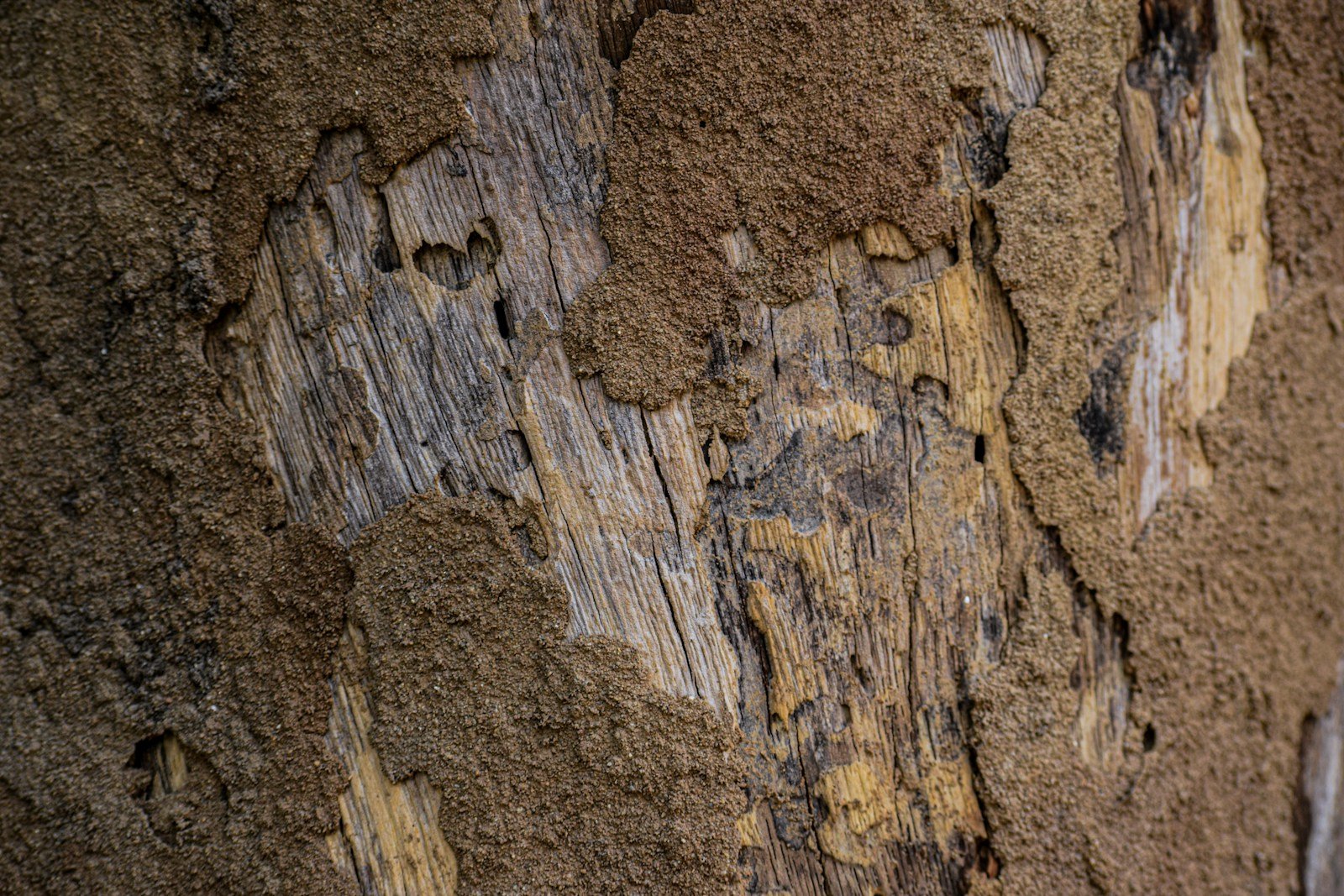
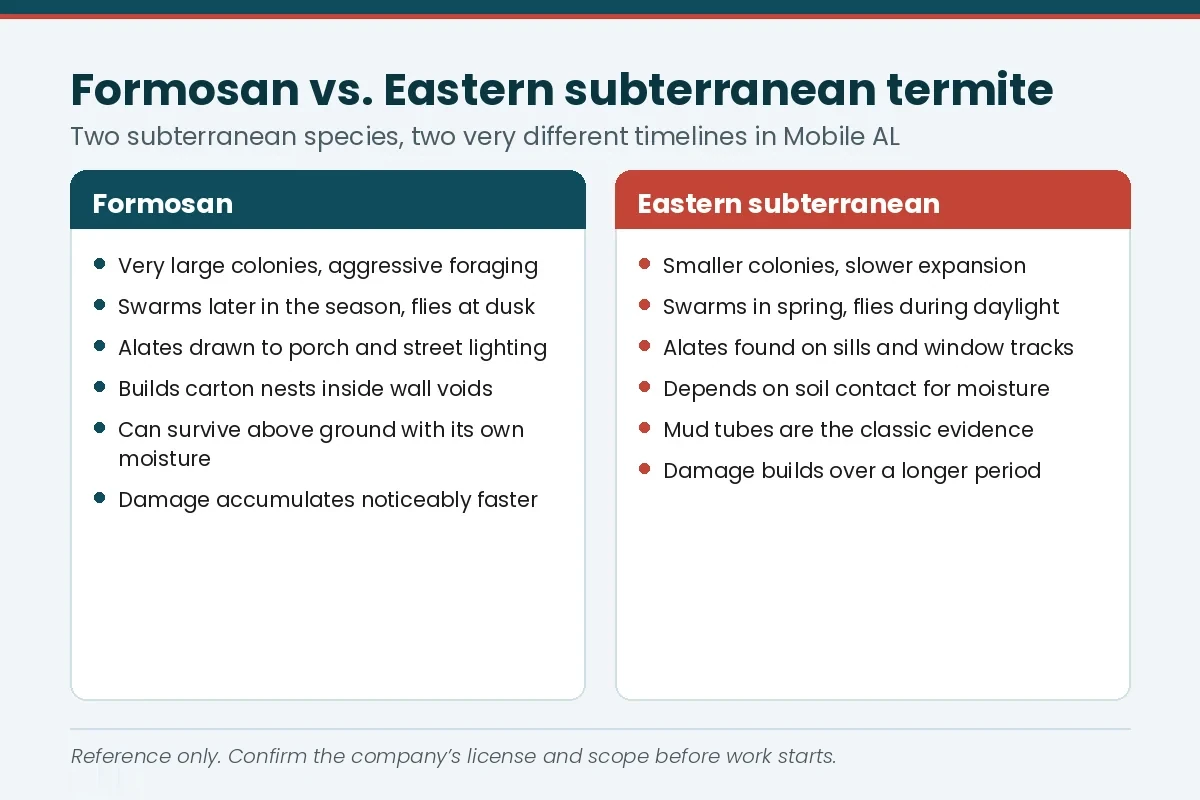
Formosan vs. eastern subterranean termite identification matters more in Mobile, AL than in almost any other U.S. city. The Port of Mobile was the documented 1985 entry point for Coptotermes formosanus on the U.S. Gulf Coast, and the species now overlaps the native Reticulitermes flavipes across most of Mobile and Baldwin County. The two look superficially similar but treat differently, so getting the ID right is the first decision a local pest control company will help you make.
Not sure which termite you found?
Call, enter your 5-digit ZIP on the keypad, and get connected live with a local pest control company. Free to call, 24/7.
Why Does the Distinction Matter in Mobile?
Eastern subterranean termites are the species most U.S. pest control programs were originally designed around. Their colonies are large but their workers, soldiers, and reproductive output are roughly half the scale of the Formosan termite. A Formosan colony can produce several million termites and consume more wood per year per colony — meaning damage can accelerate noticeably once an infestation establishes. That changes how aggressively a treatment is scoped and how soon a homeowner should act after confirmation.
Side-by-Side: Soldier Caste
The soldier caste is the most reliable ID point because they are stable in appearance year-round, unlike swarmers.
- Eastern subterranean soldier: rectangular pale head, long mandibles, body roughly 3 to 4 mm.
- Formosan soldier: teardrop (oval) head shape, shorter curved mandibles, body 4 to 5 mm. When disturbed, Formosan soldiers exude a milky white defensive secretion from a frontal gland — a unique trait among Mobile-area termites.
If a technician finds soldiers under a bait station and the heads are clearly oval rather than rectangular, that one observation is often enough for a working Formosan diagnosis pending lab confirmation.
Side-by-Side: Swarmer (Alate) Caste
Swarmers are the dispersing reproductives you may see in spring or early summer flights — see our spring swarmer season guide for full timing.
- Eastern subterranean swarmer: dark brown or near-black body, clear wings, body length 10 to 12 mm including wings. Flights typically on warm sunny mornings, late February through April.
- Formosan swarmer: yellowish-brown body, hairy wings under magnification, body length 12 to 15 mm including wings. Flights at dusk on warm humid evenings, mid-April through June. Often attracted to porch and street lights, hence Mobile’s familiar “termite cloud” reports around Memorial Day.
Side-by-Side: Mud Tubes and Damage Patterns
Both species are subterranean and build mud tubes for moisture-protected travel between soil and food. The patterns differ:
Swarm at night or during the day?
Call, enter your 5-digit ZIP on the keypad, and get connected live with a local pest control company. Free to call, 24/7.
- Eastern subterranean tubes: thin, flat, often hugging foundation walls; rebuilt seasonally.
- Formosan tubes: thicker, more three-dimensional, and Formosans uniquely build aerial carton nests — masses of chewed wood and saliva — inside wall voids, attics, and even isolated from the ground when sufficient moisture is available. A carton nest in an attic is essentially diagnostic for Formosan in Mobile.
Damage in heavy Formosan infestations frequently shows up as hollow framing members that still look intact externally, since workers eat through the soft spring wood while leaving the grain shell. For a structured walk-through of how a WDO inspector reads these signs, see our Mobile WDO inspection page.
How Treatment Choices Differ
Treatment doctrine for both species is similar in principle — disrupt foraging populations and protect the structure long-term — but the scope differs:
- Liquid termiticide perimeter (Termidor or comparable fipronil/imidacloprid product): effective against both species when applied at label rates around the full foundation. For Formosan, technicians frequently extend treatment to known carton-nest areas in wall voids.
- Bait systems (Sentricon or comparable): effective against both species. Formosan colonies are larger, so bait consumption rates and station counts often run higher.
- Wood replacement and moisture remediation: typically a larger component of post-treatment work on Formosan jobs because of the volume of damage carton-nest infestations can hide.
The right choice depends on species, structure type (slab vs. crawl space), construction era, and how recently the colony has been active.
What to Do If You’re Not Sure Which Species You’re Seeing
Take a few clear close-up photos and, if possible, collect a small sample in a sealed jar. A local pest control company can typically distinguish the two species with a hand lens during an inspection, with lab confirmation available if needed. Do not spray over-the-counter products on visible workers or swarmers before the inspection — it scatters the population and makes follow-up harder.
Check the company before treatment starts
In Alabama, companies that do structural pest control, including household pest, termite and fumigation work, must hold a Professional Services license from the Alabama Department of Agriculture and Industries (ADAI). Ask for the company’s license and the name of its certified operator, and check with the ADAI Professional Services program before work starts.
Get the treatment plan, the products to be used, any follow-up visits and the price in writing. For termite work, ask what the contract covers, whether it’s retreatment only or includes repair of damage, and how long it lasts.
How the call works
- Call (888) 295-0220. Any time, day or night.
- Enter your 5-digit ZIP code on your phone’s keypad when prompted.
- Get connected live with a local pest control company that serves your ZIP. Describe what happened and ask when they can come out and what the job will cost.
Frequently Asked Questions
Can I have both Formosan and eastern subterranean termites on the same property?
Yes. Mobile and Baldwin County properties frequently host both species in nearby colonies. A single inspection will typically identify both if present.
Are Formosan termites more dangerous than the native species?
Per-colony, Formosan colonies are larger and consume more wood per year, so damage can build up more. That said, an established eastern subterranean infestation can be just as destructive over a longer timeline.
How do I tell soldier termites apart without a microscope?
A 10x hand lens is usually enough. Look at head shape: rectangular = eastern subterranean; oval/teardrop = Formosan. The Formosan defensive secretion (milky white droplet) is a confirming cue.
Do liquid treatments work on Formosan termites?
Yes, when applied to label and at the full perimeter, modern non-repellent termiticides are effective on both species. Formosan jobs sometimes add wall-void or attic treatment for carton nests.
How often should I have a termite inspection in Mobile?
Annual inspections are standard for properties under bond. Properties without a bond should still be inspected at least every 12 to 18 months given the Formosan pressure across coastal Alabama.
Mobile Alabama Exterminators is a free referral line. We connect Mobile and Baldwin County callers with independent local pest control companies. We are not a pest control company and do not inspect, treat, or stand behind pest control work.
Mobile Alabama Exterminators is a free referral line that connects callers with independent local pest control companies. We don’t perform the work. The company you’re connected with gives the quote, does the work and stands behind it.