Mud tubes on the slab? Meet Alabama’s native termite.
One call reaches a licensed, local exterminator who covers your address — and a real person answers, 24/7.
Free to check coverage — the operator gives the quote after inspecting.Check your ZIP first
One call reaches a licensed, local exterminator who covers your address — and a real person answers, 24/7.
Free to use · No obligation to hire anyone
The termite most Mobile homeowners actually have
Formosans get the headlines. Natives get the framing.
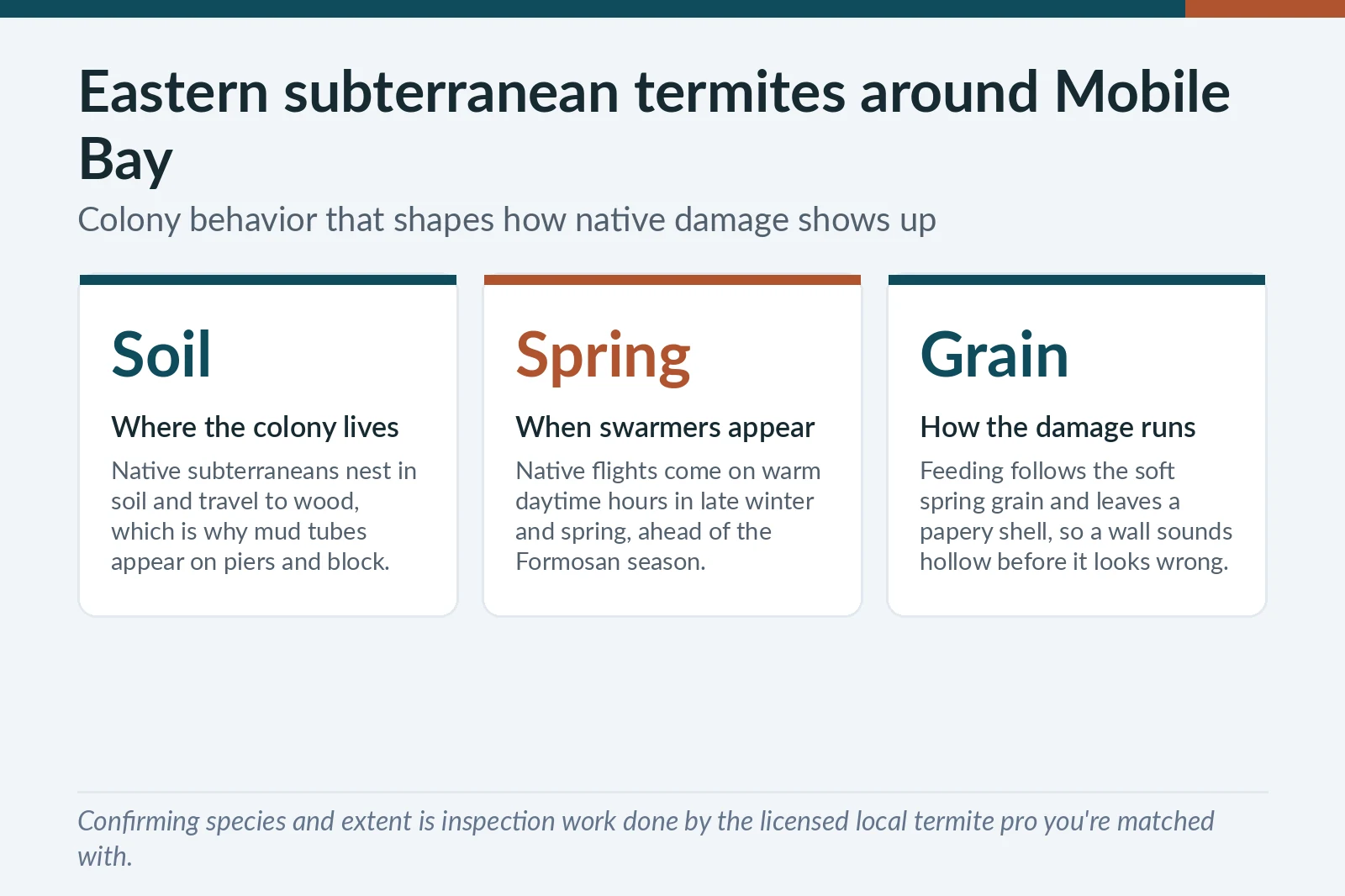
Reticulitermes flavipes — the eastern subterranean termite — is native to Alabama, established in every county in the state, and by a wide margin the species behind most of the mud tubes homeowners find on slab edges and crawlspace piers around Mobile Bay. It is not exotic and it did not arrive on a ship. It has always been here, and in Mobile’s climate it never really stops working.
That is the thing worth sitting with. Colder parts of the country get a genuine termite off-season: the soil drops below feeding temperature, the colony goes quiet, damage pauses. Mobile does not do that. Our winters run mild and our soil stays warm and damp, so a native colony feeding on a sill plate in December is feeding a little slower than it did in July — not stopping. Over a five-year stretch that adds up to real structural loss on a house nobody thought was under pressure, because nobody saw a dramatic swarm on the porch.
The good news, and it is genuine good news, is that the native termite is the more forgiving of Mobile’s two subterranean problems. A mature native colony holds somewhere in the range of 30,000 to a few hundred thousand workers. A mature Formosan colony can run into the millions. Native colonies forage maybe a hundred feet out; Formosans reach three times that. Native damage tends to develop over years, which means a homeowner who knows what a mud tube looks like has a real chance to catch it before anything structural fails.
Which is exactly what this page is for.
Identification — and why the soldier’s head is the whole ballgame
Workers are unreadable in the field. Soldiers and swarmers are not.
Workers
About an eighth of an inch, creamy white, soft-bodied, blind. Honestly indistinguishable from Formosan workers without magnification — anyone telling you the species from a worker alone on a phone photo is guessing. They make up the overwhelming bulk of any colony.
Soldiers
The field ID. Native soldiers have a rectangular, almost boxy head with straight sides. Formosan soldiers have a rounded, teardrop-shaped head and will ooze a milky white defensive fluid when you disturb them. This one feature separates the two species faster than anything else.
Swarmers (alates)
Dark brown to nearly black, roughly three-eighths of an inch with wings, four wings all the same length. Formosan alates are noticeably bigger and yellowish-tan. Timing matters too — natives fly in the afternoon, Formosans at dusk.
Found wings but no bug? Shed wings are diagnostic on their own. Native swarmers drop equal-length, translucent, smoky-gray wings in small piles on windowsills and in spider webs near windows. Sweep them up and you have thrown away the operator’s best evidence. Bag a few, photograph the rest where they fell.
Native vs. Formosan — the differences that change the treatment
Both are subterranean termites. They are not the same problem.
| Trait | Eastern subterranean (native) | Formosan (invasive) |
|---|---|---|
| Mature colony size | Roughly 30,000–250,000 workers | Often 1–several million |
| Soldier head | Rectangular, straight-sided | Oval / teardrop, secretes milky fluid |
| Swarm timing in Mobile | Late winter into spring, warm daytime flights after rain | Warm, humid May–June evenings, heavy around lights |
| Soil contact | Required — the colony must return to moist soil | Not always — carton nests hold their own moisture |
| Foraging range | Around 100 feet from the colony | Up to roughly 300 feet |
| Damage pace | Structural loss develops over years | Can compress the same loss into a season or two |
This is not trivia. The soil-contact line in that table is the one that drives method. Because native termites must keep a moist connection to the ground, a properly installed treated soil zone or a ring of in-ground bait stations sits directly across the colony’s only route in. That is why native infestations respond so predictably to conventional soil work. Formosans, with their carton nests, can survive inside a wall cavity fed by a roof leak with no soil connection at all — and that changes the entire conversation. If your house is on the Formosan side of that line, the operator will tell you.
Not sure which termite you’re looking at?
One call reaches a licensed, local exterminator who covers your address — and a real person answers, 24/7.
Free to check coverage · No obligation to hire anyone
Where native termites show up around Mobile Bay
Soil, moisture, and wood in contact with both. Our housing stock hands them all three.
Midtown, Oakleigh, and Old Dauphin Way. The historic districts are the classic case: pier-and-beam construction, real heart-pine framing, crawlspaces that were never properly vapor-sealed, and mature oaks dropping shade and leaf litter against the foundation year after year. A native colony under a Midtown cottage does not have to work hard. The piers put wood within inches of damp soil, and the crawlspace holds the humidity in like a lid.
Spring Hill and West Mobile slab homes. Slab-on-grade looks like a defense and is not. Termites do not need a crawlspace — they need a crack. Expansion joints, plumbing penetrations, cold joints where the porch slab meets the house, and the tiny gaps around the bath trap all give a native colony a covered route from soil to sill plate. On a slab, the mud tube often never shows outside at all, because it runs up through the interior of the slab edge. That is the reason a homeowner can go years without a symptom.
Baldwin County’s sandy soils. The Eastern Shore — Daphne, Fairhope, Spanish Fort — and the sandier ground down toward Foley drain fast, which slightly disfavors termites. Slightly. What our rain totals then do is re-wet everything within days. Add irrigation running on a timer against a foundation wall, and you have manufactured exactly the moist soil band the colony wants, in ground that would otherwise be too dry.
Anywhere the gutters gave up. The single most common man-made termite invitation in this region is a downspout dumping straight onto grade beside the foundation. It keeps a permanent damp column in the soil right where the wood is. If you fix one thing this month before anyone comes out, fix that.
The four signs that actually mean something
Photograph them. Do not clean them up.
- Mud tubes. Pencil-width tunnels of soil and saliva running up a slab edge, a pier, a foundation wall, or the inside face of a crawlspace joist. The tube is a covered highway — it exists because the workers cannot survive open air. Break one open and an active tube is damp inside with pale workers moving in it. A tube that gets rebuilt within a week is a live colony commuting.
- Daytime swarms, late winter. February through April, on a warm afternoon a day or two after rain, native alates pour out of a ground crack or a slab edge in a short, chaotic flight. Indoors, they head for the nearest window and die on the sill. An indoor swarm is not a maybe — it means a colony has a working route into the structure.
- Wood that sounds wrong. Tap a baseboard, a door jamb, a window sill with the handle of a screwdriver. Sound wood thuds. Termite-hollowed wood sounds papery and hollow, and a screwdriver tip pushed firmly into it sinks instead of stopping. Along with that: paint that blisters or ripples in a line, and floors that feel a touch springy.
- Frass? Not for this species. Worth knowing what doesn’t apply — subterranean termites pack their galleries with mud and waste rather than kicking out pellets. Little piles of tan, gritty, pepper-like pellets under wood mean drywood termite, which is a different treatment path entirely.
Swarmers inside the house? Treat that as this-week urgency.
Outdoor swarms in the yard are normal spring behavior on the Gulf Coast. Swarmers emerging inside living space are a different signal entirely: the colony has a covered path into the structure and reproductives are trying to leave through it. Leave the wings where they fall, take pictures, and get an inspection scheduled. Dispatch runs 24/7; the independent operator confirms their own timing and availability with you directly.
What a licensed operator will actually do
Educational only. The independent, ADAI-licensed operator decides, quotes, and performs the work.
Confirm the species
Soldiers, swarmers, tube construction, gallery pattern. A quote written before anybody establishes whether this is native or Formosan is a quote for a guess. Expect the operator to go into the crawlspace and up into the attic.
Map the moisture
Native colonies live on soil moisture. The inspection should identify the water source keeping them comfortable — a downspout, a slab leak, a failed vapor barrier, grade sloping toward the house — because chemistry alone does not fix a wet crawlspace.
Choose the method
Liquid non-repellent soil treatment, in-ground bait stations, or a combination. Native colonies respond well to both, and bait can be a strong fit on pier-and-beam homes where trenching is awkward.
Liquid soil treatments (fipronil-class, Termidor-type chemistry) establish a treated zone in the soil around and beneath the foundation. Because the chemistry is non-repellent, foragers cross it without detecting it and carry it back into the colony on their bodies. On a native infestation with a clear soil connection, this is the workhorse.
Bait systems (Sentricon-class and similar) ring the structure with in-ground stations holding a growth-regulator bait. Workers feed, share it through the colony, and molting fails colony-wide. Baiting is slower than liquid but it is also a permanent monitoring system — and because native colonies are comparatively small, the bait reaches the reproductives faster than it would in a Formosan colony.
Annual bonds. Most Gulf Coast operators offer a renewable termite bond: an annual inspection plus defined retreatment terms if activity comes back. Read what the bond covers. Retreat-only and repair-inclusive are very different products at very different prices, and the difference matters most in the years you hope you never need it.
Pricing is set by the independent licensed operator and varies by property, service, and market. Nobody on this line will pressure you out of getting a second opinion.
The native termite year on the Gulf Coast
| Window | What the native colony is doing |
|---|---|
| Feb–Apr | Peak swarm season. Warm afternoons after rain trigger daytime flights. This is when most Mobile homeowners discover they have termites — wings on a windowsill, a cloud of dark alates over the driveway. |
| May–Jun | Native swarms taper as Formosan evening swarms take over the calendar. Underground, native foraging accelerates with soil temperature. New mud tubes appear on slab edges and piers. |
| Jul–Sep | Hardest feeding of the year. Hurricane-season rain and roof intrusions create fresh wet wood, which colonies exploit fast. Good window for a crawlspace inspection while you are already checking for storm damage. |
| Oct–Jan | Quiet above ground, still working below it. Mobile’s mild winters never shut the colony down. This is the season for WDO letters, real-estate closings, and the annual bond inspection nobody thinks about until spring. |
What should you ask the operator?
- “Which species did you confirm, and what did you confirm it from?” The honest answer names a soldier’s head shape, a swarmer, or a tube-construction pattern. “Termites” is not a species.
- “Where is the moisture coming from?” If the inspection produced a treatment plan but no water source, the inspection isn’t finished. On this coast, the moisture is the infestation.
- “Liquid, bait, or both — and why for this house?” The answer should reference your foundation type, your soil, and your access, not a package tier.
- “What is your ADAI license number?” Every operator doing termite work in Alabama must hold the wood-destroying-organism category. You can verify a license with the Alabama Department of Agriculture & Industries Pesticide Management Section at (334) 240-7240. Legitimate operators expect the question.
- “What exactly does the bond cover, and what does renewal cost?” Get retreat-versus-repair, the renewal price, and whether it transfers to a buyer — in writing, before you sign.
Eastern subterranean termites — what do homeowners ask?
Are you a pest control company?
No. Mobile Alabama Exterminators is a free dispatch and referral service. We connect Mobile and Baldwin County homeowners with independent, ADAI-licensed operators who perform every inspection and every treatment. We do not inspect, treat, or set pricing, and we encourage you to verify any operator’s license with ADAI before hiring.
How do I tell an eastern subterranean termite from a Formosan?
Look at soldiers and swarmers, not workers. Native soldiers have a rectangular, straight-sided head; Formosan soldiers have a rounded teardrop head and secrete a milky fluid when disturbed. Native swarmers are dark and fly on warm winter and spring afternoons; Formosan swarmers are larger, yellowish-tan, and fly on humid May and June evenings around lights. Workers of both species look essentially identical without magnification.
Is the native termite less serious than a Formosan?
Less explosive, not harmless. Native colonies are far smaller and damage develops over years rather than months, which gives a homeowner a real chance to catch it early. But Mobile’s mild winters mean a native colony keeps feeding year-round, and years of unnoticed feeding is exactly how sill plates and floor joists fail.
I found mud tubes. Should I knock them down?
No. Photograph them and leave them. Tube location, moisture inside, and how fast a broken tube gets rebuilt are all diagnostic information the operator uses. Knocking them down or spraying them with a hardware-store product scatters the evidence and can push the colony into a route you cannot see.
When do eastern subterranean termites swarm in Mobile?
Late winter into spring — roughly February through April — on warm afternoons a day or two after rain. Daytime flights are the tell. If you are seeing large swarms at dusk in May or June, that timing points to Formosan instead.
Does a slab foundation protect my house?
No. Termites reach slab homes through expansion joints, cold joints, plumbing penetrations, and cracks — and on a slab the mud tube can run up the interior slab edge where you will never see it from outside. Slab construction changes where an operator inspects; it does not remove the risk.
How much does termite treatment cost around Mobile?
Pricing is set by the independent licensed operator and varies by property, service, and market — foundation type, structure size, method, and species all move the number. Checking coverage and getting matched is free, and the operator gives you the quote after inspecting. Comparing two operators is a perfectly reasonable thing to do.
Mobile’s winters don’t stop them. Start with your ZIP.
Free to check coverage, free to get matched, no obligation. The independent, ADAI-licensed operator inspects, confirms the species, and gives the quote.
Free to use · ADAI-licensed operators serving Mobile & Baldwin County, AL
Prefer to send details first? Use the contact form →