WDO inspection in Mobile, AL — the Section 1 report that closes your loan
VA, FHA and conventional lenders that ask for a WDO report all want the same document before closing. One call gets you matched with an ADAI WDC-licensed inspector who knows the form, the timing, and what Formosan country underwriting actually checks.
(888) 295-0220Tap to call — 24/7 — the inspector gives the quote after inspecting.Closing coming up? Call the line.
One call confirms an ADAI WDC-licensed inspector covers your area and gets your WDIR moving. A real person answers, 24/7.
(888) 295-0220Tap to call — 24/7Before you call, have ready: the property address, your closing date, and the loan type (VA, FHA, USDA, conventional). Those three let the inspector confirm turnaround on the first call.
· No obligation to hire anyone
Quick answer: A WDO inspection is Alabama’s official wood-destroying-organism check: subterranean and Formosan termites, powderpost beetles, old-house borers, and wood-decay fungi. It’s the inspection behind the Alabama “termite letter” a Mobile lender may require as a condition of sale financing, it’s performed by a WDC-certified, ADAI-licensed inspector, and it’s typically dated within 30 days of closing. Call (888) 295-0220 to get matched with one.
WDO inspection, WDIR, Section 1 letter, termite letter — same document, different names.
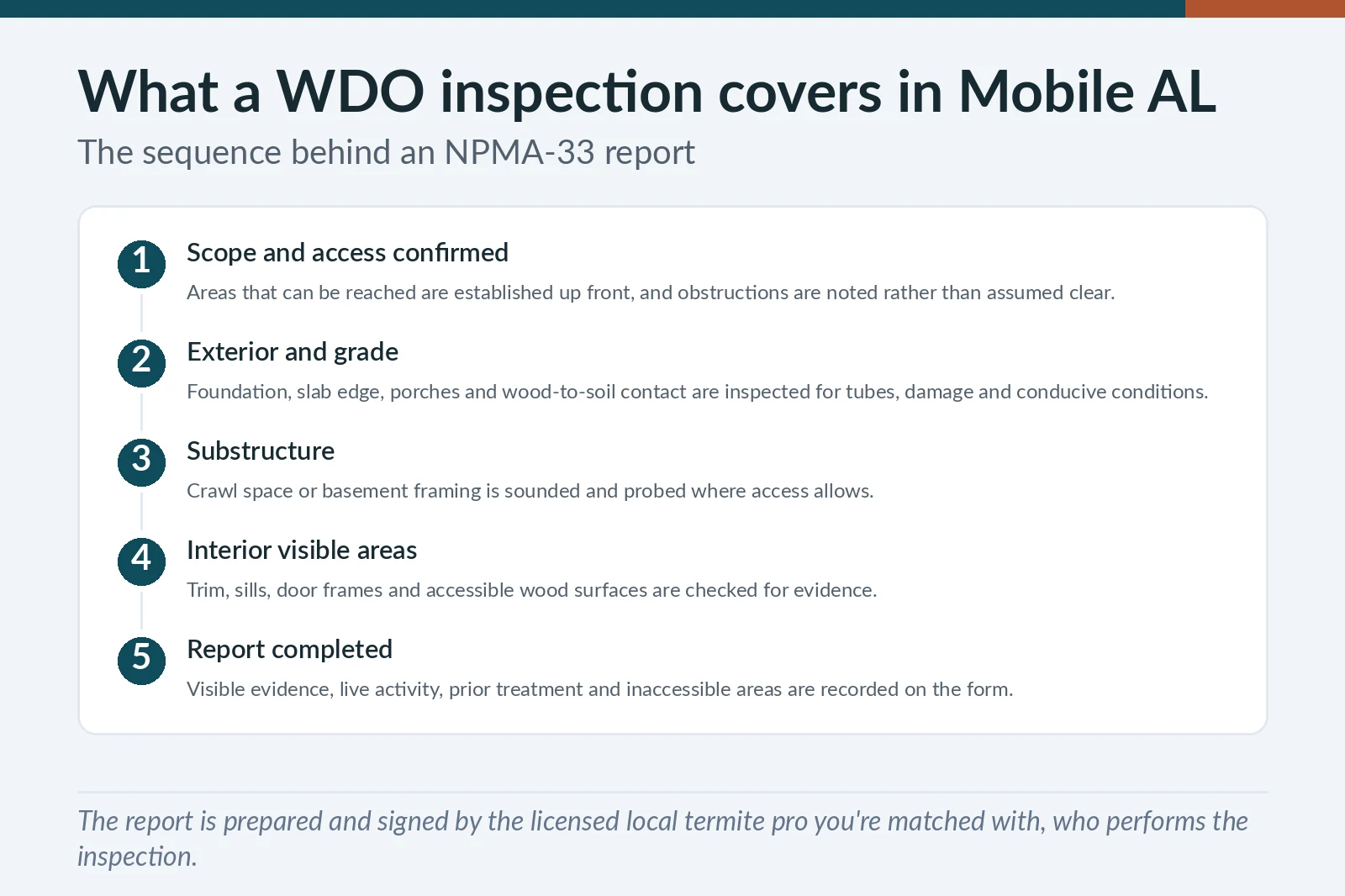
This is the first thing to know: the names get used interchangeably and they are all referring to the same report. WDIR (Wood Destroying Insect Inspection Report) is the proper formal name. In Alabama the report is made on the Official Alabama Wood Infestation Inspection Report, the written instrument named in Ala. Admin. Code r. 80-10-9-.18. NPMA-33 — National Pest Management Association form 33 — is the form many other states use, and the one FHA and VA accept as the general federal standard form; Alabama uses its own state form instead. Section 1 letter refers to its position in the loan closing documentation. Termite letter is the colloquial real-estate-agent shorthand. If your lender, your title company, or your agent asks for any of these, they want the same piece of paper.
The report is a documented inspection of the property by an ADAI WDC-certified inspector who is looking specifically for wood-destroying organi (WDO). The category is broader than just termites — it includes wood-boring beetles, carpenter ants, carpenter bees in some scopes, and wood-decay fungi. In the Mobile area Formosan termite (Coptotermes formosanus) and Eastern subterranean termite (Reticulitermes flavipes) are the most commonly flagged species, with drywood termite (Incisitermes) third, and carpenter ant and wood-boring beetle rounding out the typical findings. For the full range of pest categories a Mobile-area dispatch call can cover beyond WDO, see the Mobile, AL pest control dispatch overview. A full inventory of the species this dispatch line routes calls for is on the pests we cover page.
What’s on the form.
Alabama’s report and the NPMA-33 used in other states cover the same ground. Taking the NPMA-33 as the reference, there are four main sections. Section I is property identification — address, structure type, date of inspection. Section II is findings — visible evidence of active infestation, evidence of previous infestation, damage observed, all with checkboxes and narrative explanation. Section III is conducive conditions — wood-to-soil contact, moisture issues, debris, faulty drainage, vegetation against structure. Section IV is treatment information — was the property previously treated, by whom, when, and is there an active warranty. The inspector signs, dates, and provides license number.
What it is not.
A WDO report is explicitly a point-in-time observation, not a guarantee. The form itself says inspectors cannot detect concealed damage in inaccessible areas. A clear WDIR does not mean the property has no termites — it means no visible evidence was found at the time of inspection in the accessible areas. This distinction matters for buyers who assume a clear letter is forever protection; it is not. A retreatment bond purchased separately is the ongoing protection product.
WDIR Decision Tree — Mobile, AL Closing Scenario
Need an exterminator near you today?
📞 Call (888) 295-0220Free 24/7 dispatch line · ADAI-licensed local operators · no obligation
When loans require it — VA, FHA, USDA, conventional.
VA loans — required in high-probability termite zones.
VA requires a Section 1 Wood Destroying Insect Report where the property sits in a Termite Infestation Probability zone rated very heavy or moderate to heavy — the standard set out in VA Circular 26-22-11, Change 1. It is not a nationwide VA requirement. Mobile and Baldwin County are in the very heavy zone, so for local VA buyers the report is effectively standard; VA accepts the NPMA-33 as the report form, and Alabama-licensed inspectors issue the state’s own Official Alabama Wood Infestation Inspection Report. Schedule with the closing date in mind: 10 to 14 days out is the comfortable window, allowing buffer for any treatment-and-re-inspection cycle if findings are reported.
FHA loans — lender discretion.
FHA does not impose a blanket national requirement. A report is triggered by evidence of infestation, a state or local mandate, an area HUD treats as customary under its Termite Treatment Exception Area list, or the lender’s own discretion. In a very-heavy termite zone like Mobile it is common for an FHA appraiser or lender to call for one, but that is the lender’s decision rather than an FHA mandate. Ask your lender directly rather than assuming either way.
USDA Rural Development loans — lender and appraiser call.
We have not found a blanket WDIR mandate in USDA Rural Development guidance; on RD purchases it is the lender and the appraiser who decide whether a report is needed. Where a report is called for on an RD purchase it generally follows the appraiser’s identification of probable termite activity or the lender’s own policy. Schedule the same 10 to 14 days out.
Conventional loans — case by case.
Conventional loans do not federally require WDIR. The decision is up to the lender, the appraiser’s notes, and sometimes the underwriter. In the Mobile market many conventional lenders ask for WDIR on properties built before a certain year, properties with crawl spaces, properties with obvious moisture or maintenance issues visible at appraisal, or properties in known Formosan-active subdivisions. If the lender does not require WDIR, the buyer can still request one as part of due diligence — paying an inspection fee for documented findings before closing on a home is generally considered worth it.
Cash purchases.
No loan, no lender, no underwriting requirement. WDIR is optional but worth ordering for the same due diligence reason. Formosan in Mobile is sufficiently prevalent that buying a pre-2010 home without a WDIR is a measurable risk.
What gets flagged — active, evidence of previous, conducive conditions.
Section II — active infestation.
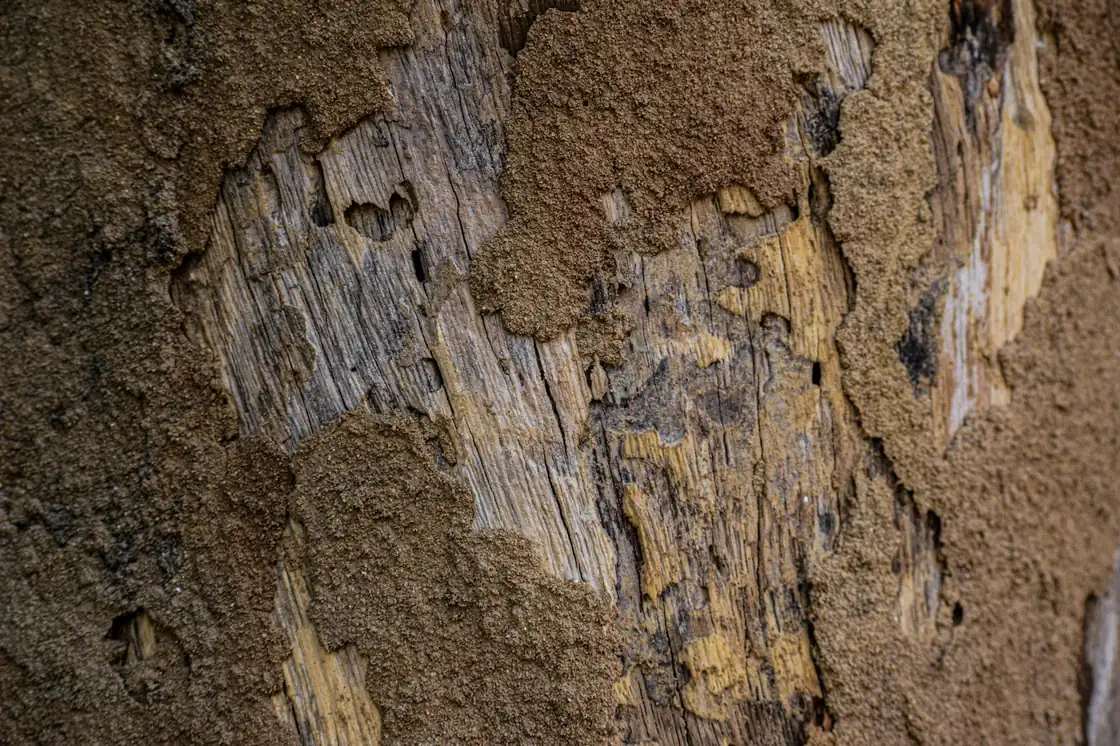
Visible live termites, ants, beetles, or fungal mycelia at the time of inspection. Mud tubes that crack open to live workers inside. Active swarmer activity. Frass piles being actively pushed out of kick-out holes. Soft, damp wood with active galleries. This is the high-stakes finding — almost no lender will fund a VA-loan property with an active untreated infestation. The standard response is treatment before closing with re-inspection to document the corrected status.
Section II — evidence of previous infestation.
Old mud tubes that are dry and inactive. Damaged wood with no current activity. Visible galleries in framing or trim. Visible swarmer wings on a window sill (even without live termites currently visible). Previous frass deposits. The inspector reports these regardless of whether current activity is found, because they document a historical infestation. Lender response depends on whether the previous infestation was treated and documented, and whether evidence suggests ongoing risk. Negotiation is common.
Section III — conducive conditions.
Wood-to-soil contact (porch posts, deck supports, trellises buried in dirt). Moisture problems — plumbing leaks, condensation, poor drainage, downspouts emptying against the foundation. Debris under structures — wood scraps under decks, paper or cardboard in crawl spaces, firewood stacked against siding. Mulch piled against siding above the foundation flashing. Heavy vegetation against the foundation. Earth-filled porches. These conditions do not require treatment to clear a WDIR but are noted as recommendations the buyer (or seller before closing) should address.
Section IV — previous treatment status.
The inspector asks about prior treatment history and notes it. If a previous treatment exists with a current warranty or active retreatment bond, that gets documented and usually weighs favorably. If a previous treatment exists with no documentation, that gets noted as such. If no previous treatment has been done, the section is marked accordingly.
Closing date already on the calendar?
WDIR requests tied to a closing date get priority routing. Call and mention your closing date when you reach the line.
Timeline coordination with closing — 10 to 14 days is the safe window.
Timing is one of the things buyers and agents underestimate. The WDIR inspection takes 60 to 90 minutes on-site. The PDF report is typically delivered to the requesting party within 2 to 5 business days (rush available at most operators for an additional fee). If the report comes back clear, that PDF goes to the lender, title, and buyer, and the closing proceeds. If the report comes back with findings, the negotiation and treatment cycle adds anywhere from 5 to 21 additional days. Scheduling tightly against the closing date is how WDIRs delay closings.
The conservative timeline.
Closing date – 14 days: Inspector visits property and conducts WDIR. Closing date – 11 days: PDF report delivered. If clear, distribute and proceed. If findings, begin negotiation. Closing date – 7 days: Treatment scheduled and completed (if needed). Closing date – 5 days: Re-inspection conducted documenting corrected status. Closing date – 3 days: Updated report issued. Closing day: All documentation in lender file, loan funds.
The compressed timeline (rush scenarios).
Closing date – 5 days: Inspector visits with rush turnaround. Closing date – 4 days: PDF delivered. If clear, proceed. If findings, treatment must happen immediately and re-inspection same week. Rush turnaround fees apply. Stressful for everyone involved. Avoid when possible.
What pushes timelines off.
Active Formosan or subterranean findings requiring treatment before closing add 5 to 14 days for treatment scheduling and re-inspection. Inaccessible crawl spaces or attics that require homeowner remediation before the inspector can fully inspect add days. Disagreements over who pays for treatment add days. Inspector workload (peak buying season, March through July in Mobile, is the busiest WDIR window) adds days. Scheduling early protects against all of these.
What to ask the operator the dispatch line connects you to.
Licensing questions.
- What is your ADAI WDC license number? Required for the inspector. Verifiable through ADAI.
- How long have you been inspecting in the Mobile-Baldwin area? Local experience matters — knowing the construction stock, knowing where Formosan is more likely, knowing the appraisers and lenders.
- What is your typical turnaround on the PDF? 2 to 5 business days is standard. 24-hour rush is typical at a premium.
Scope questions.
- What’s included in the inspection — interior accessible, exterior visible, attic, crawl space? The standard WDO scope covers all four. Some operators charge extra for difficult attic or crawl access.
- Will you note conducive conditions in Section III? Standard practice. If the operator says “we just look for termites” that is incomplete WDIR.
- Can you do treatment as well, or just inspection? Some operators do both; some only inspect. Either is fine — confirm scope.
Findings and follow-up questions.
- If findings are reported, can you provide a treatment quote quickly? Most can. Faster turnaround if the finding leads to treatment.
- Is re-inspection after treatment included or extra? Mobile-market norm is included if the same operator does the treatment, extra if not.
- Do you offer retreatment bonds and what does annual renewal cost? Separate purchase, but worth understanding pricing if WDIR triggers a bond conversation.
Delivery questions.
- PDF by email or mailed hard copy? Almost all Mobile operators now deliver PDF by email. Hard copy is available on request.
- Who do you send the report to — buyer, seller, lender, title? Specify recipients at the time of scheduling. Default is the requesting party; CC list available.
What an honest WDIR actually costs and what the cheap ones leave out.
The fee for a standard residential WDIR is set by the independent licensed operator, and around Mobile it clusters into a fairly narrow band. Inside that band there are real differences in what you get, and quotes well below it usually mean something was cut. Understanding what drives the number helps a homebuyer or seller know whether they are getting a real inspection or a checkbox exercise.
The discount inspection.
Some operators advertise a WDIR well under the going rate. The cost-cutting usually happens in one of three places. The inspector spends 20 to 30 minutes instead of 60 to 90 — a fast walk-through that catches obvious findings but misses subtle ones. The crawl space or attic does not get inspected unless trivial access (skipping difficult access is technically allowed with documentation, but a complete inspection includes them). Conducive conditions get cursory treatment. For a modest cash purchase the discount inspection may be acceptable. For a VA-financed Spring Hill purchase with a crawl space and pre-1960 construction, the discount inspection is a false economy — the things missed are exactly the things that matter most.
The premium inspection.
Premium pricing usually reflects one of three factors. The property is large or complex (multi-building, mixed slab and pier, multiple additions, commercial). Rush turnaround is being requested (24-hour PDF instead of 5-day standard). The inspector is bundling additional services — moisture meter readings throughout, thermal imaging of suspect areas, written treatment recommendations beyond the standard report. Premium inspections are not always necessary but for older Mobile homes with known risk factors they can be worth the cost.
What is reasonably included at the standard rate.
Full property walk-through with the inspector physically going through every accessible interior room, every exterior elevation, attic with adequate access, crawl space with adequate access. Moisture meter use at suspect areas. Complete report form with all sections filled out. PDF report delivered by email within 5 business days. Brief verbal summary at the end of the inspection. Reasonable phone follow-up if questions arise about the findings.
What is reasonably extra.
Rush turnaround (24 hours instead of 5 days): quoted as an add-on by the operator. Sub-floor crawl that requires removal of insulation or breaking access (often beyond standard scope): negotiated. Multiple structures on one lot: separate inspection fee per structure typically. Treatment quote development beyond the standard report recommendations: included with treatment, otherwise quoted separately. Re-inspection after treatment by a different operator: quoted separately.
Need a WDC-licensed inspector who knows Formosan country?
Not every inspector treats Formosan evidence the same as native subterranean. Call the line and get matched with a local ADAI WDC-licensed inspector.
Mobile + Baldwin specifics — Formosan country adds wrinkles.
WDIR inspections in Mobile and Baldwin Counties carry weight that the form does not by itself reflect. The two-county area is endemic Formosan range, with confirmed Coptotermes formosanus populations across most residential subdivisions south of Saraland and most of the Eastern Shore. That means every WDIR an inspector completes here is implicitly a Formosan-aware inspection — the inspector is looking for species-specific signs (May-June swarm wings, aerial carton nest evidence, distinct mud tube morphology) on top of the standard Eastern subterranean and drywood checks.
Aerial carton nest implications for WDIR.
Carton nests inside wall voids — the Formosan diagnostic — are notoriously difficult to find in a standard WDIR walk-through because they are inside finished walls. An inspector who finds visible Formosan damage will typically note that further wall-void inspection may be advisable; this gets a conducive-conditions or recommendation note rather than an active-infestation flag in many cases. Buyers should understand that a clear WDIR in Mobile does not rule out carton nest activity, only that none was visible at inspection.
Existing bond presence.
Many Mobile and Baldwin homes carry existing termite bonds — Sentricon AG monitoring contracts, liquid retreatment bonds, or damage warranties. A WDIR with an active bond and transferable terms is generally a strong selling point. Bonds are not always transferable to a new owner; some require a transfer fee, some require re-inspection, some require the new owner to renew at original price. The WDIR inspector documents the bond status in Section IV but does not negotiate transfer — that is between buyer, seller, and the bond-issuing operator.
Neighborhood-level pressure notes.
Spring Hill, Old Dauphin Way, Oakleigh, Toulminville, Crichton: pre-1960 housing stock, highest Formosan pressure in Mobile. Treat WDIR findings here with the highest seriousness. Tillmans Corner, Hillcrest, West Mobile: 1960s-1990s slab construction, moderate Formosan pressure. Findings still important but more predictable treatment paths. Eastern Shore (Daphne, Fairhope, Spanish Fort), Semmes, Saraland: newer construction predominates, Formosan present but better-tracked. Dauphin Island, Bayou La Batre, Coden, marsh-edge subdivisions: coastal moisture, sometimes combined Formosan-drywood findings, additional moisture-management considerations. See the full Mobile + Baldwin County service area map for coverage across both counties.
WDO inspection — common questions Mobile homebuyers and sellers ask.
Can I get a termite inspection near me in Mobile this week for my closing?
Call (888) 295-0220 and give your closing date and the property address. You’ll be connected with an ADAI WDC-licensed inspector who works that part of Mobile or Baldwin County. Most closings can be scheduled within the lender’s window when you call one to three weeks out; the inspector confirms the exact date and fee.
What is a WDO inspection and when do I need one?
WDO inspection (also called Section 1 Wood Destroying Insect Inspection, WDIR, or termite letter) is a property inspection by an ADAI WDC-licensed inspector who looks for evidence of wood-destroying organi. In Alabama the findings are documented on the Official Alabama Wood Infestation Inspection Report (Ala. Admin. Code r. 80-10-9-.18); many other states use the NPMA-33 form, which FHA and VA also accept. VA requires a report in Termite Infestation Probability zones rated very heavy or moderate to heavy (VA Circular 26-22-11, Change 1) — that includes Mobile and Baldwin County. FHA has no blanket national requirement; it turns on evidence of infestation, a state or local mandate, local custom, or lender discretion. USDA Rural Development and conventional loans are lender and appraiser calls.
How much does a WDO inspection cost in Mobile, AL?
The fee is set by the independent licensed operator. A standard residential inspection sits at the operator’s base rate; larger or complex structures are quoted above it. Rush 48-hour turnaround adds a surcharge. Re-inspection after treatment is sometimes free if scheduled with the same operator, and otherwise is quoted separately.
What does the inspector actually look at?
Interior accessible areas, exterior visible areas, attic and crawl space if accessible. Mud tubes, frass piles, visible damage, swarmer wings, conducive conditions. The inspection is point-in-time observation, not a warranty — it documents what is visible on that day. The report form explicitly notes inspectors cannot guarantee absence of damage in inaccessible areas.
What is the difference between WDIR and a retreatment bond?
Two different products. WDIR is the inspection report — documents current findings, is a one-time fee, and has no ongoing protection component. Retreatment bond is a separately purchased ongoing service contract — the operator inspects annually, retreats if termites reappear, and charges an annual renewal.
What gets a property flagged on a WDIR?
Active infestation — live termites or other WDO visible. Evidence of previous infestation — old mud tubes, damaged wood, frass that has not been cleaned up. Conducive conditions — wood-to-soil contact, water leaks, debris under structures, mulch against siding. Active and previous infestation are the high-stakes findings.
What happens if the WDIR comes back with findings?
Seller pays for the treatment before closing, seller credits the buyer at closing, price reduction, buyer accepts as-is, or buyer walks away. Active termite findings almost always trigger treatment before closing — lender will not fund a VA-loan property with active termites. Re-inspection after treatment generates an updated report.
How long is a WDIR good for?
A WDO report is point-in-time observation. Acceptable dating windows are set by the lender — commonly 30 to 90 days before closing; confirm yours. Schedule conservatively — 10 to 14 days before original closing date.
Can I use any pest control company for a WDIR?
In Alabama, the inspector must hold an active ADAI WDC certification. Not every pest control company that does ant and roach work holds WDC certification — confirm before scheduling. Ask for the WDC license number on the call and verify with ADAI if there is any doubt.
One number. Real human. ADAI WDC-licensed inspector on the line.
, free to get matched, no obligation. The licensed inspector performs the WDIR and stands behind their own report.
(888) 295-0220Tap to call — 24/7
Prefer to send details first? Use the contact form →
About this service. Mobile Alabama Exterminators is a dispatch and matching service. We answer the phone 24/7 and route callers to ADAI-licensed pest control operators and ADAI WDC-certified inspectors (Alabama Department of Agriculture and Industries — license categories HPC, WDC, and FC) serving Mobile and Baldwin County, Alabama. We are not a licensed pest control company. We do not inspect, treat, fumigate, complete WDIR forms, or warranty pest control work. The licensed inspector the call routes to performs the inspection, issues the report, and stands behind it. Free to get matched. The licensed operator gives the quote.
Mobile Alabama Exterminators is a free dispatch service that connects Mobile and Baldwin County homeowners with independent, ADAI-licensed pest control operators. We are not the treatment provider and do not perform inspections or treatments ourselves, and we do not guarantee specific results, pricing, or appointment availability. Requests are routed to participating local operators during their normal business hours; 24/7 availability is not guaranteed.