Every legit exterminator in Alabama has a license number. Here’s how to check it.
All structural pest control in Alabama — residential service, termite treatment, fumigation, WDO inspection — must be performed under certification from the Alabama Department of Agriculture and Industries (ADAI). This guide explains the license categories, what each one authorizes, and exactly how to verify one before anyone treats your home.
Ready to talk to a company and ask for its license?
Call, enter your 5-digit ZIP on the keypad, and get connected live with a local pest control company. Free to call, 24/7.
The governing framework, in plain English
ADAI’s Pesticide Management Section, headquartered at 1445 Federal Drive, Montgomery, AL 36107, administers structural pest control licensing under Chapter 28, Title 2, Code of Alabama 1975 (the Alabama Pesticide Act / Pest Control Industry Act) and Chapter 80-1-13 of the Alabama Administrative Code.
Licensing runs on a two-tier model, and both tiers matter when you’re checking a company:
- Individual applicator certification — the human doing or supervising the work must be certified in one or more categories (the codes in the table below).
- Business permit — the company itself must hold a Structural Professional Services Permit for household pest, termite, or fumigation work.
A company advertising termite letters whose only certified operator holds HPC (household pest) but not WDC (wood-destroying organisms) is operating outside its category — and that’s exactly the kind of mismatch a short verification call catches.
How to verify a license — the short version:
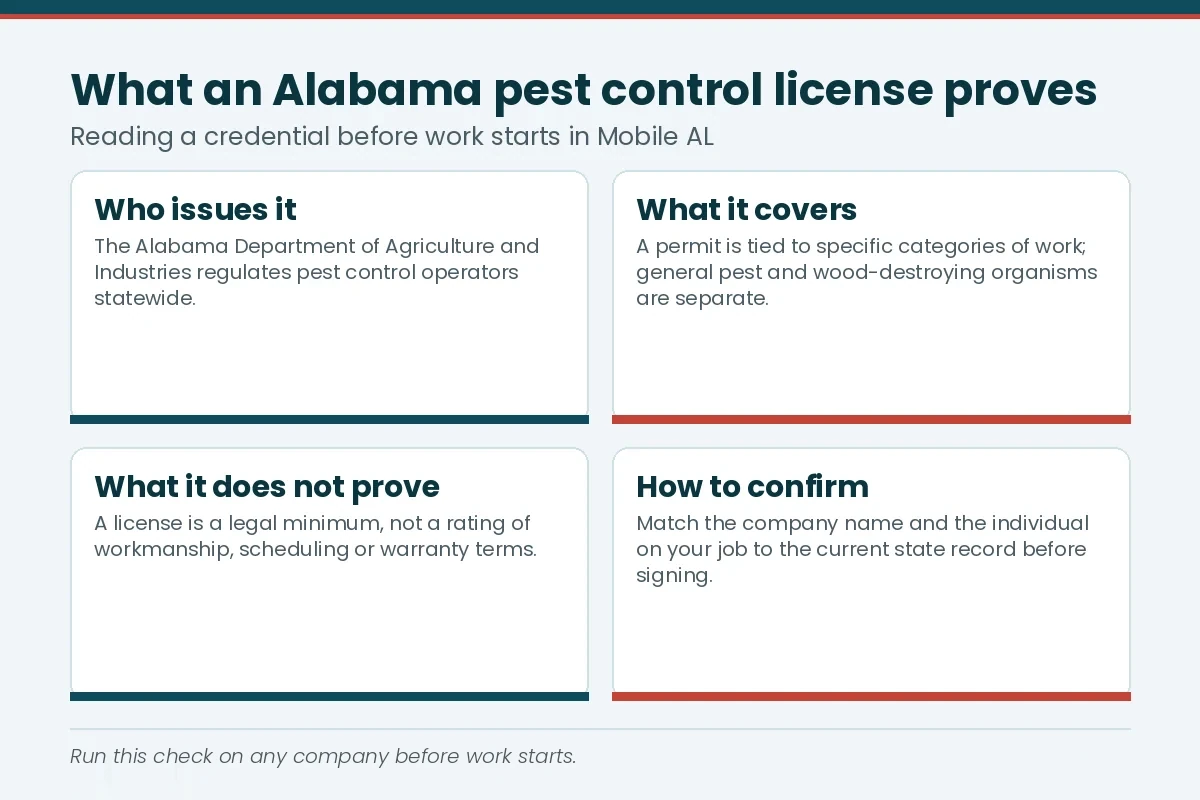
1. Ask the company for its ADAI certification number and the category code it holds (they should give both without hesitation).
2. Call ADAI’s Pesticide Management Section — that’s the department’s published line, written here as plain reference, not a service number — or use ADAI’s online applicator lookup.
3. Confirm the category fits the work: HPC for general pest, WDC for anything termite, FC for tenting.
The structural categories that matter to homeowners
These are the codes you’ll actually encounter on the Gulf Coast — and what each authorizes.
| Code | Category | What it authorizes |
|---|---|---|
| HPC | Household Pest Control — Certified Operator | Operating or supervising general pest services from a main office — roaches, ants, rodents, spiders, occasional invaders. |
| HPB | Household Pest Control — Branch Supervisor | Supervising branch-office household pest operations. |
| WDC | Wood Destroying Organisms — Certified Operator | Issuing the Official Alabama Wood Infestation Inspection Report (“termite letter”), writing termite treatment and bond contracts. This is the category for anything termite. |
| WDS | Wood Destroying Organisms — Supervisor | Branch-level equivalent of WDC. |
| FC | Fumigation — Certified Operator | Whole-structure fumigation (sulfuryl fluoride / “tenting”). The FC exam is only offered through ADAI Montgomery directly — never online. |
| FB | Fumigation — Branch Supervisor | Branch-level fumigation supervision. |
| IIHC | Industrial, Institutional & Health-Related | Healthcare and institutional facility applications. |
| OTPC / OTPS | Ornamental & Turf | Landscape pests — lawn fire ant work and turf applications. |
ADAI also maintains categories you’ll rarely meet as a homeowner — Public Health (PH, used by programs like the Mobile County Health Department’s vector control), Aquatic (AQ), Right-of-Way (ROW), Forest (FOR), agricultural categories, and more. The full plain-English breakdown lives on the companion page: ADAI license categories explained.
Testing, reciprocity, and why it matters to you
Alabama administers computer-based certification exams at eight sites — Mobile, Athens, Auburn, Birmingham, Hanceville, Headland, Millbrook, and Pelham — with the fumigation operator exam offered only through ADAI Montgomery directly. Certifications renew on ADAI’s cycle with continuing-education requirements, which is why a license verified two years ago is worth re-verifying now.
What this means for a Mobile or Baldwin County homeowner is simple: the license framework is real, specific, and checkable. A legitimate operator can tell you their certification number, their category, and their certified operator’s name on the spot. Hesitation on any of the three is a red flag worth acting on.
Red flags a verification call catches:
- A “termite letter” offered by a company with household-pest certification only — WDO reports require WDC.
- Tenting quoted by a company without FC fumigation certification (legitimate operators without it subcontract to a licensed fumigator — ask who).
- A company name that differs from the name on the Structural Professional Services Permit.
- No physical Alabama business address, or reluctance to name the certified operator supervising your job.
Catching mismatches like these before anyone treats your home is what the framework is for. For agency contacts, statutes, and university extension resources, see the authority resources page.
Want a local company you can check before hiring?
Call, enter your 5-digit ZIP on the keypad, and get connected live with a local pest control company. Free to call, 24/7.
ADAI licensing — what do homeowners ask?
How do I verify an Alabama exterminator’s license?
Ask the company for its ADAI certification number and category, then confirm it with ADAI’s Pesticide Management Section or through the department’s online applicator lookup. Verify the category fits the work — HPC for general pest, WDC for termite work, FC for fumigation.
What license does a termite letter require?
WDC — Wood Destroying Organisms, Certified Operator. Only a WDC (or branch-level WDS under one) can issue the Official Alabama Wood Infestation Inspection Report that lenders commonly ask for at closing, and only that category can write termite treatment and bond contracts.
Does a lawn-care company need a pest license for fire ant treatment?
Lawn and ornamental fire ant work falls under the Ornamental & Turf categories (OTPC/OTPS) with a Horticultural Professional Services Permit. Structure-adjacent household pest work requires HPC. Companies doing both need both — worth confirming when one vendor quotes the whole property.
What’s the difference between the individual and business license?
The individual certification belongs to the applicator — the person certified in a category. The business must separately hold a Structural Professional Services Permit. A legitimate company can produce both; a one-truck operation working under someone else’s certification can’t.
Who regulates pesticide misuse complaints in Alabama?
The same agency: ADAI’s Pesticide Management Section investigates misuse, unlicensed operation, and contract disputes involving licensed categories. Document what happened, keep the service paperwork, and contact the section in Montgomery.
Check the company before treatment starts
In Alabama, companies that do structural pest control, including household pest, termite and fumigation work, must hold a Professional Services license from the Alabama Department of Agriculture and Industries (ADAI). Ask for the company’s license and the name of its certified operator, and check with the ADAI Professional Services program before work starts.
Get the treatment plan, the products to be used, any follow-up visits and the price in writing. For termite work, ask what the contract covers, whether it’s retreatment only or includes repair of damage, and how long it lasts.
How the call works
- Call (888) 295-0220. Any time, day or night.
- Enter your 5-digit ZIP code on your phone’s keypad when prompted.
- Get connected live with a local pest control company that serves your ZIP. Describe what happened and ask when they can come out and what the job will cost.
Mobile Alabama Exterminators is a free referral line that connects callers with independent local pest control companies. We don’t perform the work. The company you’re connected with gives the quote, does the work and stands behind it.