Eco-friendly pest control in Mobile — the honest version.
Want the roaches gone without blanket-spraying the whole yard? There are real lower-impact options on the Gulf Coast — and real limits, too. This free 24/7 referral line connects you with an independent local operator you can ask about IPM, targeted baiting, and reduced-risk products. They inspect, they quote, they treat. You decide. See safe bee removal for how a local pest control company handles a hive with the same care.
Want pests handled with fewer chemicals?
Call, enter your 5-digit ZIP on the keypad, and get connected live with a local pest control company. Free to call, 24/7.
What “eco-friendly” really means in pest control — and what it can’t do
Let’s clear the air first. There’s no official “organic” certification for structural pest control in Alabama, and any company promising “completely non-toxic” or “100% chemical-free” results is selling marketing, not entomology. What honestly exists is a spectrum: lower-impact approaches that use less product, place it more precisely, and lean on non-chemical tactics first. That’s worth asking for — and on the Gulf Coast, it works better than most people expect.
Three ideas do most of the heavy lifting:
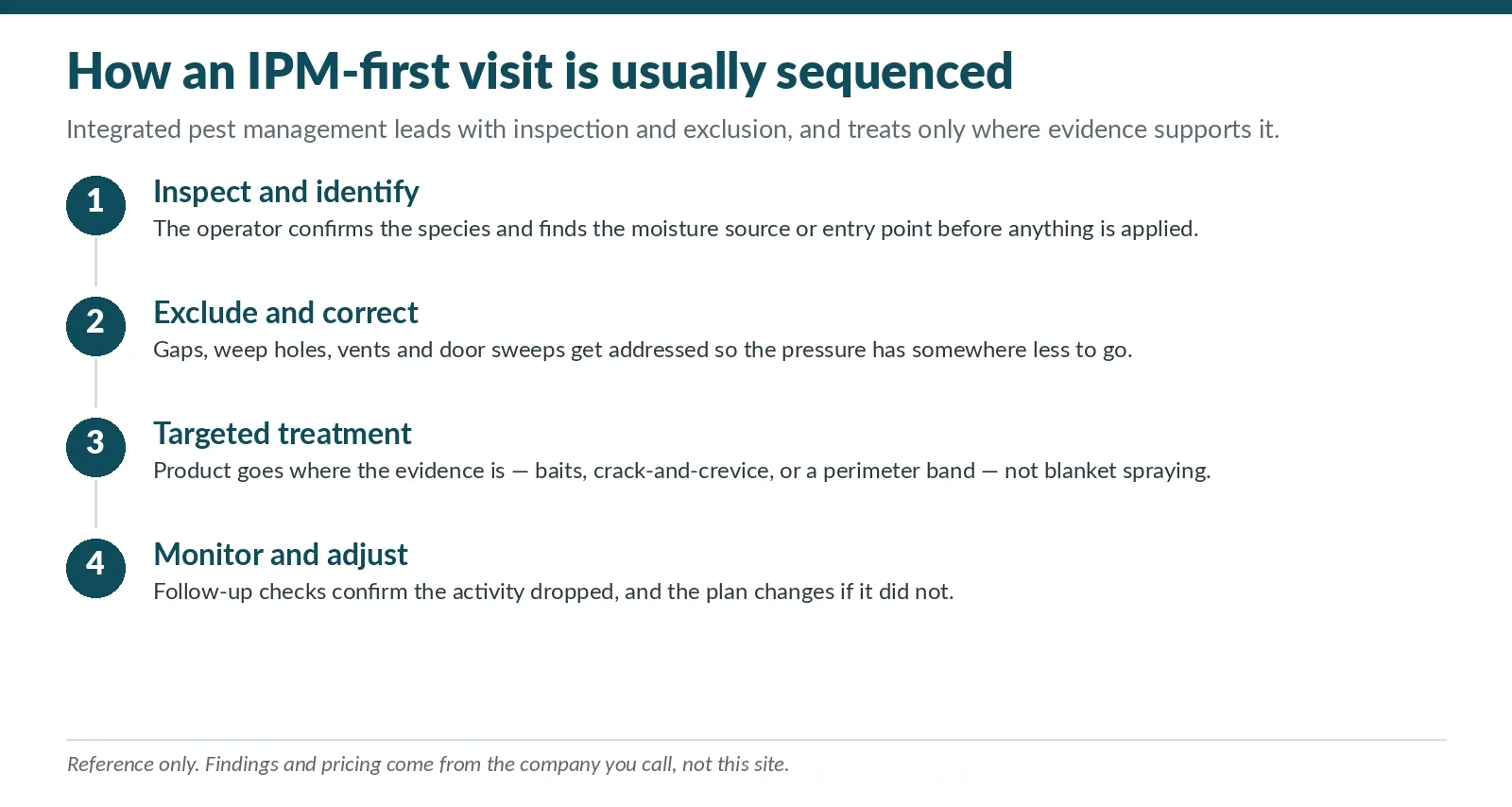
- IPM — integrated pest management. Inspection comes first: what species, where they’re nesting, what’s feeding them. Then exclusion (sealing entry gaps), sanitation (removing food and water sources), and habitat fixes (drainage, mulch pulled back from the slab, gutters cleared) — with targeted product use as the last layer instead of the first reflex. In Mobile’s humidity, the moisture-control piece alone eliminates a surprising share of problems.
- Targeted baiting instead of broadcast spraying. Gel baits placed in cracks and crevices reach roaches and ants where they actually live, using a fraction of the product a baseboard spray-down would. Termite bait-station systems and fire ant baits work the same logic outdoors — the pest carries the active ingredient home, so the yard doesn’t get blanketed.
- Reduced-risk product classes. Some products — certain botanical formulations built on plant oils, borate treatments for wood, insect growth regulators that interrupt breeding rather than poisoning outright — carry lower-toxicity profiles. “Reduced-risk” is a real EPA designation for some of them, not a slogan. Which of them fits your situation is a judgment call for the pest control company.
And that last sentence is the important one. Every pesticide used in Alabama is EPA-registered and applied under label requirements that carry the force of law — the label is the law, and reading your situation against it is exactly what the operator’s ADAI license is for. This page can tell you what to ask about; it can’t and won’t pick products. That decision belongs to the professional standing in your kitchen, not to a website.
Want the lower-impact conversation? Call, enter your ZIP, and tell the company you’re connected with — “I’d like to start inspection-first and prefer baiting,” or “we have a dog and a vegetable garden, and I want to talk through options.” From there, you decide whether to hire.
What a lower-impact visit looks like on the Gulf Coast
More clipboard, less spray tank — here’s the shape of an IPM-style service call.
A lower-impact service call in Mobile looks noticeably different from a spray-and-go visit. Expect more questions, more crawling around, and more talk about your house than about chemicals:
- A real inspection with species ID. Smokybrown roaches out of the oak litter need a different plan than German roaches under the sink; fire ants need different bait than carpenter ants in a moist sill. Precision starts with knowing the enemy.
- A moisture and entry-point audit. Gulf humidity is the engine behind most Mobile infestations — so a good IPM visit maps leaky hose bibs, clogged gutters, mulch against the slab, unscreened vents, and gaps under doors before anyone opens a product case.
- Placement over volume. Crack-and-crevice gel applications, enclosed bait stations, spot treatments where activity is confirmed — instead of wall-to-wall broadcast coverage by default.
- A pet-and-garden conversation. Tell the operator about dogs, cats, chickens, koi ponds, raised beds. Product selection, placement, and the label’s re-entry directions all get planned around that — that’s normal professionalism, and the label directions are the operator’s legal rulebook.
- A written scope with the why. What they found, which non-chemical steps come first, what product goes where and why, what it costs, and what follow-up looks like. Pricing is the operator’s, set after inspection — no prices are published on this site.
Fair warning from the same honest place: some jobs — an entrenched Formosan termite colony in a wall, a heavy rodent population — may need conventional tools to actually solve. A good operator tells you that straight instead of letting a “green” label fail slowly while the damage compounds. Lower-impact means starting smart, not tying the professional’s hands.
Lower-impact tactics, season by season
The Gulf Coast pest year — and the IPM-flavored answer to each stretch of it.
| Season | What’s stirring — and the lower-impact angle |
|---|---|
| Feb–Jun | Termite swarm season, natives then Formosans. The lower-impact question to raise: monitored bait-station systems versus liquid barriers — the operator can explain what your house and infestation level actually call for. |
| Apr–Oct | Fire ant mounds after every rain; ant trails into kitchens. Baiting programs timed to active foraging use ounces of product across a whole lawn — precision beats saturation. |
| Jul–Sep | Peak roach pressure indoors and out. Crack-and-crevice gel baiting, harborage cleanup (oak litter, gutters, mulch lines), and sealed entry points carry the load; silverfish and millipedes answer to the same moisture fixes. |
| Oct–Mar | Rodents test garages and crawlspaces as nights cool. Exclusion — sealing gaps, screening vents, door sweeps — plus snap-trap programs inside is the classic lower-impact rodent play; ask the operator how they handle it. |
Kids or pets and want a lighter approach?
Call, enter your 5-digit ZIP on the keypad, and get connected live with a local pest control company. Free to call, 24/7.
What should you ask the operator?
These sort the genuine IPM practitioners from the greenwashed spray-and-go approach.
- “Walk me through your inspection before we talk products.” An IPM-minded operator leads with what they found and which non-chemical steps come first. If the pitch opens with a spray package, keep asking.
- “Can this job start with baiting and exclusion?” Sometimes yes, sometimes honestly no — what matters is that the operator explains the reasoning for your specific infestation instead of a one-size answer.
- “What reduced-risk or botanical options fit this situation?” Let them name product classes and trade-offs. The choice is theirs to make under the label — but the conversation tells you plenty about how they work.
- “We have pets and a garden — how does that change the plan?” Listen for specifics: placement away from beds and bowls, enclosed stations, and re-entry timing per the label. Vague reassurance is a red flag; concrete adjustments are the mark of a pro.
- “What’s your ADAI license number?” Every legitimate Alabama operator has one, and the Pesticide Management Section in Montgomery can confirm it. Lower-impact work is still regulated work.
Eco-friendly pest control in Mobile — what do homeowners ask?
Is eco-friendly pest control the same as chemical-free?
No — and be wary of anyone who says otherwise. “Eco-friendly” in practice means lower-impact: non-chemical tactics first, targeted placement over broadcast spraying, and lower-toxicity product classes where they fit. Products used are EPA-registered and applied under label requirements, and results — not slogans — are the goal.
Do you choose the products that get used?
No. Mobile Alabama Exterminators is a free referral line — we connect you with an independent operator and step out of the way. Product and method decisions are made by that professional based on the inspection and the product label, which carries the force of law.
Do lower-impact methods actually work on Gulf Coast pests?
For a lot of the everyday problems — roaches, ant trails, fire ants, silverfish — yes: baiting and moisture control are the professional standard, not a compromise. For heavy termite or rodent situations, the honest answer may involve conventional tools. The operator’s job is to tell you which case you have.
What about my pets and my vegetable garden?
Bring them up on the first contact — it changes placement, product class, and timing. Operators plan around bowls, runs, coops, and raised beds, use enclosed bait stations where appropriate, and follow the label’s re-entry directions. Ask them to walk you through it; a good one will without being asked.
What is IPM in plain English?
Find out exactly what pest you have and why it’s there, fix the conditions feeding it — moisture, entry gaps, food sources — and then use the most targeted product application that finishes the job. Less product, placed smarter, with the cause addressed so the problem stays solved.
What does the call cost, and how does pricing work?
The call is free, and you decide whether to hire anyone. Pricing is set by the independent operator after they’ve inspected — lower-impact programs sometimes involve follow-up visits, and the operator’s written quote spells that out before any work begins.
Check the company before treatment starts
In Alabama, companies that do structural pest control, including household pest, termite and fumigation work, must hold a Professional Services license from the Alabama Department of Agriculture and Industries (ADAI). Ask for the company’s license and the name of its certified operator, and check with the ADAI Professional Services program before work starts.
Get the treatment plan, the products to be used, any follow-up visits and the price in writing. For termite work, ask what the contract covers, whether it’s retreatment only or includes repair of damage, and how long it lasts.
How the call works
- Call (888) 295-0220. Any time, day or night.
- Enter your 5-digit ZIP code on your phone’s keypad when prompted.
- Get connected live with a local pest control company that serves your ZIP. Describe what happened and ask when they can come out and what the job will cost.
Mobile Alabama Exterminators is a free referral line that connects callers with independent local pest control companies. We don’t perform the work. The company you’re connected with gives the quote, does the work and stands behind it.