Do pests die in winter in Alabama? Mostly, no — here’s what actually happens.
A cold snap feels like it should solve everything. For most Alabama pests, it doesn’t — it just changes where they are and how visible they are, which is a very different thing.
☎ Call (888) 295-0220
Free 24/7 dispatch · anywhere in Alabama
No — most Alabama pests don’t die in winter, they relocate, slow down or go dormant instead. Subterranean termites stay active below the frost line year-round, German roaches never notice winter because they live indoors, smokybrown and American roaches overwinter in harborage, mosquitoes survive as diapausing eggs or adults, fire ant colonies retreat deep underground, and rodents actively move indoors — making them, if anything, more of a winter pest than a summer one. Winter is better understood as the season pests hide, not the season they disappear.
Do termites actually die when the ground freezes?
No, and this is the myth with the highest stakes. Alabama’s frost line — the depth to which the ground actually freezes in winter — is shallow across most of the state and often doesn’t reach more than a few inches down even during a hard cold snap. Subterranean termites simply move deeper into the soil, below that frost line, and stay active there through the winter, tending the colony and foraging tunnels rather than shutting down. Near a heated slab foundation, where soil temperature stays elevated by the house itself, activity can continue closer to the surface all winter long with barely any slowdown at all.
This matters because it means winter is not a safe season to skip a termite concern. A homeowner who notices mud tubes in November and decides to “wait until spring” because it’s gotten cold is not buying any real protection — the colony underground hasn’t paused. It’s actually the opposite: winter, when termites aren’t swarming and drawing attention to themselves, is when a slow-building problem is easiest to overlook. The termite swarming season guide covers the spring event everyone notices; this is the quieter season that sets it up.
What about roaches, ants and mosquitoes — do any of them actually go away?
It depends entirely on the species, and lumping “bugs” together is where the myth comes from. German roaches live indoors year-round, in the warm, humid microclimate of a kitchen or bathroom — they have no outdoor season to begin with, so winter changes nothing about their behavior. Smokybrown and American roaches, by contrast, are outdoor-based and do slow down, but they don’t die off; they overwinter as nymphs or adults in harborage — leaf litter, mulch beds, wall voids, crawl spaces — and simply become less visible until warm weather brings them back out. That connection to why roaches come inside in fall is really the first half of this same story.
Fire ants don’t disappear either — the colony retreats deeper underground and clusters together for warmth, and mounds that look abandoned after a hard freeze often become visible again within days of a warm winter rain, since the colony simply moved up and down in the soil profile rather than dying. Mosquitoes survive winter in one of two ways depending on species: some overwinter as adults in protected harborage, while others survive as diapausing eggs laid in the fall that simply wait out the cold in a dormant state — which is exactly why the first stretch of warm days can produce a startling number of mosquitoes seemingly out of nowhere, covered in more detail on the mosquito season page. None of these are “killed by winter” scenarios; they’re all pause-and-resume.
Noticing activity even though it’s cold out? Tell the dispatcher what you’re seeing and your city. You’ll be matched with an independent, ADAI-licensed operator who covers your Alabama address for inspection, exclusion or bond-renewal work.
If anything, are rodents actually a winter problem instead of a summer one?
Yes — rodents are the clearest exception to the whole “winter kills pests” idea, because cold weather doesn’t reduce rodent activity, it redirects it indoors. As outdoor food sources thin out and temperatures drop, mice and rats actively seek the warm, dry, food-rich environment a house provides, which is why rodent calls run higher in the cooler months than the warm ones in most of Alabama. The timing guide covers how this push arrives earlier in north Alabama than on the coast, but the pattern is the same statewide: winter is when rodents become more of a problem, not less.
This is really the cleanest illustration of the broader point. A homeowner who assumes a cold snap has quieted things down and skips a winter inspection is, for rodents specifically, skipping exactly the season when the risk is climbing. The Birmingham rodent control page and the Mobile fire ant page both reflect this same seasonal logic from opposite ends — one species getting more active as it cools, another simply relocating underground.
So does Alabama’s regional climate change any of this — and why is winter actually a smart season to call?
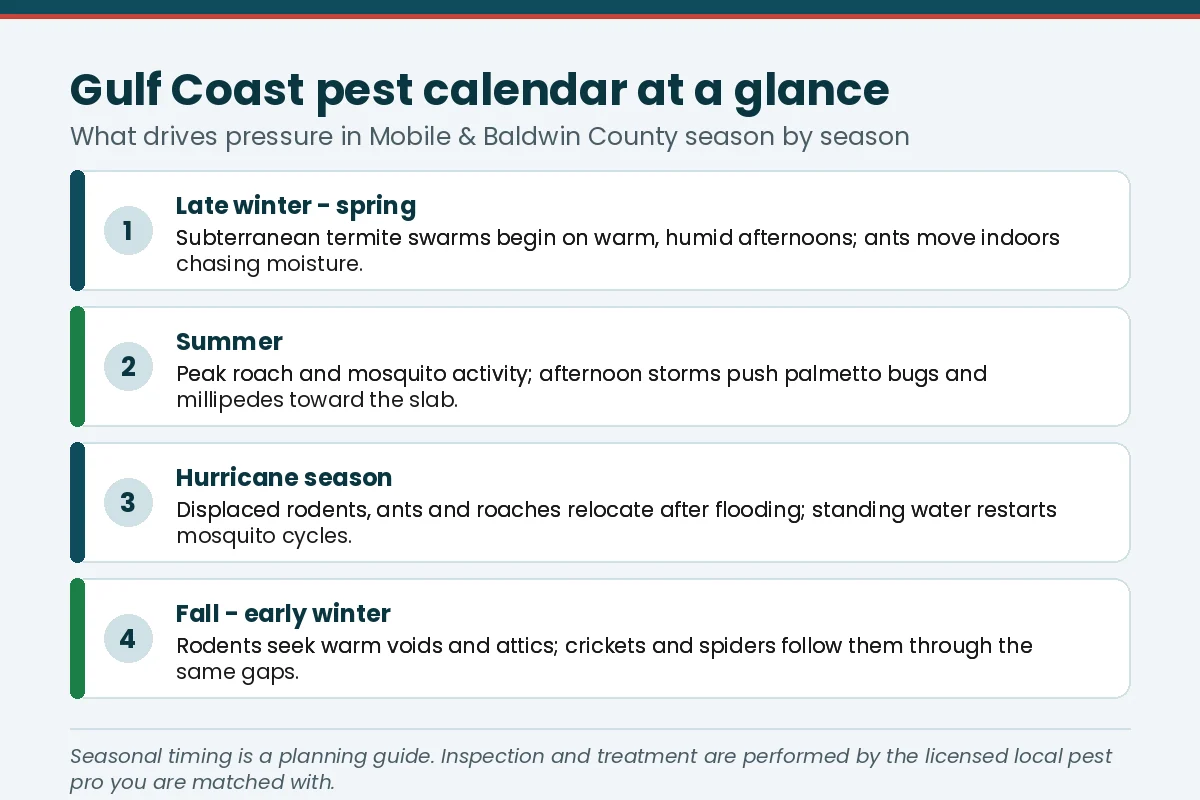
Yes, meaningfully. The Gulf Coast — Mobile and Baldwin County — barely gets a real pause at all; mild winters there mean many species stay closer to active than dormant most years, and a genuinely hard freeze is the exception rather than the rule. Moving north through Montgomery, Birmingham and Tuscaloosa, winters are cooler and more consistent, pushing more species into a real dormant phase for a longer stretch. Huntsville and the Tennessee Valley see Alabama’s most reliable hard frosts and the closest thing the state has to a true winter pause — but even there, none of the mechani above (frost-line depth for termites, indoor harborage for roaches, diapause for mosquitoes, underground retreat for fire ants, indoor movement for rodents) actually eliminate a population; they just slow it down or hide it.
That’s exactly why winter is, counterintuitively, a smart season to get ahead of things rather than a season to relax. Licensed operators’ schedules tend to open up once swarming season and the fall rodent push have passed, which makes winter a good window for exclusion work — sealing the same gaps and entry points covered in the fall guides — general inspections, and termite bond renewals, since a bond that’s allowed to lapse over a quiet winter is exactly the kind of gap that shows up as a surprise the following spring. The plain takeaway: a cold snap will not fix an infestation, and treating winter as a dead season is how small problems turn into spring surprises.
Questions people ask
No — it’s a free 24/7 dispatch and referral line. Call (888) 295-0220, describe what you’re seeing and your location anywhere in Alabama, and you’re matched with an independent operator licensed by the Alabama Department of Agriculture & Industries. That operator — not the dispatch line — inspects the property and sets the plan and price.
Generally yes for outdoor-based species — termites, outdoor roaches, fire ants and mosquitoes all become less visibly active during a genuine cold snap, especially in north Alabama where frosts are harder and more frequent. Slower and less visible isn’t the same as gone, though, which is the distinction that matters for deciding whether to wait or call.
The colony didn’t die during the cold — it moved deeper in the soil to stay warm, then moved back up once a warm rain or a stretch of mild days made the surface hospitable again. That up-and-down movement in the soil profile is normal fire ant winter behavior, not a new infestation appearing from nothing.
No — swarmers are a spring event, but the colony itself is active underground all winter, especially near a heated foundation. Winter is actually a reasonable time to get an inspection precisely because it isn’t swarming season and operator schedules tend to be less backed up.
Yes. A bond that lapses during a quiet winter stretch is easy to forget about, and the colony underground hasn’t paused just because the bond has. Renewing during the winter window, before spring swarming season, is a common and sensible time to handle it.
Seeing activity that a cold snap didn’t stop? Make one free call.
Describe what you’re seeing and your city, get matched with an independent ADAI-licensed operator who works your area. Free call, 24/7, anywhere in Alabama.