When does mosquito season end in Alabama? A month-by-month answer.
Short version: it depends on which end of the state you sleep in. Mobile Bay and Huntsville are 350 miles apart, and their mosquito seasons end nearly a month apart. Here’s the honest timeline — and what’s still worth doing about it in late summer.
☎ Call (888) 295-0220
Free 24/7 dispatch · anywhere in Alabama
Mosquito season in Alabama typically ends in mid-to-late October in north Alabama (Huntsville, Decatur, Birmingham) and early-to-mid November on the Gulf Coast (Mobile and Baldwin County) — whenever evening temperatures consistently drop below about 50°F. On the coast it can flicker back to life during warm winter spells. Statewide, the season starts again between late February (coast) and April (north).
Does mosquito season end on a date — or with the weather?
Mosquitoes don’t read calendars; they read dusk temperatures. Most of the species that bite people in Alabama go quiet once evening lows sit below roughly 50°F for a week or two. Above the mid-50s they fly, feed and breed; in the 60s and 70s they thrive. That’s the whole trick to the state’s lopsided map: the first sustained cool evenings reach the Tennessee Valley in early-to-mid October, the Birmingham metro a week or two later, and Mobile Bay sometimes not until the second week of November.
How the season ends also depends on the species. Culex mosquitoes — the storm-drain breeders behind most late-season bites in Alabama cities — overwinter as adult females, tucked into crawl spaces, garages, culverts and sheds. They aren’t dead in December; they’re parked. A warm coastal week in January can wake a few. Asian tiger mosquitoes (Aedes albopictus), the daytime ankle-biters that dominate Alabama yards, overwinter instead as drought-proof eggs glued inside buckets, gutters, plant saucers and corrugated downspout extenders, waiting for spring rain and warmth to hatch all at once.
That’s why “when does it end” has a two-part answer: biting pressure fades over a few cooling weeks, but the population never really leaves — it just changes form until spring.
How does the end of season differ across Alabama?
Here’s the realistic month-by-month wind-down, region by region:
- Mobile & Baldwin County (Gulf Coast): the longest season in the state — roughly late February through early-to-mid November. Salt-marsh species come off the bays and bayous on top of the usual yard breeders, and mild spells can produce December bites. If you’re coastal, plan around a nine-month season; the Mobile mosquito control page and the Daphne page break down the local drivers.
- Montgomery & the River Region: roughly late March through late October. The Alabama River’s oxbows and Catoma Creek keep floodwater species going after upstate yards have gone quiet — details on the Montgomery mosquito control page.
- Birmingham metro: April through mid-to-late October, with Village Creek and Valley Creek floodplain neighborhoods holding activity latest — see the Birmingham mosquito control page.
- Huntsville & the Tennessee Valley: the shortest season — roughly mid-April to mid-October. Real frosts arrive earliest here and shut the flying season down hard; the Huntsville mosquito control page covers the drainage-driven exceptions.
Wherever you are, the pattern is the same: the season doesn’t stop on the first cold night. It takes two to three weeks of cooling evenings to wind down, and a stretch of Indian-summer warmth in October can bring one more wave.
Getting eaten alive in your own backyard? Tell the dispatcher what your yard backs up to — a creek, a retention pond, a storm drain — and how long the problem has run. You’ll be matched with an independent, ADAI-licensed operator who covers your Alabama address and can set up a barrier program on the right cadence.
Is it still worth treating for mosquitoes in late August?
Yes — and late summer is arguably when treatment earns its keep. From mid-August, coastal Alabama still has ten to twelve weeks of biting season left, and even Huntsville has six to eight. August and September are also peak transmission months for West Nile virus in Culex populations, precisely because the season is old: the virus has had all summer to amplify in birds and mosquitoes.
Yard barrier treatments — the residual applications licensed operators apply to shaded foliage, under decks and along fence lines where mosquitoes rest — typically run on a 21-to-30-day cycle. Starting in late August still leaves room for two or three full cycles before the season closes, which covers the tail of the season plus early fall evenings on the patio. The last application of the year, timed for September or early October, also knocks down the adult Culex females that would otherwise slip into your crawl space or garage to overwinter.
One honest caveat: a barrier treatment manages your yard, not your block. If a neighboring property has an untended pool or a clogged gutter line, expect improvement, not silence — and ask the operator you’re matched with how they handle adjacent-source pressure.
What can you do this fall to make next season lighter?
The cheapest mosquito control of 2027 happens in the fall of 2026, because Asian tiger eggs laid this year are next year’s first hatch. Before winter:
- Dump-and-scrub the container circuit: plant saucers, buckets, kids’ toys, tarps, birdbaths and trash-can lids. Scrubbing matters — the eggs are glued to the sides above the waterline and survive dry winters.
- Clean gutters and corrugated downspout extenders — the number-one hidden nursery on newer Alabama homes.
- Fix the standing-water geography: low spots that hold rain for more than five days, French drain outlets, and forgotten watering cans behind the shed.
- Deny winter shelter: screen crawl-space vents and weather-strip garage doors so overwintering Culex females park somewhere other than under your house.
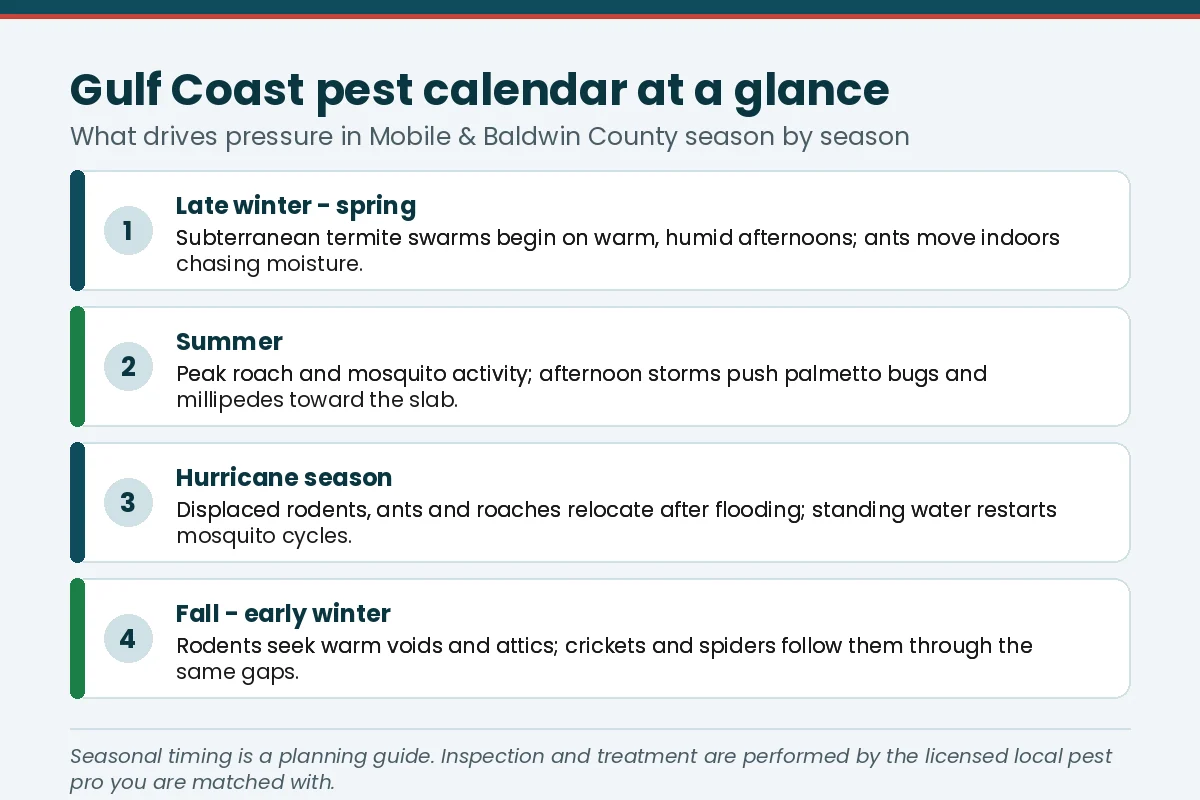
Pair that checklist with the Gulf Coast pest prevention calendar if you want the whole year’s rhythm in one place.
Questions people ask
Mostly, but not absolutely. North of Montgomery, December through February is effectively mosquito-free. On the Gulf Coast, overwintering adults can fly during warm spells — a 70-degree Christmas week in Mobile sometimes produces a few surprised bites. Sustained activity doesn’t resume until late February at the coast and April upstate.
Late February to mid-March in Mobile and Baldwin County, late March in the River Region, and April in Birmingham and the Tennessee Valley. The trigger is the reverse of fall: a week or two of evenings above the mid-50s plus spring rain to hatch the overwintered eggs.
Yes — residual barrier applications work in any month mosquitoes are active, and a final fall application also reduces the overwintering adults that seed next spring. What changes in October is the math: upstate, you may only need one more cycle; on the coast, two.
No — it’s a free 24/7 dispatch and referral line. Call (888) 295-0220, describe the mosquito problem and your location anywhere in Alabama, and you’re matched with an independent operator licensed by the Alabama Department of Agriculture & Industries. That operator — not the dispatch line — inspects the yard, sets the treatment plan and sets the price.
September pressure is almost always a breeding-site question, not bad luck. Shade, irrigation, container clutter, a clogged gutter run or a storm drain at your corner can hold a population your neighbor’s sunnier, drier lot can’t. A licensed operator’s first visit should include a source inspection, not just a spray.
Still swatting? Make one free call.
Describe your yard and your city, get matched with an independent ADAI-licensed mosquito operator who works your area. Free call, 24/7, anywhere in Alabama.