Roaches in the house this fall? Here’s why Alabama’s outdoor roaches move in.
Every September, Alabama homeowners who never see a roach all summer suddenly find one on the kitchen counter at 9pm. It’s not a new infestation — it’s an old one, coming inside for the winter.
☎ Call (888) 295-0220
Free 24/7 dispatch · anywhere in Alabama
Roaches show up inside in fall because large outdoor species — smokybrown and American (palmetto bug) roaches — lose their outdoor food and moisture supply as nights cool in September and October, and they push through attic vents, soffit gaps, garage door corners and weep holes to find both indoors. German roaches, by contrast, live indoors year-round and don’t need a cold front to show up — if you’re seeing roaches in July too, that’s a different (and more urgent) problem.
Why do outdoor roaches suddenly show up inside in September and October?
Alabama’s big outdoor roaches — smokybrown roaches and American roaches (often called palmetto bugs) — spend summer living outside, in leaf litter, mulch beds, tree bark, woodpiles and storm drains. They don’t need your house when it’s 85 degrees and humid outside; the yard has everything they want. What changes in fall isn’t the roach, it’s the weather: the first stretch of cooling nights in the low 60s and 50s dries out the leaf litter they shelter in and slows the insect and decaying-plant food supply they feed on. A warm, humid, food-rich house suddenly looks a lot better than a cooling yard.
Attics and soffits matter more than people expect. Smokybrown roaches in particular are strong fliers and excellent climbers, and they’re drawn to the warm, humid microclimate under a shaded attic or soffit — especially on homes with mature tree canopy overhanging the roofline. Branches touching the roof are a bridge; gaps where soffit panels meet the fascia are a doorway. From the attic, it’s a short trip down a wall void into a bathroom or kitchen.
At ground level, garage door corners and weep holes do the same job for American roaches. Weep holes — the small gaps at the base of brick veneer that let masonry walls drain and breathe — are functionally a permanently open door sized for a roach. Garages attached to the house, especially ones that stay a few degrees warmer than the outside air and store cardboard or firewood, are one of the most common fall entry points on record across Alabama homes.
Is it a smokybrown, an American, or a German roach — and does it matter?
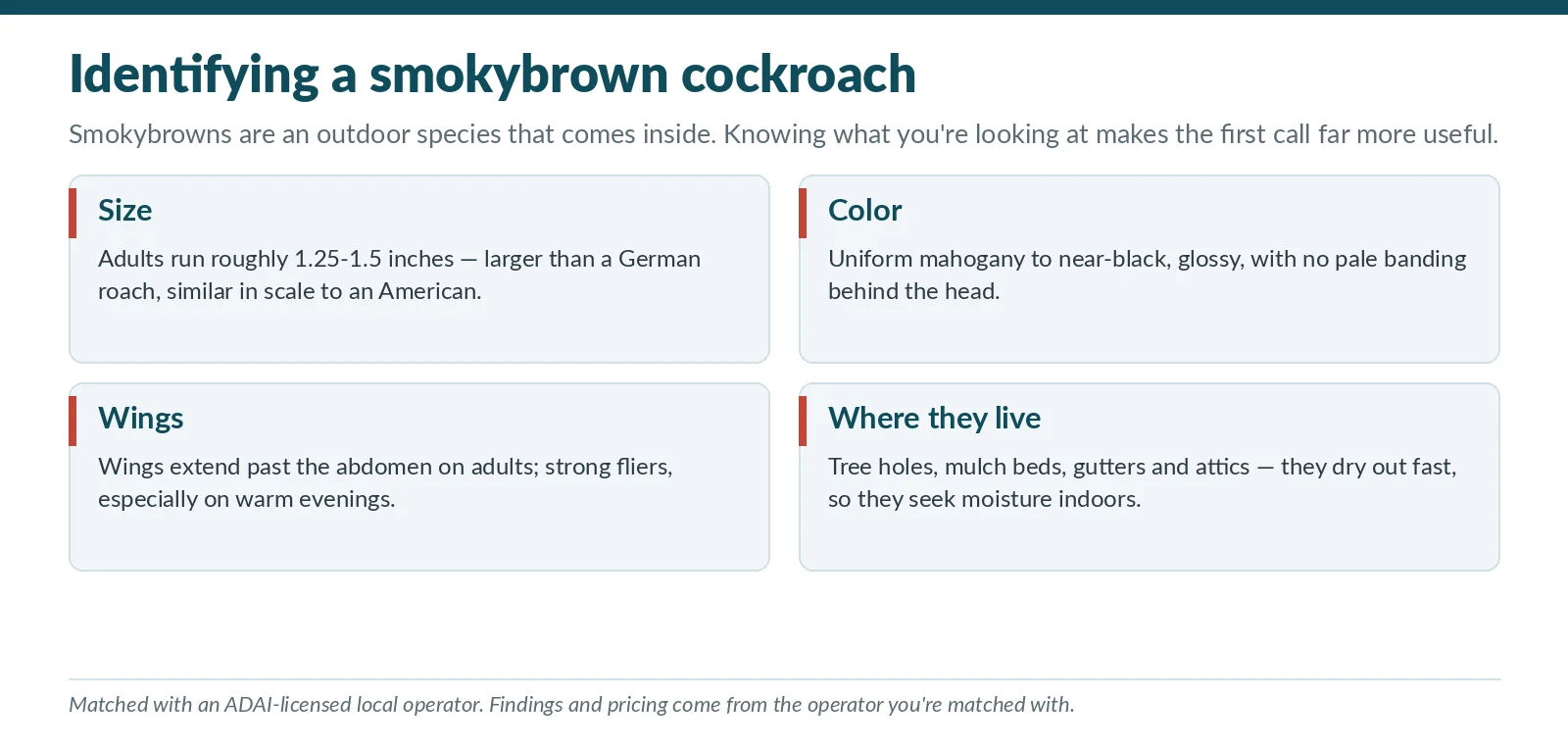
It matters a lot, because the fix is different for each. Smokybrown roaches are solid dark brown, about 1–1.25 inches, with wings noticeably longer than their body — strong fliers, often the ones that show up near porch lights or drop out of a soffit gap. American roaches (palmetto bugs) are reddish-brown, up to 2 inches, with a pale yellow band behind the head, and they favor damp ground-level spots — crawl spaces, garages, storm drains, sewer connections. Both are outdoor-based species that come inside seasonally or when conditions push them, and both are usually manageable with exterior-focused work: sealing entry points, treating the perimeter and harborage areas, and reducing moisture.
German roaches look different and behave completely differently — smaller (about half to five-eighths of an inch), tan to light brown, with two dark parallel stripes running down behind the head. They don’t fly, don’t come from the yard, and don’t care what season it is. A German roach infestation lives indoors year-round, breeds fast in kitchens and bathrooms, and needs a completely different approach — targeted gel baiting and monitoring, not exterior sealing. If you’re seeing roaches in the kitchen in July as well as October, or finding them near the dishwasher and under the sink rather than near doors and windows, that’s the species question worth answering before anyone treats anything. The Mobile cockroach control page and the smokybrown roach identification page go deeper on telling them apart.
Seeing roaches move in as it cools off? Tell the dispatcher what kind you’re seeing — big and near a door, or small and in the kitchen year-round — and your city. You’ll be matched with an independent, ADAI-licensed operator who covers your Alabama address and can inspect, seal and bait appropriately.
Does the fall roach push look different across Alabama?
Yes, and the differences track the same climate pattern that drives every other Alabama pest calendar. On the Gulf Coast (Mobile, Baldwin County), the outdoor season runs long and cooling nights arrive later, so the indoor push is more gradual and stretches from September into November — homeowners covered on the Mobile roach control page often see it as a slow trickle rather than a single wave. Moving north, Birmingham, Montgomery and Tuscaloosa tend to get a sharper, more concentrated push in late September and October as the first real cold fronts move through — see the Birmingham, Montgomery and Tuscaloosa roach pages for what that looks like locally.
North Alabama — Huntsville and the Tennessee Valley — gets the earliest and often the most noticeable fall push in the state, since the first hard cooling arrives there weeks before the coast; the Huntsville roach page covers the timing. Homeowners in that region and in older parts of north and central Alabama with cool, damp stone or block basements should also know about the Oriental roach — a shiny black, slow-moving species that favors exactly that kind of space and is far less common on the humid, basement-free Gulf Coast. Coastal cities like Fairhope and Dothan instead deal almost entirely with smokybrown and American pressure, since true basements are rare there.
What actually works against a fall roach push — and what backfires?
The two things that move the needle are exclusion and bait, not spray. Exclusion means walking the outside of the house before the push peaks: sealing gaps where soffit panels meet fascia boards, screening or capping visible weep holes without blocking their drainage function, weatherstripping the garage door’s bottom seal and corners, and trimming back any tree limbs or shrubs touching the roofline or siding. This is the highest-leverage single step, because it stops the roaches that would otherwise use the attic or garage as a staging area before they ever reach living space.
Inside, gel bait placed at cracks, under sinks and behind appliances, sometimes paired with an insect growth regulator (IGR) that disrupts breeding, is the standard professional approach for both the outdoor species that have gotten in and any German roach population found alongside them. Baits work because roaches carry them back to harborage and share them with others in the group.
What backfires: reaching for an aerosol repellent spray the moment a roach appears. Repellent sprays scatter roaches deeper into wall voids and cracks rather than eliminating them, which can turn one visible roach into a hidden population that’s harder to find and treat later. It’s the fall equivalent of sweeping a mess under a rug you can’t lift again. A licensed operator’s first move is almost always inspection and sealing, then targeted bait — not a can of spray.
Questions people ask
No — it’s a free 24/7 dispatch and referral line. Call (888) 295-0220, describe what you’re seeing and your location anywhere in Alabama, and you’re matched with an independent operator licensed by the Alabama Department of Agriculture & Industries. That operator — not the dispatch line — inspects, identifies the species and sets the treatment plan and price.
That’s almost always the seasonal push, not a new infestation. Smokybrown and American roaches live outside all summer and only move toward houses once cooling nights in September and October reduce their outdoor food and shelter. Seeing one or two large roaches near a door or window in fall is common; it doesn’t automatically mean a breeding population indoors yet.
One large outdoor-type roach near an entry point is often just that — a single roach that found a gap. It’s still worth a quick perimeter check for the entry point it used. Multiple small roaches in a kitchen, especially seen at night with a flashlight, points toward an established indoor population and is worth a licensed inspection sooner.
Sealing won’t stop every roach, but it removes the main pathways — soffit gaps, weep holes, garage door corners — that let outdoor roaches follow the cooling weather inside. Paired with targeted baiting for anything already in, it’s the combination licensed operators rely on rather than repeated spraying.
Not seasonally — German roaches live indoors year-round and their numbers are driven by food, water and harborage, not outdoor temperature. If you see small striped roaches in the kitchen in any month, that’s a year-round species and calls for gel bait and monitoring rather than exclusion work.
Roaches moving in for the season? Make one free call.
Describe what you’re seeing and your city, get matched with an independent ADAI-licensed roach operator who works your area. Free call, 24/7, anywhere in Alabama.