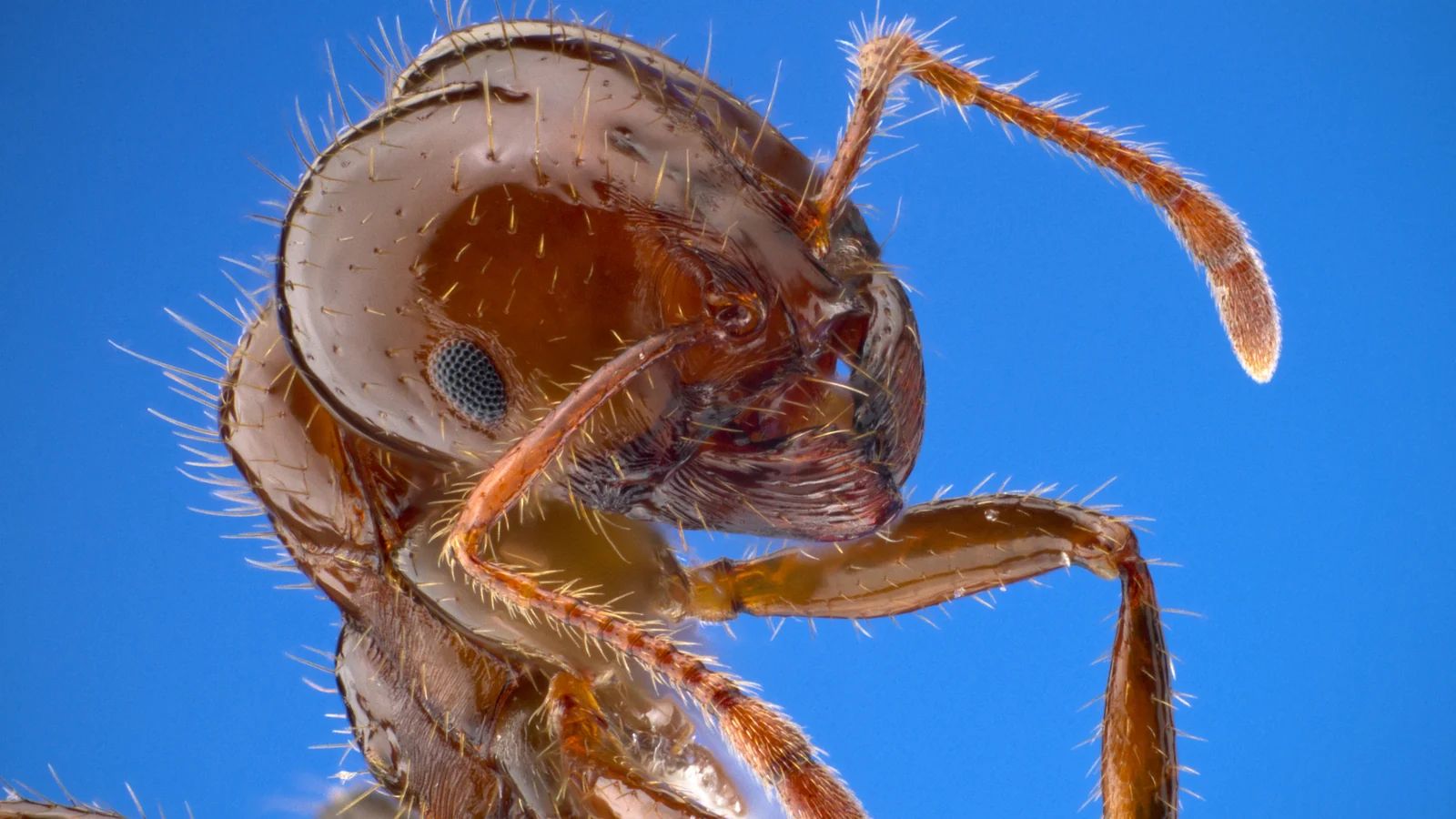
Not every ant pile in a Mobile or Baldwin County yard is fire ants, and not every ant in the kitchen is harmless. Telling them apart matters, because fire ants sting, spread aggressively and need a different plan than the sugar ants trailing across your counter. Mobile has a long history with this pest: imported fire ants first reached the United States through the Port of Mobile in the early 1900s and spread across the Southeast from here. Here’s how to tell a fire ant from the other ants around a Gulf Coast home, and what actually works on each.
Not sure if those are fire ants?
Call, enter your 5-digit ZIP on the keypad, and get connected live with a local pest control company. Free to call, 24/7.
Fire ants: the at-a-glance ID
Imported fire ants in coastal Alabama are mostly red imported fire ants, with black imported fire ants and hybrids of the two also present in the state. You don’t need to know which one you have. These features cover all of them:
- Mixed sizes in one colony. Open a mound and you’ll see workers of many different sizes, from tiny to about a quarter inch, all reddish brown to dark brown. Most household ants have workers that are all about the same size.
- Mounds with no center hole. Fire ant mounds are loose, crumbly domes of soil with no single entrance on top. The ants come and go through tunnels underground. Mounds pop up overnight after a good rain and are most obvious in sunny lawns, along driveways and around the base of mailboxes and AC pads.
- They boil out and attack. Disturb a fire ant mound and dozens of ants pour out within seconds and run up whatever touched it.
- The sting. A fire ant grabs on with its jaws and stings repeatedly. The burning fades, and within about a day a small white pustule forms at each sting. That pustule is the tell-tale sign.
The other ants Gulf Coast homeowners confuse with fire ants
Bigheaded ants
Small brown ants that leave loose lines of soil along sidewalk edges, slab edges and pavers. They’re often mistaken for fire ants or even termites. The giveaway is two distinct worker sizes, including a few “majors” with oversized heads. They bite but don’t sting.
Argentine ants
Small, light-to-dark brown ants that form thick, busy trails, often along the outside of the house and into the kitchen. They nest in mulch and under debris rather than building mounds and are common in older Mobile neighborhoods.
Ghost ants and odorous house ants
Ghost ants are tiny, with a dark head and a pale, almost see-through body, and they turn up at sinks and bathroom counters. Odorous house ants are small, dark brown and give off a rotten-coconut smell when crushed. Both are nuisance ants that trail to sweets and moisture.
Carpenter ants
Large black or red-and-black ants, usually seen at night. They don’t build soil mounds; they nest in damp or damaged wood. Seeing them inside, especially with piles of fine sawdust, points to a moisture problem worth checking. Our ant control in Mobile page covers these indoor species in more detail.
Fire ant mounds near the kids’ play area or the AC unit?
Tap to reach the free 24/7 referral line. One free call connects you with a local pest control company in Mobile or Baldwin County who inspects and quotes the job.
Why fall is the right time to deal with fire ants
October and November are a smart window for fire ant control around Mobile and Baldwin County. Ants are still foraging in the mild weather, colonies are actively feeding brood, and baits applied now cut down the number of mounds that come roaring back in spring. Extension programs across the Southeast point to fall as one of the most effective times to bait because the colonies that survive are weakened heading into winter.
Ant pile in the yard you’re unsure about?
Call, enter your 5-digit ZIP on the keypad, and get connected live with a local pest control company. Free to call, 24/7.
What works on fire ants (and what doesn’t)
The approach Extension entomologists recommend for lawns is often called the two-step method:
- Broadcast a fire ant bait over the whole yard when ants are actively foraging. A simple test: drop a potato chip or a bit of something oily near a mound. If ants are all over it in under half an hour, they’re foraging. Put bait out on dry grass with no rain expected for a day, and it has to be fresh, since ants ignore old, rancid bait.
- Treat individual problem mounds about a week or so later, especially mounds near play areas, doorways, pet runs and AC units.
Things that usually don’t work: pouring gasoline or bleach on mounds (dangerous and bad for the soil), kicking mounds apart (the colony just moves a few feet), and treating only the mounds you see while new colonies keep moving in from the neighbor’s yard. After heavy rain and flooding, fire ants can also float out in living rafts; the guide to fire ant rafts after flooding explains how to handle that safely.
What works on the other ants
Most indoor and trailing ants are managed differently. Spraying a trail of Argentine ants or ghost ants with a repellent spray often splits the colony and makes things worse. Slow-acting baits placed along trails, plus sealing gaps and fixing leaks, are the usual approach. Bigheaded ants often prefer protein or oily baits over sweet ones, so fitting the bait to the ant matters.
When to call a local pest control company
A local pest control company is worth it if fire ants keep coming back after you’ve baited, if you have mounds near where kids play or near someone allergic to stings, if ants are getting into electrical boxes, pumps or AC units, or if you can’t tell which ant you have. A local pest control company can identify the species, set up a yard program using professional baits and residual products, and treat sensitive spots like utility boxes properly. Ask whether the service covers new mounds between visits.
For fire ant service specifically, see fire ant control in Mobile.
Check the company before treatment starts
In Alabama, companies that do structural pest control, including household pest, termite and fumigation work, must hold a Professional Services license from the Alabama Department of Agriculture and Industries (ADAI). Ask for the company’s license and the name of its certified operator, and check with the ADAI Professional Services program before work starts.
Get the treatment plan, the products to be used, any follow-up visits and the price in writing. For termite work, ask what the contract covers, whether it’s retreatment only or includes repair of damage, and how long it lasts.
How the call works
- Call (888) 295-0220. Any time, day or night.
- Enter your 5-digit ZIP code on your phone’s keypad when prompted.
- Get connected live with a local pest control company that serves your ZIP. Describe what happened and ask when they can come out and what the job will cost.
Frequently asked questions
How can I tell if an ant is a fire ant?
Fire ant colonies have workers of many different sizes, their mounds are loose domes of soil with no entrance hole on top, and the ants swarm out and sting in force when the mound is disturbed. A fire ant sting usually forms a small white pustule within about a day.
Are there ants in Mobile that look like fire ants but are not?
Yes. Bigheaded ants leave lines of loose soil along sidewalks and slab edges and are often mistaken for fire ants. They have two distinct worker sizes, including some with oversized heads, and they bite but do not sting.
Is fall a good time to treat fire ants in Alabama?
Yes. Fire ants keep foraging in mild fall weather, and baits applied in the fall reduce the number of colonies that come back strong in spring. Bait should go down on dry grass when ants are actively feeding.
Do home remedies like bleach or gasoline kill fire ants?
They are not recommended. Gasoline and bleach are dangerous and damage soil, and disturbing a mound often just makes the colony move a few feet. A bait-based approach is more effective.
Not sure which ant you have?
Call to get connected with a local pest control company who can identify it and set up the right plan. No cost to call, 24/7.
Mobile Alabama Exterminators is a free referral line connecting Mobile and Baldwin County households with independent pest control operators. We are not a pest control company; calls are connected with local pest control companies that perform the inspections and treatments.
Mobile Alabama Exterminators is a free referral line that connects callers with independent local pest control companies. We don’t perform the work. The company you’re connected with gives the quote, does the work and stands behind it.