Ant control in Mobile, AL — for the ants that aren’t fire ants.
Trails across the counter, a faint rotten-coconut smell when you wipe one up, ants pouring out of a wall outlet after a heavy rain — Mobile’s humidity keeps odorous house ants, Argentine ants, and ghost ants moving indoors all year. This free 24/7 dispatch line connects you with an independent, ADAI-licensed pest control operator who treats the colony, not just the trail. They inspect, they quote, they treat. You decide.
Free to check coverage. ADAI-licensed operators serving Mobile & Baldwin County, AL.
Free call, free match — the operator gives the quote. Availability varies by schedule.
Check your ZIP first
Enter your Mobile-area ZIP to confirm coverage, then get connected.
Free to use · No obligation to hire anyone
24/7 dispatch line — real people answer
Free call — the operator gives the quote
Mobile & Baldwin County coverage
Quick answer: If you’re seeing ant trails inside your Mobile-area home but no mounds outside, you’re likely dealing with odorous house ants, Argentine ants, or ghost ants — not fire ants. This free 24/7 line matches you with an independent, ADAI-licensed pest control operator who inspects, identifies the species, and treats the colony at its source. There’s no cost to get matched, and no obligation to hire the operator who responds.
What’s the difference between ant control and fire ant control in Mobile, AL?
Mobile homeowners searching for ant help are usually dealing with one of two very different problems. Fire ants build visible mounds in the yard and sting — that’s its own page, with its own protocol. The ants covered here are the ones that never build a mound you can see: they nest in wall voids, under slabs, inside landscape timbers, and in the mulch bed against your foundation, then send scouts inside looking for sugar, grease, or standing water. No sting, no mound — just a trail that keeps coming back no matter how many times you wipe the counter.
Three species drive almost every general-ant call in this climate:
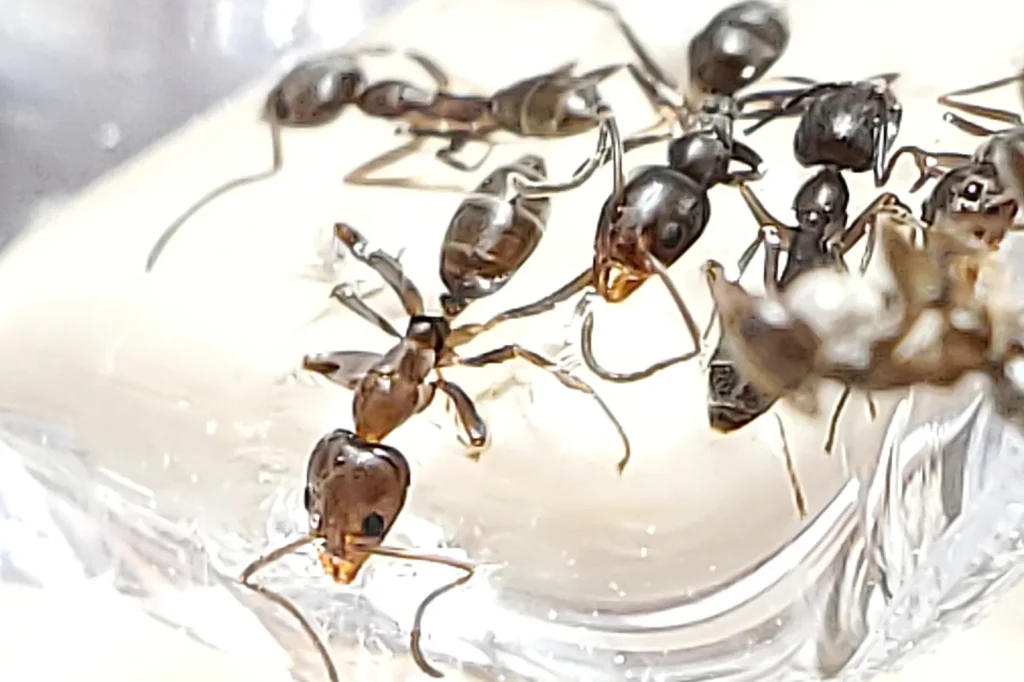
- Odorous house ants (Tapinoma sessile). Small, dark brown, and the single most common nuisance ant in Gulf Coast kitchens. Crush one and it gives off a smell many people describe as rotten coconut or blue cheese — a reliable field ID. Colonies bud into satellite nests when disturbed, which is exactly why a can of store-bought spray often makes an infestation worse instead of better.
- Argentine ants. Pale to dark brown, fast-moving, and capable of forming supercolonies that stretch across several properties with no real territorial fighting between nests. Heavy rain floods their shallow outdoor nests and pushes thousands of workers indoors in a single afternoon — a pattern Mobile’s summer thunderstorm cycle repeats all season.
- Ghost ants. Tiny, with a dark head and pale, almost translucent legs and abdomen that make them hard to spot until there are dozens on a countertop. Common in homes with mulch beds, potted plants, or irrigation lines near the foundation — all standard in Mobile landscaping.
According to the University of Florida IFAS Featured Creatures series, Argentine ant colonies often show little to no aggression between neighboring nests, letting them merge into sprawling supercolonies that can stretch across multiple properties — one reason a single treatment aimed only at the trail you can see rarely solves the problem for long. (Source: UF/IFAS Featured Creatures, Argentine Ant)
Carpenter ants are a fourth possibility — larger, and a structural concern rather than just a nuisance — and they have their own dedicated page linked below, since the inspection and treatment approach differs.
Seeing a trail right now? Don’t spray it. Disturbing a foraging trail scatters the colony and can trigger budding, which turns one nest into three. Note where the trail enters the room and where it seems to be heading, then get connected below — the operator treats the colony at the source, not just the ants you can see.
How does the ant control dispatch line work in Mobile, AL?
Total transparency: we answer phones and match. Licensed operators do the work.
You reach out, we listen
Tell us your address and where you’re seeing the trail — kitchen, bathroom, along a baseboard. It takes about a minute, no cost, no obligation.
We match you locally
Mobile Alabama Exterminators is a dispatch and referral service, not a pest control company. Your call routes to an independent operator licensed by the Alabama Department of Agriculture & Industries who covers your neighborhood.
The operator takes over
The licensed operator inspects the property, identifies the species, and gives you their own quote. Hiring them is entirely your call — verify their ADAI license first through the Alabama Department of Agriculture & Industries’ Pesticide Management Section.
What does a thorough ant inspection include?
Species identification first, treatment second — not the other way around.
Kitchen & bath moisture points
Under sinks, around the dishwasher, behind the refrigerator, and at any water heater pan — the indoor water sources that pull ants inside during dry stretches between rains.
Foundation & mulch beds
The mulch-to-siding gap, landscape timbers, and irrigation boxes where Argentine and ghost ant colonies actually live, usually a few feet from the door they’re using to get in.
Trail mapping, not spot-spraying
A real inspection follows the trail back to the entry point and, where possible, toward the nest — because treating the trail alone just relocates the problem a few feet.
The Mobile ant calendar
What tends to trigger ant activity indoors, month by month.
| Season | What drives ant activity in Mobile homes |
|---|---|
| Feb–Apr | Warming soil wakes overwintering colonies; early scouts test kitchens and bathrooms for food and water before outdoor forage picks up. |
| May–Aug | Peak season — Gulf thunderstorms flood shallow Argentine ant nests and push large numbers indoors in a single afternoon; odorous house ants trail heavily in kitchens. |
| Sep–Oct | Dry spells between storms send ants hunting indoor moisture; ghost ants show up around potted plants and irrigation boxes. |
| Nov–Jan | Activity slows but rarely stops in Mobile’s mild winters; established colonies stay active in wall voids and under slabs on warmer days. |
Five questions to ask the operator
- “Which ant species is this?” Odorous house, Argentine, ghost, and carpenter ants each need a different plan. If the answer is vague, ask again.
- “What’s your ADAI license number?” Every legitimate Alabama operator has one, and the Alabama Department of Agriculture & Industries’ Pesticide Management Section in Montgomery can confirm it.
- “Bait or spray, and why?” Baiting lets workers carry the treatment back to the colony — usually the better call for budding species like odorous house ants. Ask why the operator picked their method for your situation.
- “Did you find the nest, or just the trail?” A quote based only on the ants you can see is a partial answer.
- “What changes outside will keep them from coming back?” Mulch depth, irrigation timing, and gutter drainage all affect how fast a treated colony gets replaced by the next one.
The same free dispatch line also matches Mobile-area homeowners with licensed operators for Formosan and subterranean termite swarms, roof rat and mouse intrusions, and German and American cockroach infestations — all through the same ZIP-based match.
Ant control in Mobile — common questions
Are you a pest control company?
No — Mobile Alabama Exterminators is a free dispatch and referral service. We connect Mobile and Baldwin County homeowners with independent, ADAI-licensed operators who perform every inspection and treatment.
How is this different from your fire ant page?
Fire ants build visible outdoor mounds and sting; this page covers the ants that invade indoors without stinging — odorous house ants, Argentine ants, and ghost ants. If you’re dealing with mounds in the yard, our fire ant control page is the better starting point.
Why do store-bought sprays make my ant problem worse?
Contact sprays kill the workers you can see but can trigger budding in species like odorous house ants, splitting one colony into several. A licensed operator uses methods that reach the colony instead of scattering it.
How much does ant control cost in Mobile?
Pricing is set by the independent operator after inspection and depends on the species, the property, and the scope. The call and the match are free.
Are these ants dangerous?
Odorous house, Argentine, and ghost ants don’t sting or bite and aren’t a health risk — they’re a persistent nuisance and, in large numbers, a contamination concern around food prep areas.
What if it turns out to be carpenter ants instead?
Carpenter ants are larger, tunnel into wood, and warrant a different inspection focused on moisture-damaged framing. The operator will identify the species on-site and route you to the right protocol; see our dedicated carpenter ant page as well.
Do the operators serve my neighborhood?
One call reaches a licensed, local exterminator who covers your address — and a real person answers, 24/7.
Trail keeps coming back? Get the colony, not just the ants.
Free to get matched, no obligation to hire. The licensed operator inspects and gives the quote.
Free to check coverage. ADAI-licensed operators serving Mobile & Baldwin County, AL.
Prefer to send details first? Use the contact form →