
Scratching in the attic? Mobile is a roof rat city — get it handled right.
Noises overhead at night, droppings in the pantry, chewed wiring in the attic — call the free 24/7 referral line, enter your ZIP, and get connected live with an independent local rodent control company that works Mobile and Baldwin County. They inspect, seal, trap, and quote. You decide.
Hearing scratching in the attic at night?
Call, enter your 5-digit ZIP on the keypad, and get connected live with a local pest control company. Free to call, 24/7.
Roof rat or Norway rat — which one is over your head?
Rodent control starts with knowing which rodent — because the two rats take opposite strategies, and the mouse is a third conversation entirely.
Short answer: In Mobile, ceiling noise and coastal live-oak canopy point to roof rats; ground-level burrowing near slabs and sheds points to Norway rats; pencil-width gaps and kitchen activity point to house mice. Call the referral line and the pest control company you’re connected with inspects, confirms the species from droppings and gnaw marks, seals entry points, and traps — exclusion first, not just bait boxes.
According to the University of Florida IFAS Extension, roof rats (Rattus rattus) are the dominant rat species in Gulf Coast port cities and favor elevated travel paths — power lines, fence tops, and tree canopy — while Norway rats (Rattus norvegicus) stay closer to ground level and burrow near foundations and debris piles. Mobile’s live-oak canopy and port traffic make it a textbook roof rat environment. (Source: UF/IFAS Extension.)
Roof rat — Mobile’s signature rodent
Sleek, agile climbers that travel oak limbs, fence tops, and utility lines into the roofline. Mobile’s live-oak canopy plus the port’s grain traffic make this a roof rat town.
- Noise: light scurrying overhead at night
- Droppings: spindle-shaped, pointed ends
- Entry: rooflines, soffit returns, attic vents
Norway rat — the burrower
Heavier-bodied and ground-oriented — burrows under slabs, sheds, and debris piles, working low entries like crawlspace vents and garage-door gaps.
- Noise: low in walls, crawlspace activity
- Droppings: capsule-shaped, blunt ends
- Entry: foundation gaps, drains, low vents
House mouse — the space heater tenant
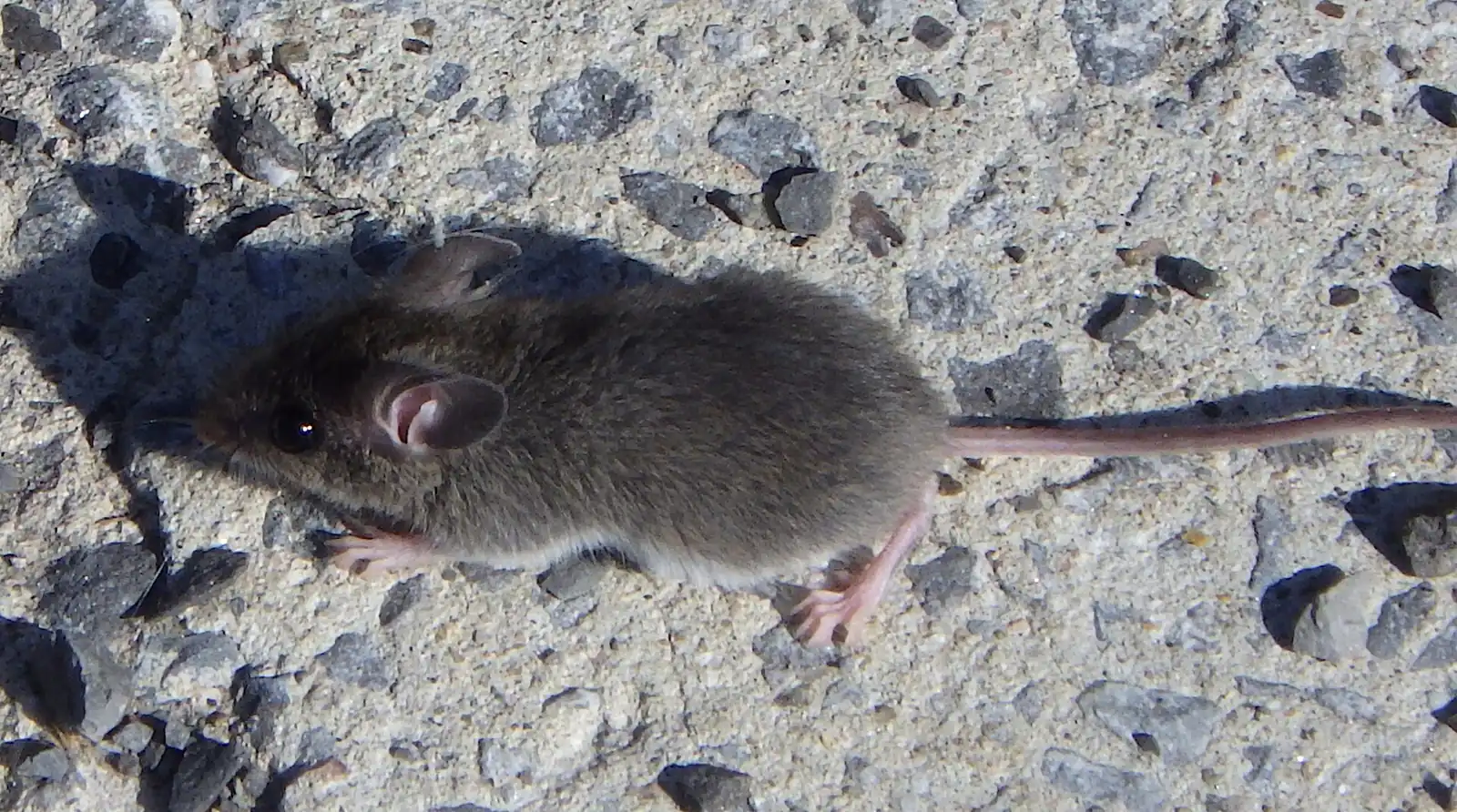
Needs a gap about the width of a pencil. Lives inside walls near warmth and crumbs, breeds year-round, and makes up the bulk of cool-season kitchen calls.
- Noise: faint scratching in walls, cabinets
- Droppings: rice-grain size, scattered
- Entry: pipe penetrations, door sweeps
Tell the company what you’re hearing and where. “Scurrying over the ceiling at 2 AM” points to a different job than “droppings under the kitchen sink” — the operator shows up with the right traps, sealants, and ladder work planned instead of a second trip.
What does real rodent control work look like in Mobile?
Bait boxes alone are a subscription, not a solution. Here’s the integrated approach the good operators run.
- Full-perimeter inspection. Roofline, soffit returns, gable vents, AC chases, crawlspace vents, garage-door sweeps, and the oak limbs touching the roof. On Midtown and Old Dauphin Way pier-and-beam homes, under the house is half the story.
- Exclusion — sealing the entries. Hardware cloth over vents, metal flashing at gnawed corners, copper mesh in pipe gaps, door sweeps. This is the step that actually ends the problem; everything else manages it.
- Knock-down trapping. Snap traps or multi-catch stations placed on runways (rub marks and droppings mark them), checked and re-set on a defined schedule — ask what the follow-up cadence is.
- Exterior baiting where appropriate. Locked, anchored stations placed by a local pest control company, with product choices and placement that account for kids, pets, and Mobile’s owls and hawks. Ask the operator about secondary-exposure precautions — a good one has a ready answer.
- Sanitation & habitat notes. Pet food storage, pine straw against the slab, wood piles, and limb trimming — the homeowner homework that keeps the fix permanent.
If a proposal is just “we’ll drop some bait boxes and see you next quarter,” you’re allowed to ask where the exclusion work is — or to get a second opinion. The quote is the operator’s; the decision is yours.
Droppings in the pantry or cabinets?
Call, enter your 5-digit ZIP on the keypad, and get connected live with a local pest control company. Free to call, 24/7.
When and why does rodent pressure spike in Mobile, AL?
| Window | What’s happening in Mobile & Baldwin County |
|---|---|
| Oct–Dec | The big move-in: first cool nights push roof rats off the canopy and into attics. Attic-noise calls climb sharply after the first real front. |
| Jan–Mar | Indoor populations peak — established nests, active gnawing (wiring damage risk), mice deep in wall voids near kitchens and water heaters. |
| Apr–Jun | Breeding season outdoors; burrow activity around sheds and slabs. Exclusion work done now pays off before fall. |
| Jul–Sep | Hurricane season — storm-damaged soffits, lifted flashing, and debris piles open new entries. Post-storm inspections catch them before October’s move-in. |
Five questions to ask the rodent operator
- “Which species did you confirm, and from what evidence?” Droppings shape, gnaw marks, and runway height tell roof rat from Norway rat from mouse — and the plan follows the species.
- “What entry points did you find, and what gets sealed?” Ask for the list — photos ideally. Exclusion is the fix; if it’s missing from the proposal, ask why.
- “What’s the follow-up cadence?” Trapping without scheduled re-checks strands dead rodents in walls and lets survivors re-breed. Get the visit schedule in writing.
- “What’s your ADAI license number?” Verify it on ADAI’s Structural Pest Control Section website before work begins — a legitimate operator expects the question.
- “How are bait stations secured, and what about pets and wildlife?” Locked, anchored, labeled stations and a clear answer on secondary exposure separate pros from bait-scatterers.
Not sure it’s rats? Daytime thumping and chewed fascia usually means squirrels in the attic, heavy walking at night can be raccoons, a sudden smell in a wall after baiting is a dead animal removal job, and holes dug along the slab point to armadillos. See also wildlife removal in Mobile.
Check the company before treatment starts
In Alabama, companies that do structural pest control, including household pest, termite and fumigation work, must hold a Professional Services license from the Alabama Department of Agriculture and Industries (ADAI). Ask for the company’s license and the name of its certified operator, and check with the ADAI Professional Services program before work starts.
Get the treatment plan, the products to be used, any follow-up visits and the price in writing. For termite work, ask what the contract covers, whether it’s retreatment only or includes repair of damage, and how long it lasts.
How the call works
- Call (888) 295-0220. Any time, day or night.
- Enter your 5-digit ZIP code on your phone’s keypad when prompted.
- Get connected live with a local pest control company that serves your ZIP. Describe what happened and ask when they can come out and what the job will cost.
Rodent control in Mobile — common questions
Are you a rodent control company?
No — Mobile Alabama Exterminators is a free referral line. We connect you with independent operators in Mobile and Baldwin County who perform the inspections, exclusion, trapping, and treatments. Verify any operator’s license with ADAI before hiring — we encourage it.
How much does rodent control cost in Mobile?
It depends on species, entry points, and how much exclusion work the structure needs — and the price is set by the independent operator after inspecting, not by us. The call is free; the operator’s quote comes before any work, and comparing quotes is reasonable.
I hear scratching at night — rats or mice?
Rhythmic scurrying across the ceiling after dark leans roof rat, faint scratching inside a kitchen or bathroom wall leans mouse, and low thumping or crawlspace noise leans Norway rat. The operator confirms with droppings, rub marks, and gnaw evidence — leave those in place.
Can I just put out poison myself?
Store-bought rodenticide often kills rodents inside your walls (the smell lasts weeks) and poses secondary risks to pets and raptors. Professional operators use locked stations, placement rules, and — more importantly — exclusion, which ends the problem instead of cycling it.
Do the operators handle attic cleanup after rodents?
Many do — droppings removal, contaminated insulation, and sanitizing are commonly offered alongside exclusion. Ask the company you’re connected with whether it offers it, and ask for it as a line item on the quote.
When can someone come out?
The referral line is open 24/7, and appointment timing is set by the independent operator — availability varies, and the operator confirms scheduling directly with you. Calendars fill up in fall move-in season, so calling at the first noise helps.
Mobile Alabama Exterminators is a free referral line that connects callers with independent local pest control companies. We don’t perform the work. The company you’re connected with gives the quote, does the work and stands behind it.