✅ Network of ADAI WDC-Licensed Operators • 🛡️ Bonded & Insured Operators • ⚡ fast-dispatch routing • 🔍 no-obligation inspection routing
If you find a bug in your Mobile-area house, the first question most homeowners ask is whether they can handle it themselves. Here is a Mobile-specific framework for deciding.
The general rule
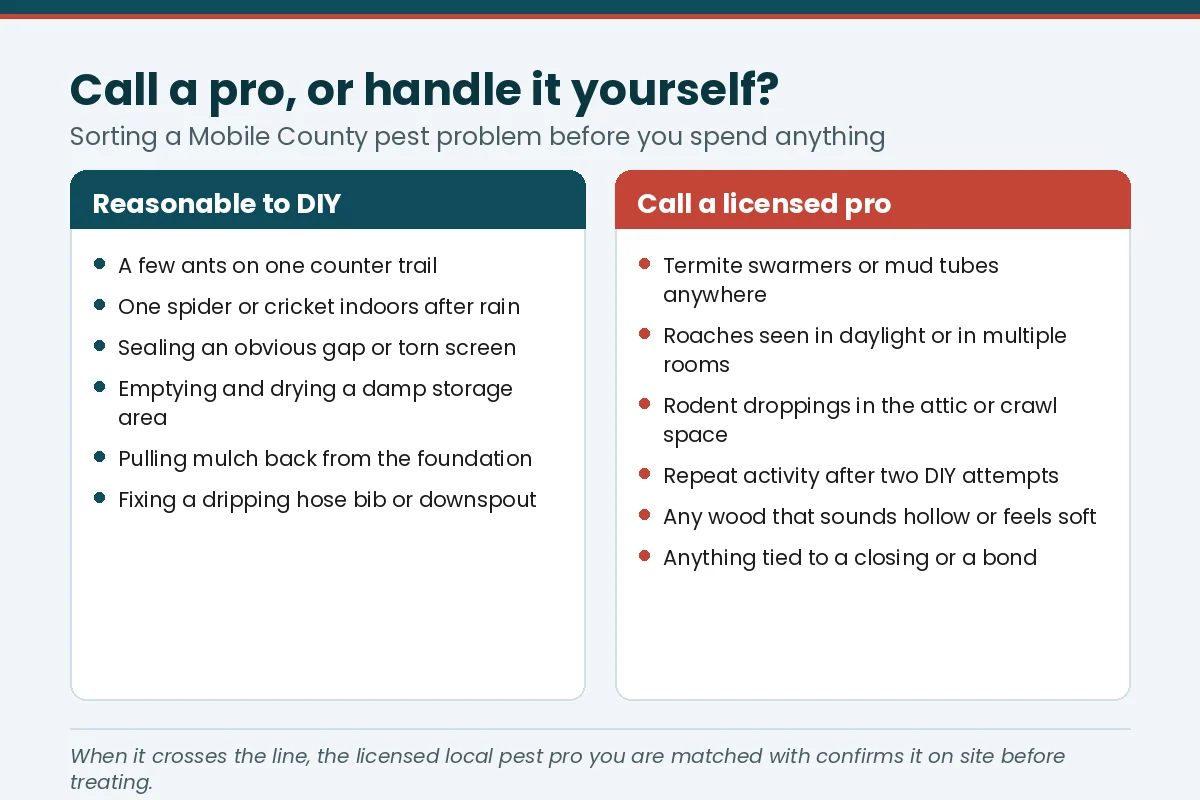
DIY is reasonable for identified, small-population, surface-active pests where treatment failure is not a structural or health risk. Professional treatment is appropriate for wood-destroying organi, fumigation-level infestations, anything where the species is uncertain, anything inside a wall cavity, and anything that is biting people.
Ants on the counter
Probably DIY for sugar ants and odorous house ants. Place a bait gel, wait 48 hours, deep-clean the trail. The exception: Tawny Crazy Ant (supercolonies, doesn’t respond to consumer baits) and fire ant in yards with pets or kids.
Cockroaches in the kitchen
Palmetto bug at night through an open door: DIY mop-up after finding and sealing the entry. German cockroach in cabinetry: call a pro. By the time you see one in daylight, the population is already a few hundred. Our American cockroach (palmetto bug) species guide covers identification and moisture-source diagnosis in more depth if you’re not sure which one you’re looking at.
Rodents in the attic or walls
Rarely a clean DIY project in Mobile and Baldwin County. Consumer snap traps can knock down a light roof rat population if you catch it early and the entry points are already sealed, but that second part is the catch: store-bought traps placed without closing off the actual entry route just remove a few individuals while more move in behind them. Norway rats burrowing against a foundation are an even worse DIY candidate, since collapsing or baiting an active burrow incorrectly can drive the colony toward the house instead of away from it. If you’re hearing scratching in the attic at night, seeing grease trails along baseboards, or finding gnawed pet-food bags, it’s worth comparing what you’re seeing against our rodent control Mobile guide before deciding whether to handle it yourself or request an inspection.
Suspected termites
Always professional. There is no recreational DIY for wood-destroying organi. ADAI’s WDC license category is required to perform termite treatment, write a bond, or issue the official Alabama Wood Infestation Inspection Report — the same document a WDO inspection at closing produces for a home sale. Photograph evidence, leave it undisturbed, call. For the seasonal timing of swarmer activity on the Gulf Coast, see our Alabama termite swarming season guide, and for the cost-vs-risk math on annual contracts, see is a termite bond worth it in Mobile, AL. If you want the fuller picture on why Formosan termites specifically tip so many borderline cases toward ‘call a pro,’ see our Mobile Formosan termite explainer.
Bed bugs
Almost always professional. The narrow exception: a single recently-arrived bed bug confirmed on travel luggage. In every other scenario — visible evidence on furniture, repeated bite pattern, infestation in a rental — professional treatment is the right call.
What should you ask when you call?
What license category covers my species? Is the on-site technician the same license-holder as quoted? What is the reentry interval after treatment? An operator who hesitates on any of these is one to keep calling past. Before you even get that far, it is worth confirming the company’s ADAI license number is active — our ADAI license verification guide walks through the 90-second lookup, and see the ADAI license categories explained for the underlying framework.