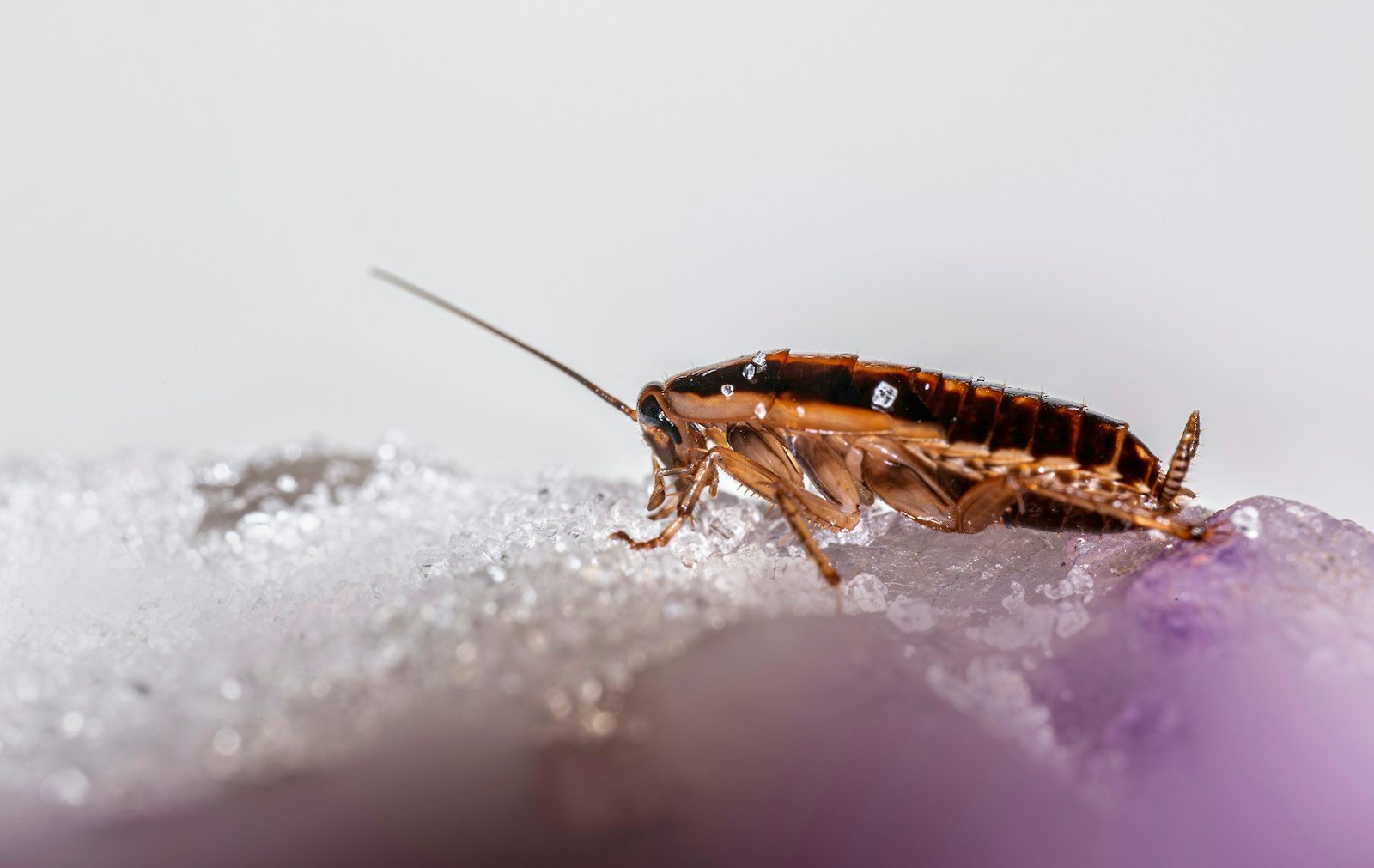
The palmetto bug — Mobile’s big humid-night visitor.
One call reaches a licensed, local exterminator who covers your address — and a real person answers, 24/7.
Free to check coverage — the operator gives the quote after inspecting.
Check your ZIP first
One call reaches a licensed, local exterminator who covers your address — and a real person answers, 24/7.
Free to use · No obligation to hire anyone
Identification — big, reddish, and marked with a figure-8
Scientific name: Periplaneta americana. Also called: palmetto bug, water bug. Family: Blattidae. Status in Mobile-Baldwin: ubiquitous, primarily outdoors, with heavy indoor activity in humid months and after weather events.
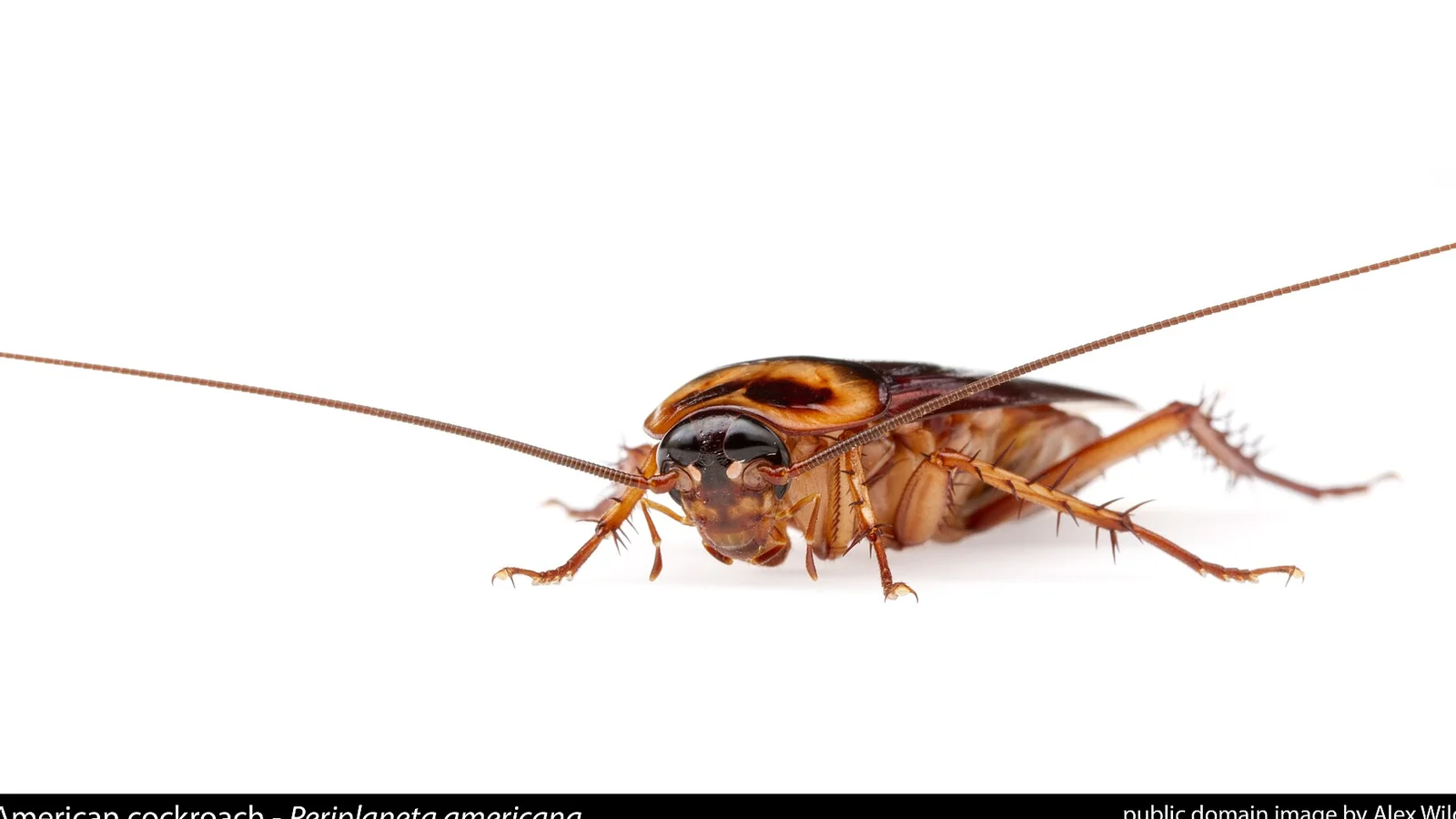
Adults are the giants of the Gulf Coast roach world — 1.5 to 2 inches, reddish-brown, with a pale yellow figure-8 marking on the pronotum (the plate behind the head). Both sexes have full wings and can glide short distances, which is why one turns up at the porch light or sails across the garage on a warm evening. Nymphs are wingless and darken with each molt. Egg cases are dark brown, about 8 mm, holding 14–16 eggs.
The size and the figure-8 are the quick tell that separates the palmetto bug from the small, two-striped German cockroach — a distinction that matters, because the two species live in completely different places and call for completely different treatment. If you’re not sure which one you’re looking at, the three-way Gulf Coast roach ID guide lines them up side by side.
Why palmetto bugs push indoors in Mobile
The single most useful fact about the American cockroach on the Gulf Coast: it’s fundamentally an outdoor insect. It lives in the wet, dark, organic-rich places Mobile has in abundance — leaf litter, mulch beds, the base of palm fronds (hence “palmetto bug”), sewers and storm drains, tree hollows, and woodpiles. When it appears indoors, it’s usually a commuter, not a resident, and that changes the entire treatment logic away from “bomb the kitchen” and toward exclusion and perimeter.
Indoors, they gravitate to the same moisture: kitchens with a persistent leak, basements, crawlspaces, plumbing chases, bathroom voids, and the warm damp under refrigerators and dishwashers. But the entry points are the real story — they come through floor drains, under garage doors, around plumbing and utility penetrations, through weep holes and torn door sweeps, and up sewer lines. Seal the commute and you solve most of the problem.
Coastal humidity and the long warm season concentrate populations here well beyond what homes farther north deal with. A Mobile yard with heavy mulch, a palm cluster, and a storm drain at the curb is running a palmetto bug reservoir whether anyone treats indoors or not — which is why the operator’s attention outdoors matters as much as anything they do inside.
Sudden flood of big roaches after a storm? That’s displacement, not filth.
One call reaches a licensed, local exterminator who covers your address — and a real person answers, 24/7.
Free to check coverage. ADAI-licensed operators serving Mobile & Baldwin County, AL.
What a licensed operator does about palmetto bugs
Educational only — the independent operator recommends and performs the treatment, and every property is different.
Close the commute
Exclusion first: door sweeps, garage-door seals, weep-hole screens, sealing plumbing and utility penetrations, and covering or treating floor drains. This is where palmetto bug jobs are actually won.
Treat the perimeter and the harborage
A perimeter band plus targeted work in the outdoor reservoirs — mulch edges, the palm bases, the woodpile, the drain zone — with granular baits and residual product where the population actually lives.
Fix the moisture story
The operator flags what’s feeding the humidity: gutters dumping at the foundation, a crawlspace that needs ventilation, mulch piled against the siding, the leak under the sink. Reducing moisture shrinks the reservoir.
Because palmetto bugs are an outdoor species, many Mobile households fold them into a quarterly exterior program rather than chasing one-off sightings — the perimeter stays defended through the humid months when pressure peaks. That’s a conversation to have with the operator based on your lot.
The palmetto bug year in Mobile
Pressure tracks the humidity curve — so you can describe the timing accurately when you reach out.
| Season | What palmetto bugs are doing around Mobile |
|---|---|
| Mar–May | Activity builds with warming soil and rising humidity; outdoor populations grow in mulch, drains, and palm bases; first indoor sightings on warm evenings. |
| Jun–Sep | Peak season. Hottest, most humid stretch drives the most flying activity and the heaviest push-in through open doors and garage gaps; storm displacement spikes follow heavy rain. |
| Sep–Nov | Hurricane-season flooding and sewer backup produce sharp displacement events; populations stay elevated into early fall while the weather holds warm. |
| Dec–Feb | Outdoor activity drops sharply below ~45°F, but indoor populations already established in a warm, moist harborage — a slab leak, a poorly ventilated crawlspace — can persist through winter largely undisturbed. |
Free to check coverage. ADAI-licensed operators serving Mobile & Baldwin County, AL.
What should you ask the operator?
You’ll get a better outcome — and a fairer quote — if you ask these on the first visit.
- “Are these coming from outside or breeding inside?” For palmetto bugs the answer is almost always outside — an operator who wants to fog the kitchen without walking the perimeter is solving the wrong problem.
- “What are my entry points?” Ask them to name the specific gaps — door sweeps, weep holes, floor drains, utility penetrations. Exclusion is the durable fix; product alone is a refill subscription.
- “What outdoor harborage did you find?” Mulch against the siding, the palm cluster, the woodpile, the storm drain at the curb. If the plan ignores the yard, the reservoir refills after every treatment.
- “What’s your ADAI license number?” Every legitimate Alabama operator has one, and the Alabama Department of Agriculture & Industries’ Pesticide Management Section — (334) 240-7240 in Montgomery — can confirm it. Pros answer without blinking.
- “Should this be a quarterly exterior program?” On a humid, heavily mulched Mobile lot, ongoing perimeter defense usually beats one-off treatments. Get what’s included and the re-service terms in writing.
Palmetto bugs — what do homeowners ask?
Are you a pest control company?
No — Mobile Alabama Exterminators is a free dispatch and referral service. We connect Mobile and Baldwin County callers with independent pest control operators licensed by the Alabama Department of Agriculture & Industries. Every inspection and every treatment is performed by the operator, never by us — and we suggest verifying any operator’s license with ADAI before you hire.
Is a palmetto bug the same as a cockroach?
Yes — “palmetto bug” is the Southern nickname for the American cockroach (and sometimes the smokybrown). It’s the big reddish-brown roach that lives outdoors in palm bases, mulch, and drains, as opposed to the small German cockroach that breeds indoors in kitchens.
Does seeing palmetto bugs mean my house is dirty?
No — they’re primarily outdoor insects that wander in through gaps or get displaced indoors by storms. A spotless home in a humid, mulched Mobile neighborhood still sees them. The fix is exclusion and perimeter management, not just cleaning.
Why do they show up in the bathroom and shower?
Moisture and access. They follow humidity and often enter through floor drains, overflow pipes, and gaps around plumbing. A palmetto bug in the tub usually came up or in through the drain or a nearby void chasing water.
How much does palmetto bug treatment cost in Mobile?
Pricing is set by the independent operator after inspecting — lot size, harborage, exclusion needs, and whether it becomes a quarterly program all move the number. The match is free, and the operator’s quote comes before any work.
Why do I get a wave of them after a hurricane or heavy rain?
Flooding and sewer backup displace large outdoor populations toward higher, drier ground — often your garage or ground floor — in the 24 to 72 hours after the storm. It’s a temporary displacement event; exclusion plus a perimeter reset is the durable response.
Big roach, humid night — start with your ZIP.
Free to check coverage, free to get matched, no obligation. The licensed operator inspects and gives the quote.
Free to check coverage. ADAI-licensed operators serving Mobile & Baldwin County, AL.
Prefer to send details first? Use the contact form →