If you just found small piles of what looks like sawdust along a baseboard, or a scatter of papery wings on the windowsill after a warm, humid evening, your gut is probably right to worry. Mobile sits in one of the heaviest Formosan termite pressure zones in the continental U.S., and between the native Eastern subterranean species and the Formosan population that’s established itself across the central Gulf Coast, most older homes here will deal with a termite question at some point — the only variable is how early you catch it.
Dealing with a pest problem right now?
📞 Call now — get matched with a licensed local exterminator: (888) 295-0220When you call, stay on the line for a few seconds while we match you with the licensed local exterminator for your area. Have your address and a quick description of the problem ready.
Licensed local pros · Fast response, subject to availability · No obligation
This isn’t a diagnosis guide that ends with you buying a spray can. It’s a quick reference for what to check today, what those signs typically mean in a Mobile-area home, and how to get a licensed local exterminator looking at it fast, before a swarm turns into structural repair work.
Which signs are worth checking this weekend?
None of these guarantee an active termite colony — only a licensed inspection can confirm that — but each one is common enough in Mobile and Baldwin County homes that it’s worth a closer look:
- Mud tubes. Pencil-width tunnels of dirt running up a slab foundation, pier, or exterior wall. Subterranean and Formosan termites build these to travel between soil and wood without drying out. Check the foundation perimeter, especially shaded or vine-covered sections.
- Discarded wings. A small drift of wings near a window, door, or porch light — often after a warm, humid night — can point to a termite swarm that just happened nearby or inside a wall void.
- Wood that sounds hollow or papery. Tap along baseboards, window sills, and porch posts. Termites eat wood from the inside out, so the surface can look normal while the structure underneath is compromised.
- Frass (drywood termite droppings). Tiny, pellet-like piles that resemble coarse sawdust or coffee grounds, usually below a small exit hole in trim or framing.
- Doors and windows that suddenly stick. Termite feeding can warp wood just enough to throw off a frame that used to close fine.
- Sagging floors or ceilings, or paint that looks bubbled. Usually a later-stage sign, sometimes confused with ordinary humidity damage — which is exactly why an inspection matters instead of guessing.
Any one of these is a reason to get a licensed exterminator’s eyes on the property. Multiple signs together move it from “keep an eye on it” to “get this looked at this week.”
Why Mobile homes see this so often
Two things stack up against Gulf Coast homeowners: climate and species mix. Mobile’s humidity and roughly 65-plus inches of annual rainfall keep soil moisture high year-round, which is exactly what subterranean termite colonies need to stay active. Native Eastern subterranean termites typically swarm late winter into spring, while Formosan termites — the more aggressive, faster-building species that dominates much of the local population — swarm on warm, humid evenings in May and June, often clustering around porch lights. A single mature Formosan colony can run into the hundreds of thousands of workers, which is part of why early detection carries so much more weight here than it does in drier inland climates. For a deeper look at how the local Formosan population compares to the native species, see our Formosan termite explainer and the county-level swarm data in our Gulf Coast termite pest-pressure reference.
What to do the moment you spot a sign
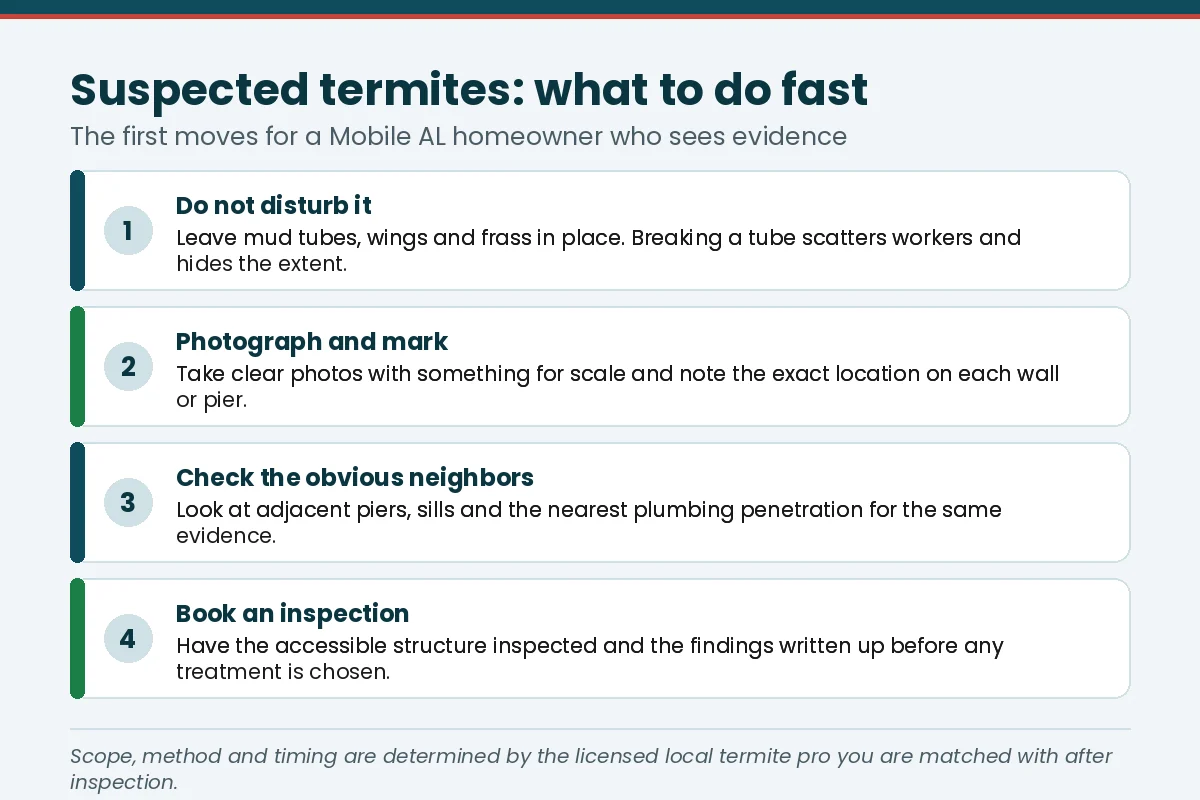
Don’t wait for a second sign to confirm the first one. Termite damage compounds quietly, and the earlier a licensed operator gets into the crawl space or along the slab, the smaller the fix tends to be. Take a few photos of what you found — the mud tube, the wing pile, the hollow-sounding trim — so you can describe it accurately when you reach out. Then get connected with a licensed local exterminator who can do a proper inspection instead of guessing from a photo.
One call reaches a licensed, local exterminator who covers your address — and a real person answers, 24/7.
Native subterranean vs. Formosan — why the distinction matters
Both species need contact with soil moisture and both build mud tubes, but a Formosan colony generally works faster and larger, which changes how a licensed operator approaches treatment — sometimes a liquid soil barrier, sometimes a bait system, sometimes both, depending on colony size and how the home is built. That’s a call for the inspecting operator to make once they’ve actually seen the property, not something to guess from a blog post. If you’re buying or selling a home in the area, this distinction also shows up on paperwork: Mobile and Baldwin County lenders commonly require a WDO (wood-destroying organism) report — commonly called a Section 1 letter — before closing, and it specifically calls out live or previous termite activity, including species when identifiable. Our WDO inspection guide covers what that report involves.
What a licensed inspection actually involves
A proper termite inspection isn’t a five-minute walk-around. A licensed, ADAI-regulated operator will typically check the foundation perimeter, crawl space or slab edges, attic framing where accessible, and any wood-to-ground contact points around the exterior — decks, fence lines, mulch beds pushed up against siding. They’re looking for live activity, past damage, and conducive conditions (moisture, wood contact, gaps) that could invite termites even if none are active yet. You can and should verify any operator’s ADAI license before work begins by calling the Pesticide Management Section in Montgomery at (334) 240-7240 — a legitimate Gulf Coast operator expects that question and won’t be bothered by it.
For the full picture on treatment options once an inspection confirms activity, our termite control guide breaks down what licensed Mobile-area operators typically recommend for subterranean and Formosan infestations.
what do homeowners ask?
I found wings but no bugs — does that still count?
Yes. A swarm event can be brief, and wings are often the only physical evidence left behind. It’s still worth getting a licensed inspection, especially if the wings showed up near a foundation wall or window frame.
Could this be flying ants instead of termites?
It’s possible — the two get confused constantly. Termite swarmers have straight antennae, two pairs of equal-length wings, and a thick waist; flying ants have bent antennae, unequal wing pairs, and a pinched waist. If you’re not sure, a photo and a licensed inspection settle it faster than trying to identify it yourself.
How fast can someone actually come look at it?
That depends on the operator’s schedule and your location — the dispatch line is available 24/7, but appointment timing is set by the independent operator, and availability isn’t guaranteed. The operator confirms scheduling directly with you once you’re connected.
One call reaches a licensed, local exterminator who covers your address — and a real person answers, 24/7.