Gulf Coast Termite Swarm & Pest-Pressure Data Reference (Mobile & Baldwin County)
A sourced reference on termite swarm timing and climate-driven pest pressure along the Alabama Gulf Coast: when native Eastern subterranean termites swarm versus invasive Formosan subterranean termites, why Mobile and Baldwin counties carry the heaviest Formosan pressure in the state, and how NOAA climate-normal humidity and rainfall patterns for Mobile track the seasonal swarm calendar. Every figure below comes from a public source — the Alabama Cooperative Extension System (ACES, Auburn University and Alabama A&M), and NOAA’s National Centers for Environmental Information — linked at the point of use so it can be independently checked.
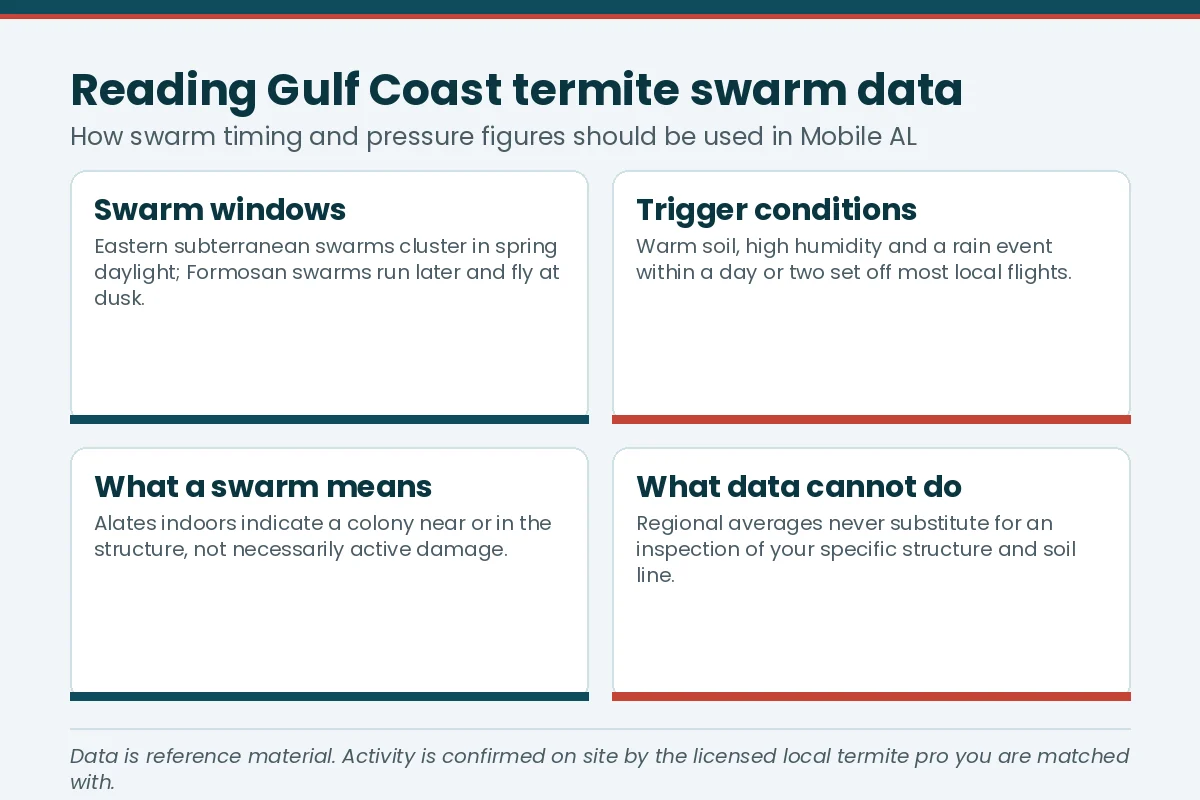
Gulf Coast Termite Swarm Calendar
| Species | Swarm window | Behavior | Source |
|---|---|---|---|
| Eastern subterranean termite (native) | February through May | Swarms during daylight hours, especially following rainfall. The most common early-spring swarm species across the Gulf Coast. | Alabama Cooperative Extension System (ACES) |
| Formosan subterranean termite (invasive) | Late May through June | Swarms at dusk on warm, humid evenings and is strongly attracted to porch lights and street lamps. The flight is brief — typically under an hour — before alates drop their wings, pair off, and search for a moist entry point. | Alabama Cooperative Extension System (ACES) |
Why Mobile & Baldwin County Carry the Heaviest Formosan Pressure
Formosan subterranean termites — widely regarded as the most destructive termite species established in the United States — are not evenly distributed across Alabama. Alabama Extension entomologist Dr. Xing Ping Hu has documented that they are “most prevalent in the hot and humid coastal counties such as Mobile and Baldwin,” though detections have spread further into central Alabama in recent years.
| Data point | Detail | Source |
|---|---|---|
| Formosan termite county distribution | Confirmed infestations in at least 12 Alabama counties, with the majority of activity concentrated in Mobile and Baldwin counties | Alabama Cooperative Extension System |
| Baldwin County Formosan Termite Watch Program (Fairhope, 2003) | Volunteers placed 109 sticky traps across the city; swarming Formosan termites were identified at 70% of the monitored sites | Alabama Cooperative Extension System |
| Monitoring network | Alabama Extension actively tracks the spread of Formosan termites statewide and asks pest control professionals to report new Formosan activity to county Extension offices or Auburn University entomology specialists | ACES – Termite Territory is Expanding in Alabama (Aug. 2021) |
Why this matters for a Mobile-area homeowner: if you see winged swarmers or discarded wings at dusk in late May or June, Extension’s county-level data says you’re in one of the two counties statewide with the highest documented Formosan pressure — worth describing accurately (time of day, month, presence of mud tubes) when you call so the operator who takes the call can bring the right inspection approach.
Climate Factors Driving Pest Pressure by Month (Mobile, AL)
| Measure | Value | Source |
|---|---|---|
| Average temperature, coldest month (January) | Approximately 51°F (10.6°C) | NOAA NCEI U.S. Climate Normals (1991–2020), Mobile Regional Airport station |
| Average temperature, warmest month (July) | Approximately 82°F (27.8°C) | NOAA NCEI U.S. Climate Normals |
| Average annual precipitation | Approximately 67.1 inches (1,705 mm) | NOAA NCEI U.S. Climate Normals |
| Highest average relative humidity | August, approximately 79.7% | NOAA NCEI U.S. Climate Normals |
| Lowest average relative humidity | October, approximately 67.8% | NOAA NCEI U.S. Climate Normals |
Termites need two things to thrive: sustained moisture and warmth. Mobile’s humid subtropical climate keeps both conditions favorable for most of the year, but the months with the highest average humidity (June through September) line up directly with the tail end of the swarm calendar and the period of heaviest colony foraging activity — a pattern Extension entomologists point to when explaining why Gulf Coast termite pressure runs higher than in drier parts of the state.
National Market Context
Termite and structural pest pressure isn’t just a local phenomenon — it’s a growing national services category. U.S. structural pest control companies generated an estimated $9.6 billion in service revenue in 2020, a 2.9% increase over 2019, per data cited by Alabama Extension. Subterranean termites (the Eastern and Formosan species covered above) account for the largest share of structural damage nationally, being the most widely distributed termite type in the country.
Source: Alabama Cooperative Extension System – Termite Territory is Expanding in Alabama (Aug. 12, 2021).
Frequently Asked Questions
When do termites swarm on the Alabama Gulf Coast?
Native Eastern subterranean termites swarm during daylight hours from February through May, usually after rainfall. Formosan subterranean termites — the more destructive invasive species — swarm at dusk on warm, humid evenings from late May through June, and are drawn to porch and street lights.
Why does Mobile County have more Formosan termite pressure than other parts of Alabama?
Alabama Extension entomologists have documented Formosan termites as most prevalent in hot, humid coastal counties, specifically naming Mobile and Baldwin as the counties with the heaviest activity, out of at least 12 counties statewide with confirmed detections.
What was the Baldwin County Formosan Termite Watch Program?
In 2003, Fairhope (Baldwin County) sponsored a citizen-science monitoring program where volunteers placed 109 sticky traps across the city. Swarming Formosan termites were identified at 70% of the monitored sites, one of the more detailed local data points on record for Formosan density along the Alabama coast.
Do termites stay active year-round in Mobile, or just during swarm season?
Established colonies stay active to some degree year-round given Alabama’s humid subtropical climate — the swarm flights (when reproductive alates disperse to start new colonies) are seasonal, but underground foraging by an existing colony does not fully stop in winter the way it might in a colder climate.
What should I do if I see termite swarmers or discarded wings around my house?
Note the time of day and month you saw them — daytime versus dusk is a useful clue for which species is likely involved — and describe that detail when you call so the pest control operator you’re matched with can bring an appropriate inspection approach.
Where does Alabama Extension’s termite monitoring data come from?
The Alabama Cooperative Extension System (a joint program of Auburn University and Alabama A&M University) tracks termite distribution statewide and encourages pest control professionals to report new Formosan termite activity to county Extension offices or Auburn entomology specialists for ongoing range-mapping research.
Seeing winged swarmers or discarded wings around your Mobile or Baldwin County home?
One call reaches a licensed, local exterminator who covers your address — and a real person answers, 24/7.
Free to use · No obligation to hire anyone
Sources & Further Reading
- Alabama Cooperative Extension System – Termite Territory is Expanding in Alabama (Aug. 2021)
- Alabama Cooperative Extension System – Formosan Termite Control Protocol for Manufactured Homes/RVs
- NOAA NCEI – U.S. Climate Normals (1991–2020)
- NOAA NCEI – U.S. Climate Normals Quick Access Tool
- Alabama Cooperative Extension System – Home
Related Mobile & Baldwin County Resources
About this reference
This page compiles publicly available data from the Alabama Cooperative Extension System and NOAA’s National Centers for Environmental Information. It is a data reference, not a pest-control diagnosis for any specific property. Compiled July 2026; source pages are linked directly above so figures can be independently verified.
Disclosure: Mobile Alabama Exterminators (mobilealabamaexterminators.com) is a free referral and dispatch service. We are not a licensed pest control company and do not directly provide pest control services. All work is performed by independent third-party pest control operators in your area; verify any operator’s license and insurance before work begins. Calls placed through this site may be connected with a participating provider, who may contact you regarding your request. Same-day, emergency, and 24/7 availability are not guaranteed and depend on provider schedules, location, and demand. Service availability, pricing, licensing, and final response times are determined solely by the providers.