Mobile and Baldwin County sit inside the highest termite-pressure zone in the continental United States — the same International Residential Code category as southern Louisiana and southern Florida. If you’re seeing anything unusual on your window sills, baseboards, or foundation right now, this guide walks through what actually counts as a warning sign, what’s just cosmetic, and when it’s worth getting a licensed operator out to look before a swarm turns into a repair bill.
Dealing with a pest problem right now?
📞 Call now — get matched with a licensed local exterminator: (888) 295-0220When you call, stay on the line for a few seconds while we match you with the licensed local exterminator for your area. Have your address and a quick description of the problem ready.
Licensed local pros · Fast response, subject to availability · No obligation
Seeing swarmers, mud tubes, or wood damage? Get connected with a licensed Mobile-area termite operator for a no-obligation inspection.
Check coverage & get connected →Quick answer: Get a termite inspection when you see any of the warning signs — swarmers or piles of wings indoors, mud tubes on the foundation, hollow or blistered wood, pinholes in drywall, sagging floors — or when the home simply hasn’t been inspected in over a year. Under the Gulf Coast’s Formosan-heavy pressure, an annual inspection is the norm here, not a luxury.
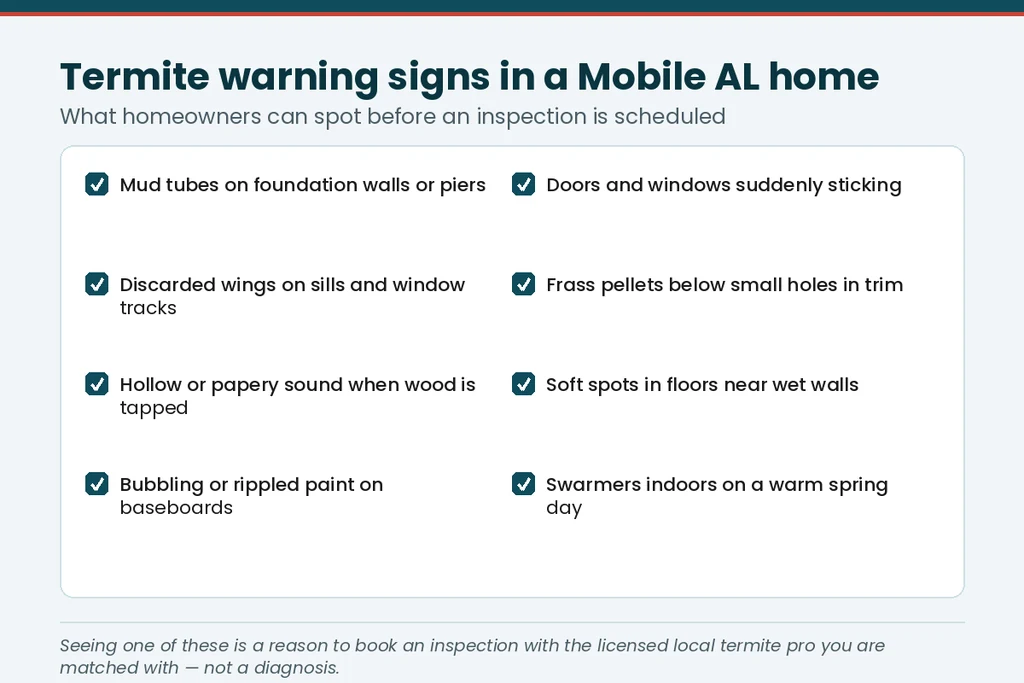
The seven signs that actually mean something
Not every odd mark on a wall is termite activity, but the presence of any one of these is enough to justify a professional look:
- Live swarmers indoors — flying insects near windows, light fixtures, or sliding-door tracks, especially between February and July depending on species.
- Discarded wings — small, equal-length, translucent wings scattered on a windowsill or caught in a spider web. Termite swarmers shed their wings almost immediately after landing.
- Mud tubes — pencil-width earthen tunnels running up a foundation wall, pier, or crawl-space joist. These are subterranean termites’ protected highway from soil to wood.
- Hollow-sounding wood — tap a sill plate, baseboard, or door frame. A papery, hollow tone where solid wood should sound solid is a strong indicator.
- Frass piles — drywood termites push tiny six-sided pellets out of the wood as they excavate. Piles look like coarse sand or coffee grounds under a window or piece of trim.
- Buckling paint or blistered trim — often mistaken for water damage, but the surface stays firm while the wood underneath is hollowed out.
- Sagging floors or doors that stick — a late-stage indicator that usually means damage has been progressing for a while.
Termite swarmers vs. flying ants — how to tell the difference
This is the single most common point of confusion, and it matters because one is a five-minute non-event and the other is worth a phone call. Termite swarmers have straight antennae, four equal-length wings, and a uniform body width with no pinch at the waist. Flying ants have elbowed antennae, two pairs of unequal-length wings, and a visibly pinched waist. If you’re not sure which you’re looking at, a photo is worth sending along when you reach out — it takes the guesswork out of the call.
Why Mobile and Baldwin County see this so often
The Port of Mobile is the documented 1985 U.S. entry point for the Formosan subterranean termite, now one of the most destructive species in North America. Add roughly 67 inches of annual rainfall, a 240-plus-day frost-free season, and decades of storm cycles — Frederic, Ivan, Katrina, Sally — that left water-damaged framing behind, and you get a region where four distinct termite species (Formosan, eastern subterranean, dark southeastern subterranean, and southeastern drywood) all generate real call volume every year.
Swarm season timing in coastal Alabama
Eastern subterranean termites swarm in daylight, February through May, usually the day after a warm rain. Dark southeastern subterranean overlaps, March through June. Formosan termites swarm at night, late April through early July, often the first calm, humid evening after rain, and they’re drawn to porch lights. Drywood termites swarm at night in spring, in smaller numbers. A swarm indoors almost always means an active colony in or under the structure.
What a termite inspection actually involves
A licensed operator’s inspection isn’t a quick glance. It typically covers an exterior perimeter walk for mud tubes and conducive conditions, a foundation-wall check at slab joints and sill plates, a crawl-space walk-through where applicable, an interior check of baseboards, window frames, and cabinets, and an attic inspection where drywood activity and Formosan carton nests most often hide. Findings get documented on an inspection report or the Official Alabama Wood Infestation Inspection Report, with photos of anything active. For a full walkthrough of the process, treatment methods, and what a termite bond actually covers, our termite treatment in Mobile, AL guide lays out every method a licensed operator may use, from liquid soil termiticide to bait stations to whole-structure fumigation.
Buying or selling a home? The inspection timeline matters more
A WDO inspection (Wood Destroying Organism inspection) — often called a termite letter, formally the Official Alabama Wood Infestation Inspection Report — is what most Alabama lenders ask for before closing. It’s a snapshot of what was observable on the inspection date, not a lifetime guarantee. If a closing date is on the calendar, mention the timeline when you reach out so the request gets routed appropriately.
When should you get an inspection — and when can you just keep an eye on it?
Any single sign from the list above — a live swarmer, a mud tube, a hollow-sounding board — is enough to justify a no-obligation inspection. Multiple signs together, or anything found during a real-estate transaction, means don’t wait for the next swarm season to find out how far it’s gone. If what you’re seeing is genuinely cosmetic — old paint, a single ant you can’t identify, a stray moth — a photo comparison against the signs above usually settles it before you need to make a call at all.
Not sure what you’re looking at? A licensed Mobile-area operator can inspect and tell you in one visit — free to check coverage, no obligation to hire anyone.
Check coverage & get connected →For pest and termite pressure specific to your neighborhood — Spring Hill, Midtown, West Mobile, Old Dauphin Way, Daphne, Fairhope, and the rest of the Eastern Shore — the Mobile Alabama Exterminators dispatch network routes requests to ADAI-licensed operators covering both Mobile and Baldwin counties.
FAQ
Are termite swarmers the same as flying ants?
No. Termite swarmers have straight antennae, equal-length wings, and no pinched waist. Flying ants have elbowed antennae, unequal wing pairs, and a visibly pinched waist.
How much does a termite inspection cost in Mobile, AL?
Residential termite inspections are typically free in the Mobile and Baldwin County market; commercial buildings sometimes carry a flat fee. The licensed operator confirms this when you reach out.
I only saw one or two discarded wings. Is that really worth a call?
Yes. Even a small number of shed wings usually means a swarm happened nearby, which points to an active colony in or under the structure. It’s worth a look before the next swarm season.
Does homeowners insurance cover termite damage?
Standard homeowners policies typically treat termite damage as preventable maintenance and don’t cover it, which is part of why termite bonds exist as a separate product.
What’s the difference between a WDO inspection and a regular termite inspection?
A WDO inspection (recorded on the Official Alabama Wood Infestation Inspection Report, sometimes called a termite letter) is the documented version lenders commonly ask for at a real-estate closing. A routine inspection follows the same process but isn’t tied to a transaction deadline.
Mobile Alabama Exterminators is a free dispatch service that connects Mobile and Baldwin County homeowners with independent, ADAI-licensed pest control operators. We are not the treatment provider and do not perform inspections or treatments ourselves, and we do not guarantee specific results, pricing, or appointment availability.