The Gulf Coast Seasonal Pest Prevention Calendar
A month-by-month reference for the pests that actually show up on the central Gulf Coast — what drives them, how to tell a stray from an infestation, and the home-sealing steps that keep humidity-loving pests out. Built for homeowners, not a sales pitch.
Covers accepted species only: ants, fire ants, roaches, crickets, mice, rats, silverfish, earwigs, centipedes, millipedes, clothes moths, termites, and common nuisance wildlife.
Prefer to skip ahead?
One call reaches a licensed, local exterminator who covers your address — and a real person answers, 24/7.
Free to use · No obligation to hire anyone
Sourced from ACES, ADAI, USDA & CDC
Accepted-species only — no scare tactics
Free to use, no obligation
Why the Gulf Coast runs a different pest calendar
Mobile and Baldwin County sit in one of the most humid, rain-heavy metro climates in the continental U.S. — the region regularly logs 65-plus inches of rain a year, and that moisture (not the calendar month) is what actually drives pest pressure here. Termite swarm timing, fire ant mound-building, and cockroach population swings all track rainfall and humidity more closely than they track a generic national pest calendar built for a drier climate.
This guide organizes the year by what the Alabama Cooperative Extension System (ACES) and the Alabama Department of Agriculture & Industries (ADAI) document for this region, plus what’s specific to Mobile: one of the heaviest Formosan termite concentrations in the country, a working port that brings in hitchhiker pests, and neighborhoods built under mature oak canopy that gives rodents and roaches an easy route to the roofline.
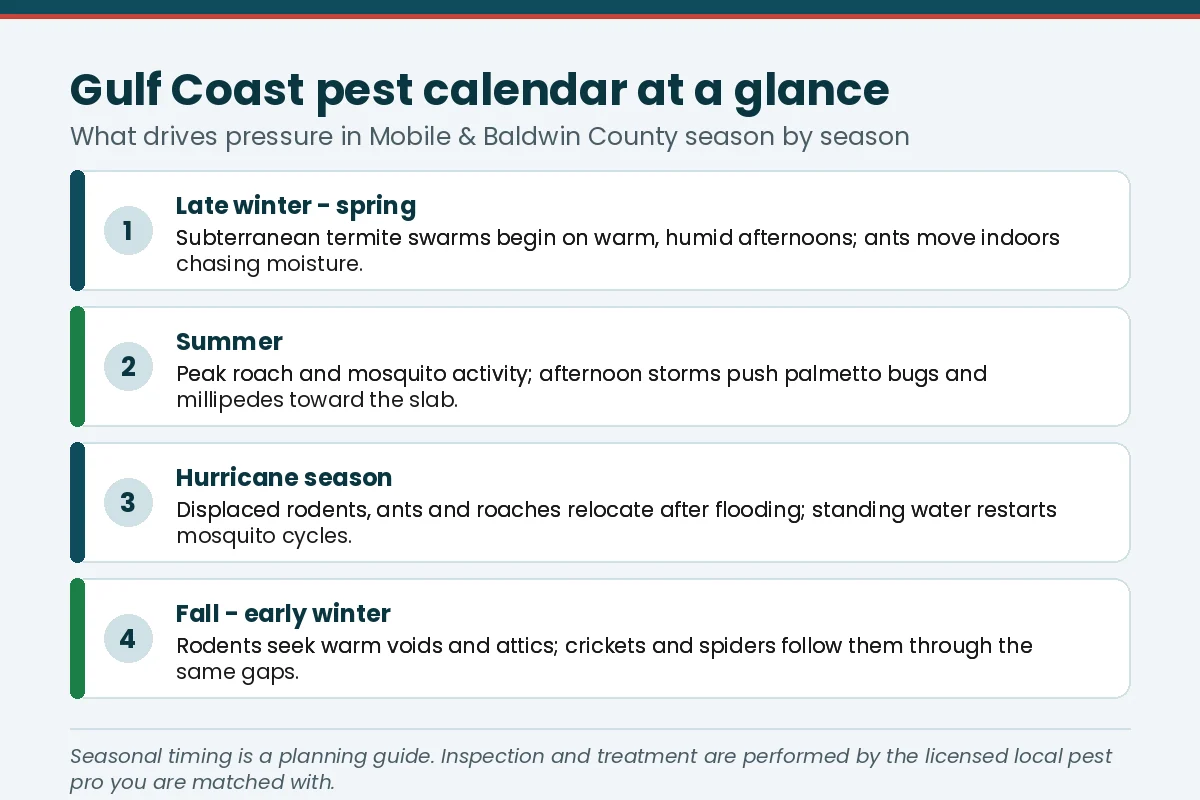
The Gulf Coast pest year, month by month
Accepted species only — the pests this library actually covers. Timing reflects general Gulf Coast patterns; any individual year can run early or late with the weather.
| Month | Pest pressure | What’s happening | Prevention focus |
|---|---|---|---|
| January | Roof rats & house mice | Cooling nights push rodents off oak-canopy travel routes into attics and wall voids — the season’s indoor peak. | Seal dime-sized gaps, dryer vents, and roofline gaps; trim limbs 6+ ft off the roof. |
| February | Native subterranean termites | Eastern subterranean termites begin swarming as soil warms in late winter. | Schedule a termite inspection before the spring swarm peak; check piers and slab edges for mud tubes. |
| March | Termites continue; fire ant mounds reactivate | Swarms continue into spring; warming soil wakes overwintering fire ant colonies. | Watch the yard for fresh mounds; keep firewood and mulch off the foundation. |
| April | Fire ant season ramps up | Mound-building accelerates through spring rains and continues into October. | Note new mound locations; check crawlspace and foundation vents for gaps. |
| May | Formosan termite swarms begin; roaches rising | Formosan termites — Mobile has one of the heaviest concentrations in the continental U.S. — start swarming on warm, humid evenings. | Cut back unnecessary porch lighting on humid nights; reduce mulch-to-siding contact. |
| June | Formosan swarms peak; clothes moths active | Peak swarm activity around porch lights; indoor humidity drives clothes moth activity in stored fabrics. | Store wool and natural-fiber items in sealed containers; vacuum closets regularly. |
| July | Cockroaches climbing toward peak; centipedes & millipedes active | Humidity and afternoon storms push American and smokybrown roaches (“palmetto bugs”) in from oaks and pine straw; centipedes and millipedes follow soil moisture indoors. | Seal door sweeps and weatherstripping; clear leaf litter and mulch from the foundation line. |
| August | Cockroach pressure continues; house crickets active | Peak summer humidity sustains roach and cricket activity around foundations and entry points. | Keep exterior lighting away from doors; check weep holes and foundation vents. |
| September | Hurricane season peak; fire ants still active | Storm season raises the risk of a post-storm pest surge — rodent displacement, roach population spikes, and fire ant “rafts” after flooding. | Review the hurricane pest prep checklist; confirm rodent entry points are sealed before a storm threat. |
| October | Rodents move indoors; squirrels active | Cooling nights start the roof rat and house mouse indoor push; squirrels forage and look for attic access before winter. | Trim tree limbs off the roofline; screen attic and soffit vents. |
| November | Rodent pressure rising; wildlife seeking winter shelter | Opossums, raccoons, and skunks look for denning sites near foundations, sheds, and crawlspaces as nights cool. | Close off crawlspace and shed gaps; secure garbage and pet food outdoors overnight. |
| December | Rodent indoor season continues; termites stay active in soil | Gulf Coast winters rarely get cold enough to fully halt subterranean termite activity in the soil. | Good month for a termite bond status check ahead of spring swarm season; finish sealing exterior gaps. |
Why humidity matters more than the calendar. Silverfish, earwigs, centipedes, and millipedes aren’t seasonal pests so much as moisture pests — they show up whenever conditions stay damp, which on the Gulf Coast can be most of the year. If a “wrong season” pest turns up in your bathroom or garage, look for a moisture source (a slow leak, poor grading, a clogged gutter) before assuming the calendar is wrong.
Home-sealing & moisture-control checklist
Six prevention steps that address the root cause — moisture and access — behind most Gulf Coast pest calls.
1Manage moisture at the roofline
Clean gutters, redirect downspouts at least 3 feet from the foundation, and fix roof or plumbing leaks promptly. Moisture is the number-one driver behind silverfish, earwigs, centipede, and millipede calls.
2Create a foundation gap
Keep mulch, soil, and firewood at least 6–12 inches below siding and off direct wood contact. This single gap reduces both termite and ant harborage against the structure.
3Seal building entry points
Caulk gaps around utility penetrations, screen attic, soffit, and foundation vents, and fit door sweeps. This keeps out rodents, roaches, crickets, and nuisance wildlife alike.
4Trim vegetation off the structure
Cut tree limbs and shrubs back 6+ feet from the roofline and walls. Overhanging canopy is the single easiest rodent and ant travel route into a Mobile-area home.
5Reduce clutter and harborage
Store firewood off the ground and away from the house; declutter garages, sheds, and crawlspaces where roaches, spiders, and rodents like to nest undisturbed.
6Manage exterior lighting
Swap bright white porch lights for yellow “bug” bulbs or motion-activated fixtures where possible — it measurably cuts down on swarm and flying-insect activity right at your door.
Infestation, or just a stray?
The practical difference between “I saw one” and “I have a problem.”
Ants & fire ants
One or two foraging ants on a counter isn’t an infestation. A visible trail, a mound in the yard, or ants returning to the same food or moisture source repeatedly means an active colony.
Roaches & palmetto bugs
One outdoor-type roach that flew in on a humid night is common on the Gulf Coast. Roaches seen in daylight, a musty odor, or dark droppings behind appliances point to an established indoor population.
Mice & rats
A single dropping could be a one-time visitor. Gnaw marks, grease trails along baseboards, or scratching in the attic at night mean rodents have moved in.
Termites
One winged insect that wandered in isn’t proof of anything. A pile of identical discarded wings on a windowsill, or mud tubes on the foundation, means a colony is established nearby.
Bats & birds
A single bat resting under an eave overnight is different from a guano pile or repeated dusk exits from the same gap — multiple bats leaving one spot at dusk means an active roost.
Snakes
One sighting in Gulf Coast landscaping is common and often harmless. Repeated sightings near the foundation or a shed can mean a rodent problem is drawing them in.
When it’s time to call a professional. If your checklist item points to an active colony, a moisture problem you can’t fix with caulk and a downspout, or a wildlife entry you can’t safely close off yourself, that’s the point to bring in a licensed operator rather than keep guessing. This guide is educational — it isn’t a substitute for an on-site inspection.
Frequently asked questions
When should I schedule a termite inspection on the Gulf Coast?
Late winter, before native subterranean termites begin their spring swarm and before Formosan termites start their May–June evening swarms, is the ideal window. An inspection ahead of swarm season catches activity while it’s still cheaper to address.
Why does Mobile have such heavy Formosan termite pressure?
The Alabama Cooperative Extension System places the Mobile and Baldwin County area in the highest-risk termite hazard zone in the country, and Formosan subterranean termites — an introduced species that builds far larger colonies than native termites — are especially well established along this stretch of the Gulf Coast.
What time of year are fire ants worst in Mobile and Baldwin County?
Mound-building activity is heaviest April through October, especially after summer rains and in newer sodded yards. Multiple queens per colony is common on the Gulf Coast, which is part of why DIY mound treatments often disappoint.
Do hurricanes really change local pest pressure?
Yes — flooding displaces rodents, disperses fire ant colonies as floating “rafts,” and creates the humid, food-scarce conditions that drive a documented post-storm cockroach and rodent surge. See the hurricane pest prep guide for the full pre- and post-storm checklist.
How do I tell a termite swarmer from a flying ant?
Termite swarmers have straight antennae, a thick waist, and four equal-length wings that shed almost immediately — a pile of identical wings with no insects attached is a termite signature. Flying ants have elbowed antennae, a pinched waist, and unequal wings that stay attached.
Is this calendar the same thing as pest control service?
One call reaches a licensed, local exterminator who covers your address — and a real person answers, 24/7.
Does this guide cover mosquitoes, wasps, bees, ticks, fleas, or bed bugs?
No — this calendar intentionally covers only the accepted household and structural pests our library is built around: ants and fire ants, roaches, house crickets, mice and rats, silverfish, earwigs, centipedes, millipedes, clothes moths, termites, and common nuisance wildlife. Stinging insects and a handful of other pest types are outside this guide’s scope.
Who do I contact to verify a pest control operator’s license in Alabama?
The Alabama Department of Agriculture & Industries (ADAI) Pesticide Management Section maintains the state’s licensee lookup. Ask any operator for their certification number and category before hiring, and confirm it directly with ADAI.
Where this calendar comes from
Public agency and university sources — not invented statistics.
Alabama Cooperative Extension (ACES)
Auburn University / Alabama A&M’s joint extension program — the technical source for Formosan termite distribution and regional pest seasonality used in this calendar.
ADAI Pesticide Management
Issues Alabama pest control licenses and maintains the public licensee lookup referenced throughout this site.
USDA & APHIS
Federal agencies behind the imported fire ant quarantine boundary that includes Mobile and Baldwin County.
Related pages
Formosan termite guide →
Fire ant control →
Rodent control →
Cockroach & palmetto bug control →
Silverfish control →
Clothes moth control →
Wildlife removal →
Hurricane pest prep →
Gulf Coast pest library →
Authority resources →
ADAI licensing guide →
Termite & pest data reference →
Embed this free checklist on your site
HOAs, neighborhood sites, and local blogs are welcome to embed this checklist free — just copy the code below onto your page. Attribution back to this guide is built in.
Free to get matched, no obligation. The ADAI-licensed operator inspects and quotes — this guide just helps you describe what you’re seeing. Free to check coverage. ADAI-licensed operators serving Mobile & Baldwin County, AL. Prefer to send details first? Use the contact form →Worked through the calendar and still not sure?