Termite treatment in Mobile, AL — Formosan, subterranean & drywood, explained
One call reaches a licensed, local exterminator who covers your address — and a real person answers, 24/7.
Free to check coverage — the operator gives the quote after inspecting.Check your ZIP first
One call reaches a licensed, local exterminator who covers your address — and a real person answers, 24/7.
Free to use · No obligation to hire anyone
Termite pressure in Mobile and Baldwin counties is among the highest in Alabama, and the highest along the US Gulf Coast outside Louisiana and southern Florida — see the full local numbers in our Mobile, Alabama Pest & Termite Pressure Report. The Port of Mobile is the documented 1985 US entry point for the Formosan subterranean termite (Coptotermes formosanus), the most economically destructive subterranean species in North America. Average annual rainfall in Mobile is approximately 67 inches in a humid subtropical (Köppen Cfa) climate, and the entire region sits inside Termite Infestation Probability Zone #1 (“very heavy”) per the International Residential Code. Termite work in Alabama must be performed by an applicator certified by the Alabama Department of Agriculture and Industries (ADAI) in the WDC (Wood Destroying Organi) category. Use the form below to reach a WDC-certified operator covering Mobile County or Baldwin County.
Quick answer: Mobile and Baldwin County sit in the IRC’s highest termite-pressure zone, with Formosan, eastern subterranean, dark southeastern subterranean, and drywood termites all active locally. If you see mud tubes, discarded wings, or hollow-sounding wood, request a no-obligation inspection — the licensed local operator you’re matched with identifies the species and recommends liquid treatment, bait stations, direct-wood treatment, or fumigation based on what’s found.
What this guide covers
This is the long-form reference for termite treatment in Mobile, AL. It covers the four termite species that drive treatment work here, signs of active infestation, every major treatment method an ADAI WDC-certified operator may use, what a termite bond actually covers, treatment cost ranges along the Gulf Coast, the difference between a WDO inspection and a termite letter, what a swarm looks like and when to expect it, how DIY methods compare to professional treatment, and a step-by-step walkthrough of a typical termite inspection. Sections link to the dedicated service, cost, and species pages where applicable. If you’re dealing with more than termites, see our dedicated guides to rodent control, cockroach control, and ant control in Mobile, AL, or the full pest control Mobile, AL overview.
The four termite species that drive treatment work in Mobile & Baldwin
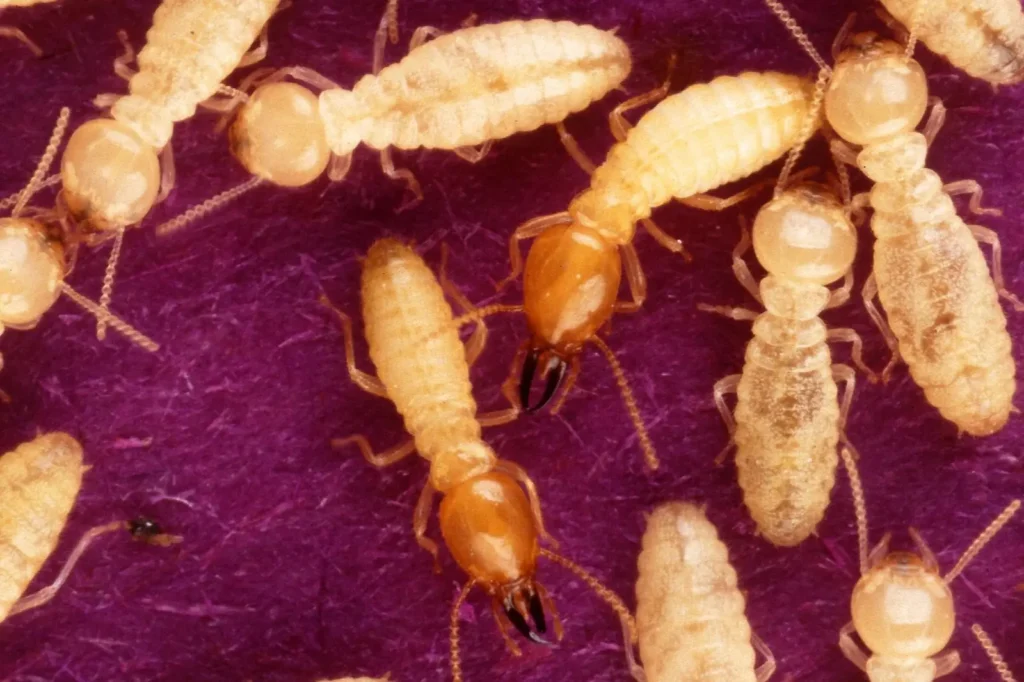
Four termite species generate the overwhelming majority of treatment calls along the Gulf Coast Alabama corridor.
Formosan subterranean termite (Coptotermes formosanus)
First identified in Alabama at the Port of Mobile in 1985. The 2003 Fairhope Formosan Termite Watch Program placed 109 sticky-trap monitoring sites across the city and recorded Formosan swarmers at approximately 70% of them. Formosan colonies routinely exceed several million individuals — an order of magnitude larger than native species — and can consume the equivalent of a one-foot length of 2×4 lumber in under a month per colony. Formosans build carton nests above grade (in wall voids, attic framing, expansion joints) and do not require constant soil contact, which makes them harder to control than native species. Swarms occur at night between late April and early July, typically the first calm humid evening after a rain event. See the dedicated Formosan termite (Mobile, AL) species page for full biology, distribution, and ID detail.
Eastern subterranean termite (Reticulitermes flavipes)
The most common native species in Alabama. Daylight swarmers between February and May, earlier in coastal Alabama than the national norm. Mature colonies typically range from 60,000 to several hundred thousand workers. Damage rate is slower than Formosan but still significant over a multi-year infestation.
Dark southeastern subterranean termite (Reticulitermes virginicus)
Native, daylight swarms March through June, often overlaps with R. flavipes. Treatment approach is functionally identical to eastern subterranean.
Southeastern drywood termite (Incisitermes snyderi)
Night swarmer in spring. Drywood termites do not require soil contact and live entirely inside the wood they consume — usually attic framing, eaves, door frames, hardwood furniture, picture frames. Heavy infestations require whole-structure fumigation with sulfuryl fluoride, which in Alabama can only be performed by an FC-certified (Fumigation Pest Control) operator. See drywood termite treatment in Mobile for the full method breakdown.
What are the signs of active termite activity?
The presence of any single indicator below is enough to justify a no-obligation inspection routing by a WDC-certified operator. Several indicators together usually mean active infestation.
- Live swarmers indoors — flying termites near windows, light fixtures, sliding-door tracks, especially in the seasonal swarm windows above.
- Discarded wings — small translucent equal-length wings on window sills, in spider webs, on bathtub edges.
- Mud tubes — pencil-width earthen tubes on foundation walls, piers, crawl-space joists, or interior baseboards.
- Hollow-sounding wood — sill plates, baseboards, door frames, deck posts that sound papery when tapped.
- Frass piles — drywood termites push tiny six-sided fecal pellets out of kick-out holes; piles look like coarse sand or coffee grounds.
- Buckling paint or wallpaper — looks like water damage but the surface is firm; underneath, the wood is hollowed.
- Sagging floors or doors that no longer close — late-stage damage indicator.
- Bubbling stucco or cracked drywall at sill height, often above slab joints.
A complete walkthrough of what a WDC operator looks for during the inspection is in the HowTo section below.
Treatment methods used in Mobile, AL
The WDC-certified operator the call routes to will recommend treatment based on species, structure type (slab vs. crawl space vs. pier-and-beam), infestation extent, and whether the home already has a bond. The major methods:
Liquid soil termiticide (the perimeter trench-and-treat)
The dominant method for subterranean termites along the Gulf Coast. Non-repellent termiticides — typically fipronil (Termidor SC), imidacloprid (Premise), or chlorantraniliprole (Altriset) — are applied to a continuous trench around the foundation and sub-slab where plumbing penetrations exist. Workers that contact the treated zone carry the active back to the colony via grooming and trophallaxis, killing the colony within weeks. Modern formulations have a label-stated soil residual of 7–10 years under normal conditions. Liquid treatment generally costs more upfront than bait but is the only method that produces a continuous chemical barrier and is what most repair-and-retreatment bonds are written against.
Bait stations (Sentricon, Trelona, Advance)
In-ground baiting systems use a chitin-synthesis inhibitor (hexaflumuron in Sentricon, novaluron in Trelona). Workers feed on the bait, share it across the colony via trophallaxis, and the entire colony collapses over 3–6 months. Bait is the only termite method that eliminates a colony rather than creating a treated zone the colony has to encounter. Sentricon Always Active stations are typically installed 8–12 feet apart around the foundation. Bait works well for Formosan colonies, which are often too large to be reliably knocked out by a treated zone alone. See the Sentricon Mobile, AL service page for the full installation and monitoring breakdown.
Direct-wood treatment (borate and foam injection)
Used on active galleries already inside the structure. Disodium octaborate tetrahydrate (Bora-Care, Tim-bor) is applied to bare wood or injected into voids. Foam treatments (Termidor Foam, Premise Foam) carry termiticide into wall voids and active galleries. Direct-wood is almost always paired with a perimeter treatment or bait — alone it does not address the soil-side colony.
Whole-structure fumigation (sulfuryl fluoride)
The only effective treatment for established drywood termite infestations that have spread through multiple structural members. The structure is tarped and sulfuryl fluoride (Vikane) is introduced at a concentration calculated from the cubic-foot volume, temperature, and target species. Fumigation requires an ADAI FC-certified operator. After exposure (typically 18–72 hours depending on conditions) the structure is aerated and cleared with a HAM meter before re-entry. Fumigation does not provide residual protection — it kills only what’s present at the time of treatment.
Heat treatment (drywood)
A non-chemical alternative to fumigation for spot or whole-structure drywood treatment. The structure or affected zone is raised to a sustained 120°F+ for several hours, lethal to all drywood termite life stages. Less common in coastal Alabama than fumigation because of structural envelope variability, but available.
Termite bond — what it actually covers
ADAI regulates two bond categories. Retreatment-only bonds are cheaper and obligate the operator to re-treat at no charge if termites are found within the contract period — but the homeowner is responsible for any structural repair. Repair-and-retreatment bonds (sometimes called “damage bonds”) cover both retreatment and structural repair up to a stated limit. Bond pricing depends on home square footage, treatment method, the operator’s underwriting, and category — annual renewal runs cheaper for retreatment-only than for repair-and-retreatment, and the operator quotes both categories directly. For full cost detail see the Mobile termite treatment cost guide and the comparison page Annual Termite Bond: Worth It or Not?.
Not sure which treatment your situation needs?
One call reaches a licensed, local exterminator who covers your address — and a real person answers, 24/7.
How much does termite treatment cost in Alabama?
Cost ranges below reflect current Mobile & Baldwin county market pricing reported by ADAI-licensed operators. Final pricing is determined solely by the dispatched operator based on linear-foot perimeter, structure type, infestation severity, and bond category.
| Treatment | What moves the number | Notes |
|---|---|---|
| Liquid perimeter (initial) | Linear feet of foundation to trench and treat; slab vs. crawl space access; obstructions like patios, walkways and additions that have to be drilled | 2,000 sq ft home, slab; crawl space adds 10–25% |
| Sentricon installation (initial) | Station count around the structure, which follows perimeter length and soil obstructions | Includes year-one monitoring |
| Sentricon annual monitoring | Number of stations installed and inspection frequency in the contract | After year one |
| Spot treatment (active gallery) | How localized the gallery really is, and whether the wall or slab has to be opened to reach it | Single localized infestation |
| Whole-structure fumigation | Cubic-foot volume of the structure, tenting complexity and roof pitch, plus the two nights of lodging the job forces | 2,000 sq ft, depends on cubic-foot volume |
| Retreatment-only bond (annual) | Square footage, treatment method already in place, and the operator’s own underwriting | After initial treatment |
| Repair-and-retreatment bond (annual) | Same factors plus the stated damage-repair limit — the repair component is what separates it from retreat-only | After initial treatment |
| WDO inspection / Alabama WDIR | Structure size and access; crawl space and attic accessibility, multiple buildings, and rush turnaround all add | Real-estate transaction inspection |
Full breakdown, including line-item structure of a typical repair-and-retreatment quote, is on the dedicated termite treatment cost in Mobile, AL page.
DIY vs professional termite treatment
DIY treatments — over-the-counter foaming termiticides, bait stakes from home-improvement stores, borate sprays — handle surface activity but do not eliminate a subterranean colony. The reasons are structural, not skill-based:
- Over-the-counter bait stations contain insect growth regulators at lower concentrations than the professional equivalents and are not registered for whole-colony elimination claims.
- DIY liquid termiticide cannot be applied to the sub-slab through plumbing penetrations without drilling and pressure injection, which requires professional equipment.
- Alabama state law requires any pesticide application for hire to be performed by an ADAI-licensed applicator. DIY application on a property the homeowner does not occupy (rental, second home) violates ADAI Section 80-1-13 if done for compensation.
- Most real-estate transactions and most homeowners-insurance products require treatment by a licensed operator before a bond or WDO report is issued.
A reasonable DIY scope: keeping wood-to-soil contact off the structure, sealing the slab perimeter against moisture intrusion, removing cellulose debris (firewood, mulch, scrap lumber) from within five feet of the foundation. Anything past that — active gallery, swarm event, bond purchase — is professional scope. The blog post DIY vs professional pest control: what actually works in Mobile, AL covers the full picture.
WDO inspection, termite letter, and real estate
A WDO inspection (Wood Destroying Organism inspection) is a visual inspection of all accessible structural wood for active infestation, prior infestation, and conducive conditions. The inspector documents findings on the Official Alabama Wood Infestation Inspection Report — the written instrument named in Ala. Admin. Code r. 80-10-9-.18. Alabama uses this state form rather than the NPMA-33 that many other states use. Under that rule the report may be required as a condition of sale financing, and in practice most Mobile and Baldwin County lenders do ask for one before closing. The same form, signed by a WDC-certified inspector, is what most people call the termite letter.
The inspection is not a guarantee that no termites are present — it is a statement about what was observable on the inspection date in accessible areas. The form lists current conditions (subterranean, drywood, beetles, fungus), evidence of prior infestation, and conducive conditions. A clean report is the baseline a lender looks for; if active infestation is found, the contract usually requires treatment + a current bond before closing.
For the full process see the WDO inspection (Alabama WDIR) page and the Termite letter for real-estate closing page.
Closing on a house and need a Section 1 letter fast?
One call reaches a licensed, local exterminator who covers your address — and a real person answers, 24/7.
Termite swarm season in coastal Alabama
Termite swarms are calendar-driven and are the single most visible piece of evidence that a colony has reached reproductive maturity nearby.
- Eastern subterranean (R. flavipes): February – May, daylight, often the first warm day after rain.
- Dark southeastern (R. virginicus): March – June, daylight.
- Formosan (C. formosanus): late April – early July, evening to night, often the first calm humid evening after a rain event. Swarmers are strongly attracted to porch lights and lit windows.
- Drywood (I. snyderi): spring, night, smaller swarms than subterraneans.
A swarm indoors almost always means an active colony in or under the structure. A swarm outdoors within 20 feet of the structure means a colony is in the soil profile near the foundation. Either way, the appropriate response is a WDC inspection within 7–14 days. See the dedicated Termite swarming season in Alabama blog post for swarm-vs-flying-ant ID, photos, and what to do if a swarm appears indoors. Not sure if what you’re seeing lines up with swarm season? Check our free Termite Swarm Season Tracker.
How does a termite inspection work in Mobile, AL?
This is what a typical no-obligation inspection routing by a WDC-certified operator covers. The order may vary; the scope rarely does.
- Exterior perimeter walk. The inspector circles the foundation looking for mud tubes, swarm castings, conducive conditions (wood-to-soil contact, mulch piled against the slab, irrigation spray hitting framing), and damaged wood at decks, porches, fences, and outbuildings.
- Foundation-wall inspection. Inside slab joints, expansion joints, and any visible sill plate; in crawl spaces, every pier, girder, joist, and the band board.
- Crawl space / sub-floor inspection (if applicable). The inspector enters the crawl, checks the vapor barrier, photographs anything anomalous, and probes accessible framing with an awl or moisture meter.
- Interior walk-through. Baseboards, window frames, door frames, bath traps, kitchen sink cabinets, garage perimeter, attic access. The inspector listens for hollow wood and visually inspects trim where moisture intrusion is likely.
- Attic inspection. Drywood termites and Formosan carton nests are most often found in attic framing — bottom chord of trusses, rafter-to-top-plate joints, sheathing near roof penetrations.
- Documentation. Findings are recorded on the Official Alabama Wood Infestation Inspection Report or the operator’s own inspection report. Photos of any active evidence are attached.
- Treatment recommendation. If active infestation is found, the operator presents species ID, treatment method options, cost, and bond category options.
Average duration for a 2,000 sq ft home: 45–90 minutes. The inspection itself is free in the Mobile / Baldwin market for residential structures; commercial buildings sometimes carry a flat fee.
Why Mobile and Baldwin counties are termite hotspots
The combination of port history, climate, and storm cycle is unusual.
- The Port of Mobile is the documented 1985 entry point for Formosan termites into Alabama. The port now moves more than 60 million tons of cargo per year, with timber and wood-product traffic continuing to seed reintroduction.
- Climate: Mobile averages ~67 inches of rainfall per year, with a 240+ day frost-free season and persistent soil moisture from spring through fall — close to ideal subterranean termite conditions.
- Storm cycle: Hurricanes Frederic (1979), Ivan (2004), Katrina (2005), and Sally (2020) each left thousands of structures with water-damaged framing, accelerating colonization in the years that followed. The post-Sally five-year window is currently active.
- Construction stock: A significant share of Mobile’s housing stock is pier-and-beam over a sandy soil profile with high water table — a combination that gives subterranean termites unusually easy access to sill plates and band boards.
For a deeper read on storm-driven pest pressure see Hurricane pest prep, Mobile AL and Post-hurricane pest control in Mobile.
ADAI rules every Mobile homeowner should know
Alabama is one of the strictest states in the country on structural pest control regulation. The relevant categories:
- WDC — Wood Destroying Organi Certified Operator. Required to issue the Official Alabama Wood Infestation Inspection Report and to write termite treatment and bond contracts.
- WDS — Wood Destroying Organi Supervisor. Branch-level supervisor responsible for WDC work performed by the branch.
- FC — Fumigation Pest Control Certified Operator. Required for whole-structure tenting with sulfuryl fluoride.
- General Pest Control (GPC) and Public Health Pest Control categories cover non-WDO work.
ADAI publishes the licensed-operator list at the ADAI Structural Pest Control Section. The full category breakdown and what each license authorizes is on the ADAI license categories explained page and the ADAI licensing reference page.
Service areas covered (Mobile + Baldwin)
Mobile County: Mobile, Saraland, Tillman’s Corner, Theodore, Semmes, Chickasaw, Satsuma, Prichard, Mount Vernon, Citronelle, Wilmer, Grand Bay, Dauphin Island, Bayou La Batre.
Baldwin County: Daphne, Fairhope, Spanish Fort, Foley, Gulf Shores, Orange Beach, Bay Minette, Robertsdale, Loxley, Magnolia Springs, Silverhill, Summerdale, Elberta, Lillian, Point Clear, Stapleton, Perdido.
Mobile neighborhoods with dedicated coverage: Spring Hill, Midtown, West Mobile, Old Dauphin Way.
FAQ — termite treatment in Mobile, AL
How long does termite treatment last?
Liquid termiticide treatments using current non-repellent formulations carry a label residual of 7–10 years under normal conditions. Bait monitoring runs indefinitely as long as the annual contract is in force. A repair-and-retreatment bond keeps protection current as long as it is renewed.
Do I need a termite bond if I’m not selling my home?
A bond is an insurance product, not a treatment. If the initial treatment has a 7–10 year residual, the bond protects against early failure and provides retreatment without an out-of-pocket reinstallation. Whether it’s worth the annual cost depends on infestation risk, structure type, and bond category. The Annual Termite Bond: Worth It or Not? comparison page lays out the math.
What’s the difference between Sentricon and Termidor?
Sentricon is a bait system — it eliminates the colony via in-ground stations. Termidor is a liquid termiticide — it creates a treated zone around the structure. Both are effective against Mobile-area species; the choice depends on structure type, infestation status, and homeowner preference. See the Sentricon vs. Termidor comparison page for the full breakdown.
Are termite swarmers the same as flying ants?
No. Termite swarmers have straight antennae, equal-length wings, and no waist (uniform body width). Flying ants have elbowed antennae, two pairs of unequal-length wings, and a pinched waist. The Termite swarming season in Alabama blog post has side-by-side photos.
Is fumigation the only option for drywood termites?
No. Spot treatment (foam injection, borate, electro-gun, or heat) works for localized drywood infestations. Whole-structure fumigation is reserved for widespread drywood damage that has spread through multiple framing members.
Does insurance cover termite damage?
Standard homeowners policies do not cover termite damage — it is considered preventable maintenance. This is why repair-and-retreatment bonds exist.
How fast can a Formosan colony cause structural damage?
USDA estimates that a mature Formosan colony can consume the equivalent of a one-foot length of 2×4 lumber in less than a month. Significant structural compromise can occur in 12–24 months if a Formosan colony establishes inside a wall or attic.
External references
- USDA Forest Service — Formosan Subterranean Termite biology and distribution:
https://www.fs.usda.gov/research/treesearch/ - Alabama Cooperative Extension System (Auburn) — Termite ID and management:
https://www.aces.edu/ - Alabama Department of Agriculture and Industries — Structural Pest Control Section:
https://agi.alabama.gov/pesticidemanagement/ - EPA — Termiticide active ingredients and label data:
https://www.epa.gov/pesticides - International Residential Code — Termite Infestation Probability Map (Figure R301.2(7)):
https://codes.iccsafe.org/
Calls route to an ADAI-licensed termite operator covering Mobile County and Baldwin County, Alabama.
Mobile averages approximately 67 inches of rainfall per year — among the highest of any continental US city, and a direct driver of subterranean termite and mosquito pressure. (Source: NWS Mobile / NOAA NCEI Mobile Regional Airport long-term climate normals.)
Mobile and Baldwin counties have absorbed at least four major hurricanes since 1979 — Frederic (1979, Category 4), Ivan (2004, Cat 3 landfall in nearby Gulf Shores), Katrina (2005), and Sally (2020) — each of which left thousands of structures with water-damaged framing and accelerated termite colonization in the years that followed. (Source: NWS Mobile post-storm reports.)
The Port of Mobile is the documented *1985 US entry point for the Formosan subterranean termite (Coptotermes formosanus) in Alabama, with the species identified in shipping pallets and quickly spreading through the surrounding city. (Source: USDA Forest Service Operation Full Stop research; ACES Formosan Termite reference.)*
The 2003 Fairhope Formosan Termite Watch Program placed 109 sticky-trap monitoring sites across the city and recorded Formosan swarmers at approximately 70% of them — a direct measurement of Eastern Shore Formosan distribution. (Source: ACES; USDA Operation Full Stop.)
The International Residential Code (IRC) Figure R301.2(7) places Mobile and Baldwin counties in Termite Infestation Probability Zone #1 — “very heavy” — the highest pressure zone in the continental US, alongside southern Louisiana and southern Florida. (Source: ICC International Residential Code 2024 edition, Figure R301.2(7).)
Four termite species drive treatment work in Mobile and Baldwin: the native *eastern subterranean termite (Reticulitermes flavipes), the native dark southeastern subterranean termite (Reticulitermes virginicus), the invasive Formosan subterranean termite (Coptotermes formosanus), and the southeastern drywood termite (Incisitermes snyderi). (Source: Alabama Cooperative Extension System termite references; ADAI WDC training materials.)*
Mobile Alabama Exterminators is a free dispatch service that connects Mobile and Baldwin County homeowners with independent, ADAI-licensed pest control operators. We are not the treatment provider and do not perform inspections or treatments ourselves, and we do not guarantee specific results, pricing, or appointment availability. Requests are routed to participating local operators during their normal business hours; 24/7 availability is not guaranteed.
Four species. One wrong guess costs thousands.
Free to check coverage, free to get matched, no obligation. The licensed operator inspects, IDs the species, and gives the quote.
Prefer to send details first? Use the contact form →