Pest control in Satsuma, AL — a straight line to a licensed operator.
Rats in the backyard citrus, mounds across a new sod lawn, wings on the porch light of an older frame house — whatever Satsuma’s mix of old and new is throwing at you, this free 24/7 dispatch line connects you with an independent, ADAI-licensed pest control operator who works the US-43 corridor. They inspect, they quote, they treat. You decide.
Free to check coverage. ADAI-licensed operators serving Mobile & Baldwin County, AL.
Check your ZIP first
Enter your Satsuma-area ZIP to confirm coverage.
Free to use · No obligation to hire anyone
Why pest control in Satsuma is its own discipline
Satsuma is literally named for fruit. A century ago this stretch of north Mobile County was satsuma-orange country, and the habit stuck — plenty of yards along Old Highway 43 still have a satsuma or kumquat tree out back. That’s charming in November and a genuine pest factor the rest of the year, because if there is one thing a roof rat loves, it’s backyard citrus.
Add in the way the town is built — older frame houses near the heart of Satsuma, newer slab subdivisions filling in along the US-43 growth corridor — and you get a pest profile that changes street by street:
- Citrus draws roof rats — really. Roof rats hollow out ripening satsumas on the branch and leave the peel hanging like a shell. From the tree it’s a short trip along the fence line to your attic. If your fruit is getting eaten from the inside out, that’s not squirrels being messy — it’s a rodent call.
- Two housing generations, two termite conversations. Older frame homes near downtown carry classic sill-and-crawlspace termite risk. The newer slabs off US-43 aren’t exempt — builder pretreatments fade after a few years, and Formosan pressure across the Mobile area doesn’t care what year the house was built. Swarms show up on humid evenings from late spring on.
- Pine flats mean fire ants that keep coming back. The sandy pine flatwoods around Satsuma are ideal fire ant country. One mound kicked over in the yard is never the whole colony — after every good rain, new mounds pop along fence lines, driveways, and playsets.
- Steele Creek’s lowlands push moisture pests indoors. Homes near the Steele Creek drainages get the classic Gulf Coast wet-ground parade after storms — millipedes on the slab, earwigs in damp mulch, silverfish in bathrooms, and the occasional snake working the creek edge (a wildlife call the line routes too).
There’s also the growth factor nobody warns you about: every time a new phase gets cleared and graded along the corridor, the field mice, rats, and ant colonies that lived on that land don’t vanish — they move next door. If your subdivision backs up to fresh construction, a spike in activity isn’t bad luck. It’s displacement, and it’s temporary if it gets handled properly.
The operators this line routes to work these streets and know which conversation your address needs. That’s the whole value of local: a plan for a 1960s frame house with a satsuma tree is not the plan for a two-year-old slab on a bare-sod lot.
Seeing activity right now? Describe it exactly when you reach out — “something’s eating my satsumas from the inside,” “mounds along the new fence after the rain,” “wings on the windowsill this morning.” Specifics route your request to the right operator with the right gear on the truck.
Free to check coverage. ADAI-licensed operators serving Mobile & Baldwin County, AL.
How does the dispatch line work?
Total transparency: we respond and match. Licensed operators do the work.
You reach out, we listen
One call reaches a licensed, local exterminator who covers your address — and a real person answers, 24/7.
We match you locally
Mobile Alabama Exterminators is a dispatch and referral service, not a pest control company. Your request routes to an independent operator licensed by the Alabama Department of Agriculture & Industries who covers Satsuma and the US-43 corridor.
The operator takes over
The licensed operator inspects the property, explains what they found, and hands you their own quote. Hiring them is entirely up to you — and you can verify their ADAI license first through the Pesticide Management Section in Montgomery, (334) 240-7240.
What a thorough Satsuma pest visit looks like
Old frame house or new slab — here’s what a real inspection covers.
Ask around Satsuma and the pattern is consistent: the operators worth hiring inspect before they quote. What that looks like depends on the house:
- On older frame homes: under the house — sills, piers, and floor joists checked for mud tubes and moisture softening; attic checked for roof rat rub marks and droppings; plumbing penetrations in kitchen and bath checked for roach and mouse traffic.
- On newer slabs: the slab-to-siding gap walked end to end, weep holes and expansion joints checked — that’s where termites slip into “new” construction once the builder pretreatment has aged out.
- In the yard: fruit trees and fence lines checked as rodent runways — branch-to-roof contact is half the roof rat problem; fire ant mounds mapped rather than spot-kicked, because a broadcast approach beats whack-a-mole in pine-flat soil.
- At the drainage side: if your lot backs toward the Steele Creek lowlands, the damp margin — mulch beds, low corners, anything holding water — gets flagged, because that’s the source of the millipede-and-earwig parade.
- On paper: a written scope — findings, plan, price, and re-service terms. The price is the operator’s, set after inspection, which is exactly why this site doesn’t publish one.
A visit that skips the crawlspace or never mentions your fruit trees isn’t a Satsuma inspection — it’s a template. Good operators also tell you what they’d do differently next season, not just what they’re charging for today. You’re allowed to say no, and you’re allowed to compare.
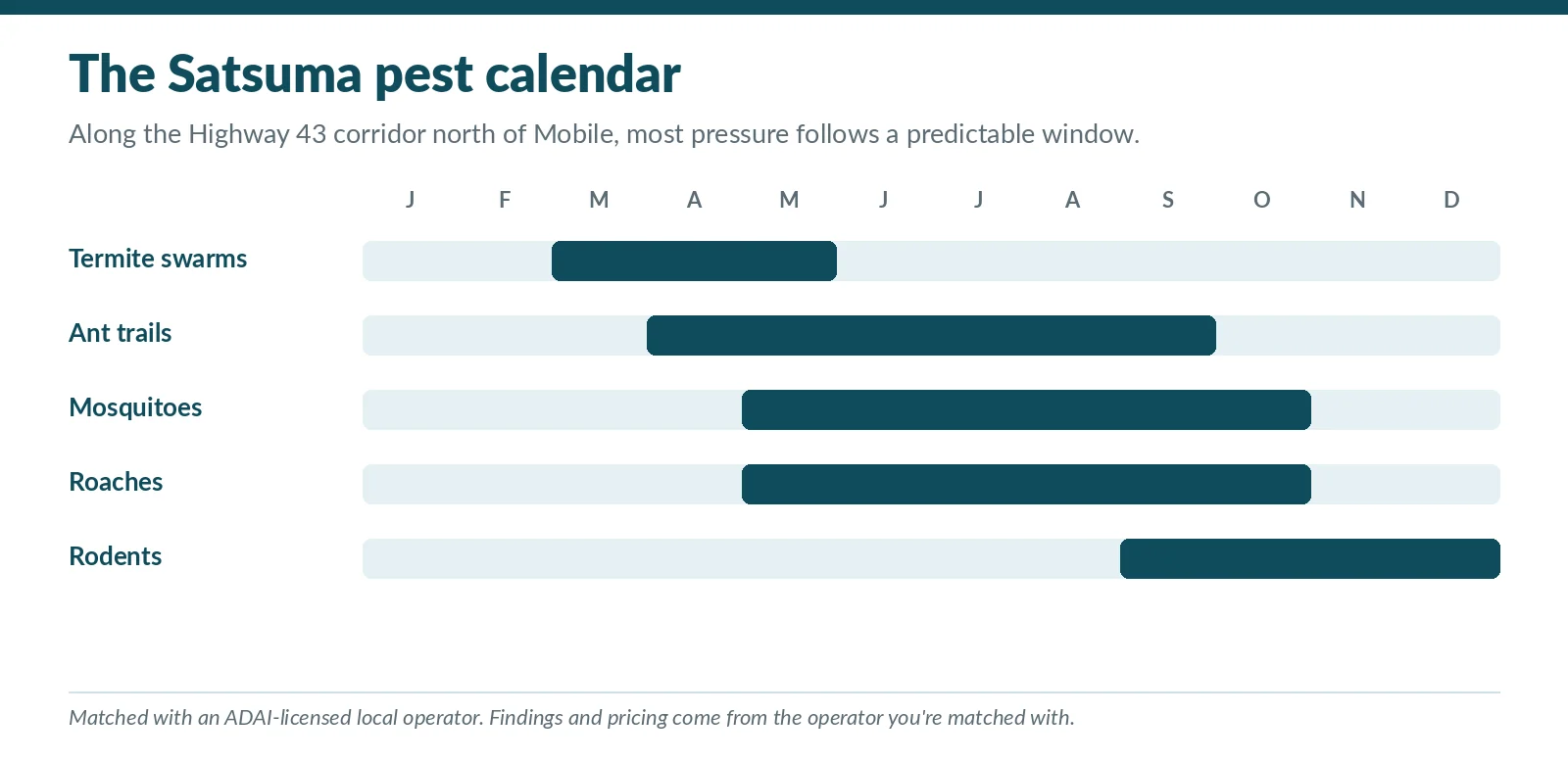
The Satsuma pest calendar
What tends to show up when along the US-43 corridor — so you can describe it accurately when you reach out.
| Season | What shows up in Satsuma homes |
|---|---|
| Feb–Jun | Termite swarm season — native subterraneans first, Formosans on humid May–June evenings. Older frame homes and aging slab pretreatments both produce the classic wings-on-the-windowsill report. |
| Apr–Oct | Fire ant mounds multiply across the pine flats after every rain; smokybrown roaches fly in from pine straw and oak litter on warm nights; ant trails work the kitchens of new builds settling into fresh soil. |
| Jul–Sep | Peak humidity. Millipedes and earwigs push up from the Steele Creek lowlands after storms, silverfish settle into bathrooms and closets, house crickets ride the moisture indoors. |
| Oct–Dec | Satsuma season — for you and the roof rats. Ripening backyard citrus pulls rodents in just as cooling nights push them toward attics. Hollowed fruit, fence-line droppings, and attic noise usually arrive together. |
| Dec–Feb | The “quiet” months that aren’t. Mice settle into wall voids and garages, spiders turn up in storage boxes, and mild winters mean roach and ant activity slows down but never actually stops. |
Free to check coverage. ADAI-licensed operators serving Mobile & Baldwin County, AL.
What should you ask the operator?
You’ll get a better outcome — and a fairer quote — if you ask these on the first visit.
- “What species are we dealing with?” Roof rat vs. Norway rat, Formosan vs. native termite, German vs. smokybrown roach — each pair takes a different plan and budget. Around citrus, rodent species ID especially changes the approach.
- “What’s your ADAI license number?” Every legitimate Alabama operator has one, and the Pesticide Management Section in Montgomery — (334) 240-7240 — can confirm it. A pro expects this question.
- “What did you find, and where?” A quote without findings is a red flag. Ask to see the hollowed fruit, the rub marks, the mud tube in the weep hole — or photos of them.
- “Do I treat the mounds or the whole yard?” For fire ants in pine-flat soil, mound-by-mound treatment usually loses. Ask whether a broadcast program makes more sense for your lot and what the re-treatment terms are.
- “What do I need to do before treatment?” Picking up fallen fruit, trimming branch-to-roof contact, clearing under sinks, mowing before yard work — good operators give prep instructions. If prep never comes up, ask why.
Pest control in Satsuma — what do homeowners ask?
Are you a pest control company?
No — Mobile Alabama Exterminators is a free dispatch and referral service. We connect Satsuma and Mobile County households with independent, ADAI-licensed pest control operators who perform the inspections and treatments. We never do the work ourselves, and we encourage you to verify any operator’s license before hiring.
Something is eating my satsumas on the tree — is that a pest control call?
Very likely, yes. Roof rats hollow out ripening citrus and leave the peel hanging — it’s one of the most distinctive rodent signs on the Gulf Coast, and with the town’s citrus heritage it’s a genuinely common Satsuma call. An operator will confirm the culprit, treat, and — just as important — handle the exclusion and trimming that keeps the next generation out of your attic.
Our house is a newer slab build — do we still need to think about termites?
Yes. Builder soil pretreatments lose strength after a few years, and subterranean termites — including Formosans — enter slab homes through expansion joints, plumbing penetrations, and foundation cracks. New subdivisions along the US-43 corridor are not exempt; they’re just earlier in the timeline. An inspection tells you where your house actually stands.
Why do my fire ants keep coming back after I treat the mounds?
Because the mound you see is a fraction of the colony, and pine-flat soil around Satsuma lets colonies spread wide and re-bud after disturbance. Kicking or drenching individual mounds usually just moves them. Operators typically recommend a broadcast approach with follow-up — ask what re-treatment is included in the plan.
How much does pest control cost in Satsuma?
It depends on the pest, the property, and the scope — and the price is set by the independent operator, not by us. A real number requires an inspection. The call and the match are free; the operator gives you their quote before any work begins, and you’re free to compare it.
Can I get someone after hours?
The dispatch line answers 24/7. Appointment timing is set by the independent operator and depends on their schedule and your location — availability is not guaranteed, and the operator confirms timing directly with you.
Ready when Satsuma is — day or night.
Free to check coverage, free to get matched, no obligation to hire. The licensed operator inspects and gives the quote.
Free to check coverage. ADAI-licensed operators serving Mobile & Baldwin County, AL.
Prefer to send details first? Use the contact form →