
Pest control in Prichard, AL — pier houses, heart-pine sills and vacant-lot rats
Roaches in a kitchen that’s fed three generations, termites working an original heart-pine sill, mice finding the same gap they found in 1965 — Prichard’s older houses need pest control that actually understands older houses. This free 24/7 referral line connects you live with an independent local pest control company serving Prichard, Whistler, and Eight Mile. They inspect, they quote, they treat. You decide.
Roaches in your Prichard kitchen?
Call, enter your 5-digit ZIP on the keypad, and get connected live with a local pest control company. Free to call, 24/7.
Why pest control in Prichard is its own discipline
Most of Prichard’s houses went up between the 1940s and the 1960s — sturdy little frame houses on pier foundations, with wood sills, wood floors, and a crawl space underneath. That construction has real advantages, but it also gives termites and rodents entry points that newer slab homes simply don’t have. Add low, damp ground on the Eight Mile side and vegetation pressure from vacant lots in between, and pest control here becomes its own local skill.
Three local realities drive most of the calls coming off this page:
- Old sills and piers are the front line. Original wood sills sitting close to grade are exactly what subterranean termites — Formosans included — are built to find. The same pier construction gives mice and rats a protected crawl space with sixty years of accumulated gaps. Both problems are fixable; both start under the floor, not in the living room.
- A vacant lot next door changes your pest math. Where tall vegetation stands unmowed, rats harbor and forage, then work the fence line to the nearest kitchen. A straight-shooting operator treats and seals your side, places bait where it actually intercepts the run, and tells you honestly that the mowing schedule next door matters as much as anything in their truck.
- German vs. smokybrown is the roach question that matters. In aging kitchens, the German roach — small, striped, strictly indoors — travels in bags and boxes and needs baiting discipline, not just spray. The big smokybrown “palmetto bug” flies in from the oaks outside. Different roach, completely different plan — and misdiagnosing it wastes everybody’s money.
On the Eight Mile side, low ground and slow drainage add a moisture layer to all of it — earwigs, silverfish, centipedes, and roaches all thrive in a damp crawl space. Ventilation and drainage fixes under the house often do as much long-term good as the treatment itself.
None of this makes Prichard’s houses bad houses. It makes them older houses — and older houses reward an operator who has actually worked on them.
Seeing activity right now? Once you’re connected, describe exactly what you’re seeing — “small striped roaches in the cabinet hinges,” “wings on the porch after a warm evening,” “scratching under the floor.” Specifics help the company you’re connected with bring the right plan the first time.
What a thorough Prichard pest visit looks like
So you can tell a real inspection from a spray-and-pray drive-by.
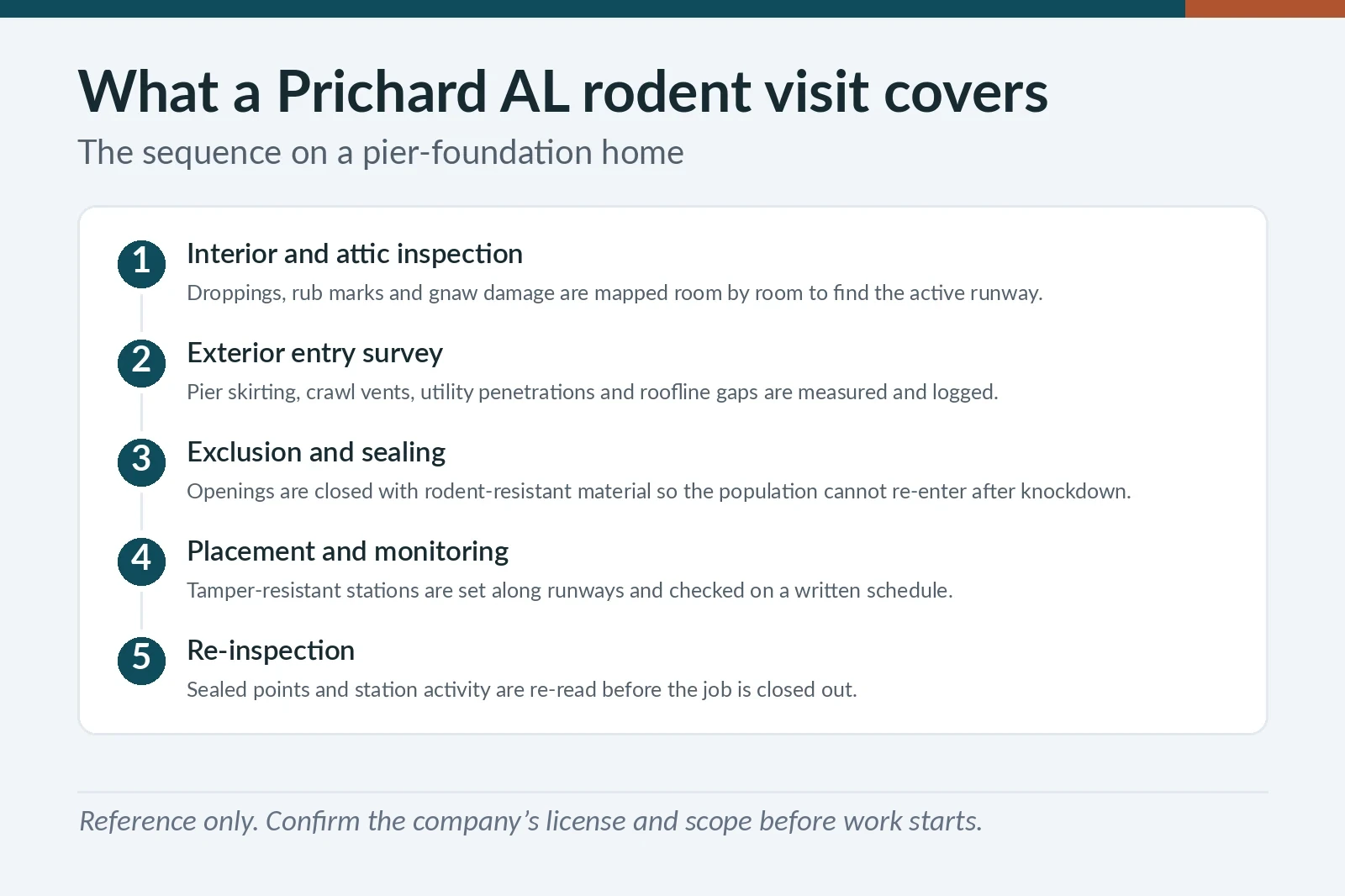
On a pier-foundation house, the crawl space is most of the inspection. A thorough Prichard visit usually covers:
- Under the house, sill by sill — mud tubes climbing the piers, moisture and soft spots at sill level, droppings and burrow entries in the crawl. This is where a 1950s house tells its story.
- Kitchen and bathroom plumbing walls — where German roaches concentrate in older houses. A good operator checks behind the fridge, under the sink, and in cabinet hinges for live activity before naming the species.
- The fence line and any vacant-lot boundary — rub marks, worn runs, and burrows show where rodent pressure actually comes from, which is where the exclusion and baiting belong.
- Roofline and soffits — on Prichard’s older shaded streets, roof rats travel the oak limbs. Chewed soffit returns and greasy rub marks give them away.
- A written scope — what they found, what they propose, what it costs, and what the re-service terms are. Pricing is the operator’s, set after inspection — which is exactly why this site doesn’t publish prices.
If a visit skips the crawl space on a pier-foundation house, you’re allowed to say no. The quote belongs to the operator, and the decision belongs to you.
Renting? Anyone can call — it works the same either way. Structural work like termite treatment is normally the property owner’s decision, so loop the landlord in early; for day-to-day pests like roaches or mice, who books and pays usually follows the lease. The operator can put findings in writing so you can hand them to whoever makes the call.
The Prichard pest calendar
What tends to show up when in north Mobile County — so you can describe it accurately when you reach out.
| Season | What shows up in Prichard homes |
|---|---|
| Feb–Jun | Termite swarm season — swarmers rising from under the floor or the porch on a humid evening is the classic pier-home report. Natives come first, Formosans on May–June nights. |
| Apr–Oct | Roach season ramps up — German roach activity spreads in kitchens, smokybrowns fly in from the oaks, and fire ant mounds pop up along walks and yards after rain. |
| Jul–Sep | Peak humidity — palmetto bugs at full strength, earwigs and silverfish in damp bathrooms, millipedes after storms — the Eight Mile low ground feels it most. |
| Oct–Mar | Rodent season — mice and rats move under the floors and into wall voids as nights cool. Brown recluse turn up in closets and storage boxes while winter things come out. |
Termites in an older Prichard house?
Call, enter your 5-digit ZIP on the keypad, and get connected live with a local pest control company. Free to call, 24/7.
What should you ask the operator?
You’ll get a better outcome — and a fairer quote — if you ask these on the first visit.
- “German or smokybrown?” Make the operator name the roach and show you why. Small and striped in the cabinets means baiting and follow-up visits; big and flying in from outside means perimeter and exclusion. The wrong answer wastes your money.
- “What’s your ADAI license number?” Every legitimate Alabama operator has one, and the Pesticide Management Section in Montgomery can confirm it. A pro expects this question.
- “What did you find under the house?” On a pier home this is the whole inspection. Ask for photos of the piers, the sills, and anything they’re basing the quote on.
- “What gets sealed, not just sprayed?” In older houses, exclusion — closing the gaps — is the fix that lasts. If the plan is all product and no caulk, hardware cloth, or door sweeps, ask why.
- “What’s the prep?” German roach baiting works when the kitchen is cleared and cleaned first; rodent work goes smoother when the operator can reach the crawl. If prep never comes up, ask why.
Pest control in Prichard — what do homeowners ask?
Are you a pest control company?
No — Mobile Alabama Exterminators is a free referral line. We connect Prichard, Whistler, and Eight Mile households with independent pest control operators who perform the inspections and treatments. We never do the work ourselves, and we encourage you to verify any operator’s license before hiring.
How much does pest control cost in Prichard?
It depends on the pest, the property, and the scope — and the price is set by the independent operator, not by us. A full exclusion job on a 1950s pier home is a different ticket than a single roach treatment. Getting connected is free; the operator gives you their quote after inspecting, and you’re free to compare it before anyone does anything.
Which pests can the operators handle?
Roaches — German and smokybrown both — plus ants and fire ants, spiders including brown recluse, mice and rats, house crickets, earwigs, silverfish, clothes moths, centipedes, millipedes, and termites — including Formosan termites and WDO / Section 1 letters. For squirrels, raccoons, and opossums, ask whether the company handles exclusion work.
I rent — do I reach out, or does my landlord?
Anyone can call; it works the same either way. As a practical matter, structural treatments like termite work are the property owner’s decision, so bring the landlord in early — most just want the operator’s findings in writing. For routine pests like roaches or mice, who books and pays usually follows your lease. The operator’s written findings work as documentation for either side.
The vacant lot next door keeps sending rats — what can actually be done on my side?
A fair amount. The operator seals your house — crawl gaps, pipe penetrations, soffit returns — places bait along the actual travel lines at the fence, and clears harborage on your side of the boundary. Overgrown-lot complaints go to the City of Prichard; exclusion on your side works regardless of when the mowing happens.
Can I get someone after hours?
The referral line is open 24/7. Appointment timing is set by the independent operator and depends on their schedule and your location — availability varies, and the operator confirms timing directly with you.
Check the company before treatment starts
In Alabama, companies that do structural pest control, including household pest, termite and fumigation work, must hold a Professional Services license from the Alabama Department of Agriculture and Industries (ADAI). Ask for the company’s license and the name of its certified operator, and check with the ADAI Professional Services program before work starts.
Get the treatment plan, the products to be used, any follow-up visits and the price in writing. For termite work, ask what the contract covers, whether it’s retreatment only or includes repair of damage, and how long it lasts.
How the call works
- Call (888) 295-0220. Any time, day or night.
- Enter your 5-digit ZIP code on your phone’s keypad when prompted.
- Get connected live with a local pest control company that serves your ZIP. Describe what happened and ask when they can come out and what the job will cost.
Mobile Alabama Exterminators is a free referral line that connects callers with independent local pest control companies. We don’t perform the work. The company you’re connected with gives the quote, does the work and stands behind it.