
Restaurant pest control in Mobile — protect the kitchen, the score, and the name on the door.
A roach on the dish line during Friday service is a different kind of emergency than one in a house. This free 24/7 referral line connects Mobile and Baldwin County food-service operators with an independent local pest control company. Ask whether it works kitchens, keeps service logs, and can talk to your inspector’s checklist. The company inspects, quotes and treats. You decide. Availability, including after-hours windows, varies by company schedule.
Roaches in the kitchen before inspection?
Call, enter your 5-digit ZIP on the keypad, and get connected live with a local pest control company. Free to call, 24/7.
Why Mobile kitchens fight a different fight
Commercial kitchens concentrate everything a German cockroach needs into a few hundred square feet: heat, moisture, food film, and a thousand dark seams to live in. Add Mobile’s climate — sixty-five inches of rain and a humidity blanket that never really lifts — and food-service pest pressure here runs harder than in most of the country.
The specific choke points come up on call after call:
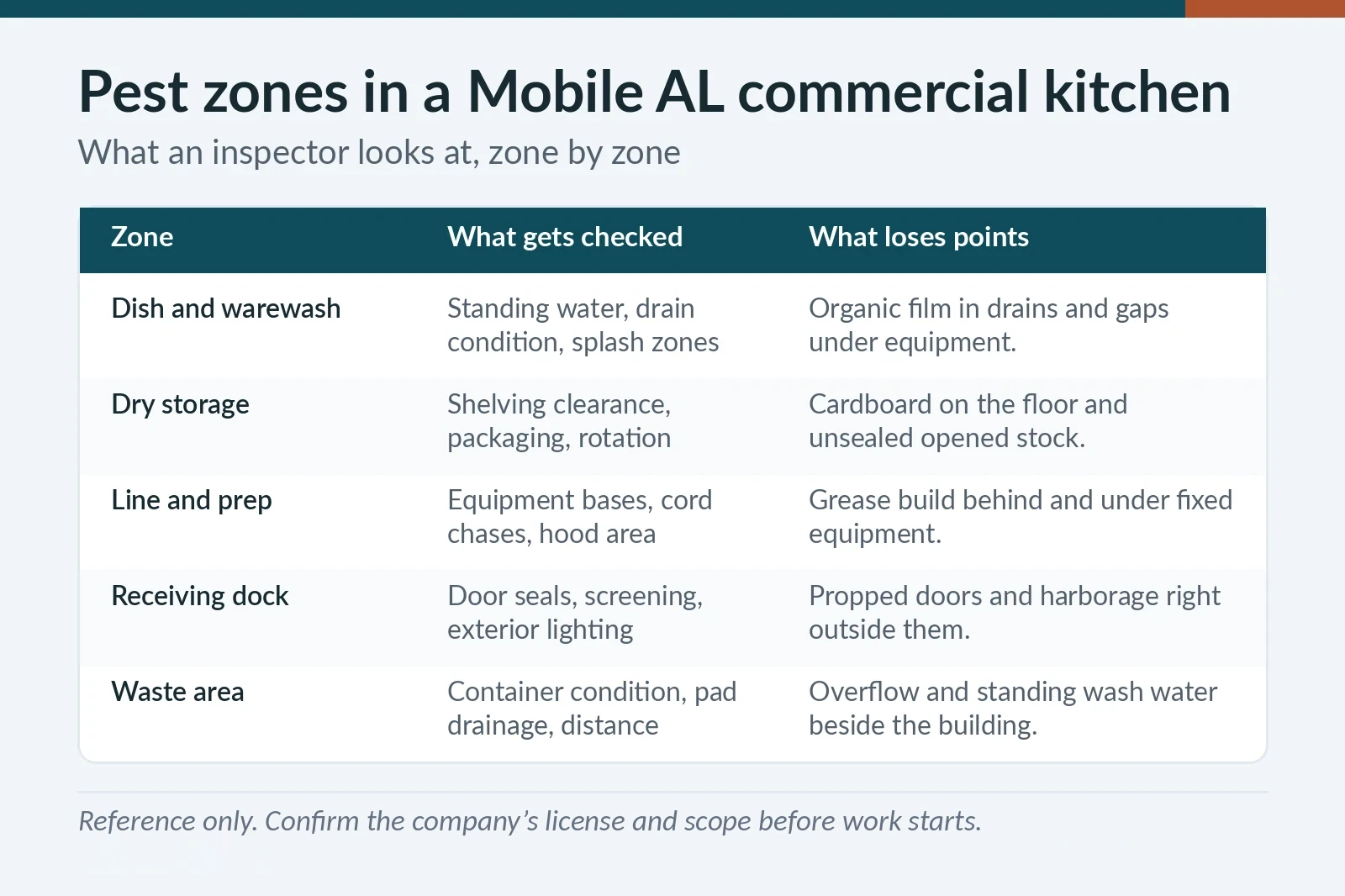
- The dish line. Warm, wet, and never fully dry, the gap behind the dish machine is prime German roach harborage. Same for the seams under stainless prep tables and the motor housings on coolers — warm equipment runs 24 hours, and the roaches know it.
- Floor drains. Organic film in drains feeds roaches, and drain lines connect spaces — which is how a problem next door becomes your problem in an old downtown block where buildings share walls and plumbing runs.
- Delivery cardboard. Corrugated boxes are the classic German roach transit system — egg cases ride the corrugation channels straight from a supplier’s warehouse into your dry storage. Kitchens that break down boxes at the receiving door and never store product in supplier cardboard cut their introductions dramatically.
- The dumpster corral and the receiving door. Rodents in commercial districts work the path between the dumpster and the back door every night. A receiving door with a worn sweep, or a corral pad with gaps and standing grease, is a standing invitation — especially in fall when nights cool and rats look for warm buildings.
- Storage rooms. Quiet, humid dry-storage and paper-goods rooms in older buildings also carry silverfish pressure — a minor player next to roaches and rodents, but one that shows up on inspection reports all the same.
Location shapes the problem too. Dauphin Street and the downtown entertainment district run on century-old buildings with shared walls, shared basements, and shared pest populations — coordination and monitoring matter as much as treatment. The seafood houses out the causeway sit over water with heavy rodent pressure and salt-air door hardware that never quite seals. West Mobile’s newer pads fight the delivery-cardboard cycle more than the building itself. A company that works food service in this county has likely seen a floor plan like yours.
Saw activity during service? Once you’re connected, tell the company what, where, and when — “German roaches behind the dish machine, worse at close” or “droppings on the receiving dock each morning.” Specifics let it plan the right program instead of guessing, and give you a fair basis to ask about its commercial kitchen experience.
Health inspections, scores, and the paper trail
The part of restaurant pest control that lives in a binder, not a sprayer.
Every food-service establishment in the county answers to the Mobile County Health Department, and inspection scores here are public — diners can and do look them up. Evidence of roaches or rodents is exactly the kind of finding that pulls a score down and puts a kitchen on the re-inspection treadmill. That’s not fear-mongering; it’s the ordinary math of running food service in a warm, wet port city. The kitchens that stay clean on paper are the ones that treat pest control as a documented program, not an emergency purchase.
A commercial program worth paying for leaves a paper trail. When the operator proposes one, look for:
- Service logs kept on site — dated entries for every visit, what was found, what was applied, and where. When an inspector asks, the binder answers.
- A monitoring map — numbered glue-board and bait-station locations on a floor plan, so trends show up as data (“station 7 by the dish line keeps catching”) instead of anecdotes.
- Findings and recommendations in writing — the torn door sweep, the wet cardboard in dry storage, the drain that needs the kitchen crew’s attention. Sanitation and exclusion notes are half the value of a good operator.
- Materials suited to food-handling areas — the operator selects and applies products consistent with their license and label requirements around food surfaces; that’s their professional lane, and a good one explains their choices plainly.
On timing: most Mobile kitchens want treatment after close or before prep, and many commercial operators build their schedules around exactly that. Ask what service windows the operator can offer — after-hours scheduling is common in this market but always depends on the individual operator’s schedule and staffing, and is never assured. Lock the expectation into the service agreement rather than assuming it.
Pest sighting in the dining room?
Call, enter your 5-digit ZIP on the keypad, and get connected live with a local pest control company. Free to call, 24/7.
The Mobile restaurant pest calendar
How the food-service pest year runs on the central Gulf Coast.
| Season | What Mobile & Baldwin County kitchens deal with |
|---|---|
| Feb–Apr | Mardi Gras through spring: delivery volume and crowd volume spike together downtown. More cardboard, more door-propping, more introductions — tighten receiving discipline when business is loudest. |
| May–Aug | Peak humidity. Outdoor smokybrown and American roaches push into kitchens on top of any indoor German roach activity; patio service adds ant pressure at thresholds. Drains and dish lines need their strictest routine. |
| Sep–Nov | Nights cool and rodents move — dumpster corrals, receiving doors, and cellar spaces in old downtown blocks see the traffic. The window for door sweeps, sealing, and exterior stations is before Thanksgiving, not after the first droppings. |
| Dec–Jan | Holiday volume, then the January lull — the trade’s classic window for deep cleaning, equipment pull-outs, and a full program walk-through with the operator before the year cranks up again. |
Check the company before treatment starts
In Alabama, companies that do structural pest control, including household pest, termite and fumigation work, must hold a Professional Services license from the Alabama Department of Agriculture and Industries (ADAI). Ask for the company’s license and the name of its certified operator, and check with the ADAI Professional Services program before work starts.
Get the treatment plan, the products to be used, any follow-up visits and the price in writing. For termite work, ask what the contract covers, whether it’s retreatment only or includes repair of damage, and how long it lasts.
How the call works
- Call (888) 295-0220. Any time, day or night.
- Enter your 5-digit ZIP code on your phone’s keypad when prompted.
- Get connected live with a local pest control company that serves your ZIP. Describe what happened and ask when they can come out and what the job will cost.
Five questions to ask the operator before signing a program
Commercial agreements reward the owners who interview first.
- “What service windows can you actually offer?” If you need after-close service, say so up front and get the window written into the agreement. After-hours service is common in Mobile food service, but it depends on the operator’s staffing and schedule — availability is theirs to commit to, not ours.
- “What documentation do you leave on site?” Service logs, a monitoring map, and written findings should be standard on a food-service account. If the answer is a monthly invoice and nothing else, keep interviewing.
- “How will you handle the dish line and the drains?” Listen for specifics: crack-and-crevice work behind equipment, gel bait placement out of food zones, drain treatment, and monitoring. “We’ll spray the baseboards monthly” is a residential answer to a commercial problem.
- “What do you need from my crew?” Good commercial operators assign homework — cardboard breakdown at receiving, dry mopping at close, clearing the floor-wall seam. A pro who asks nothing of the kitchen is planning to fail politely.
- “What’s your ADAI license number?” Every legitimate Alabama operator carries one, and the Alabama Department of Agriculture & Industries’ Pesticide Management Section in Montgomery can confirm it before you sign anything.
Restaurant pest control in Mobile — what do restaurant owners ask?
Why are German cockroaches such a problem in commercial kitchens?
Because a kitchen is their ideal habitat: constant warmth from equipment, moisture from the dish line and drains, food residue in seams, and nightly deliveries of cardboard that can carry egg cases in from elsewhere. They breed at a pace where a small introduction becomes an established population in weeks, which is why commercial kitchens run standing programs with monitoring instead of one-off treatments.
Will a pest problem affect my health inspection?
It can. The Mobile County Health Department inspects food-service establishments and publishes scores, and evidence of roach or rodent activity is the kind of violation that lowers a score and can trigger follow-up. A documented pest program — service logs, monitoring maps, written findings — both reduces the risk and shows the inspector the kitchen is managing it seriously.
Can the operator service my kitchen after hours?
Many commercial operators in the Mobile market build schedules around after-close and pre-prep windows — it’s a normal request. But scheduling belongs to the individual operator and depends on their schedule and staffing; after-hours availability varies. Raise it on the first call and get the agreed window in writing in the service agreement.
What paperwork should a commercial pest program include?
At minimum: dated service logs kept on site for every visit, a monitoring map showing numbered station locations, and written findings with sanitation and exclusion recommendations. That binder is what stands between you and an inspector’s open question — and it’s how you evaluate whether the program is actually working over time.
Are you a pest control company?
No — Mobile Alabama Exterminators is a free referral line. We connect Mobile and Baldwin County restaurants and homeowners with independent pest operators who perform every inspection and treatment themselves. We never do the work, and we encourage you to verify any operator’s license with ADAI before hiring.
Do you cover restaurants outside downtown Mobile?
Yes. Call (888) 295-0220 and enter your ZIP, and you’re connected live with an independent local pest control company that serves your address. The line is open 24/7.
Mobile Alabama Exterminators is a free referral line that connects callers with independent local pest control companies. We don’t perform the work. The company you’re connected with gives the quote, does the work and stands behind it.