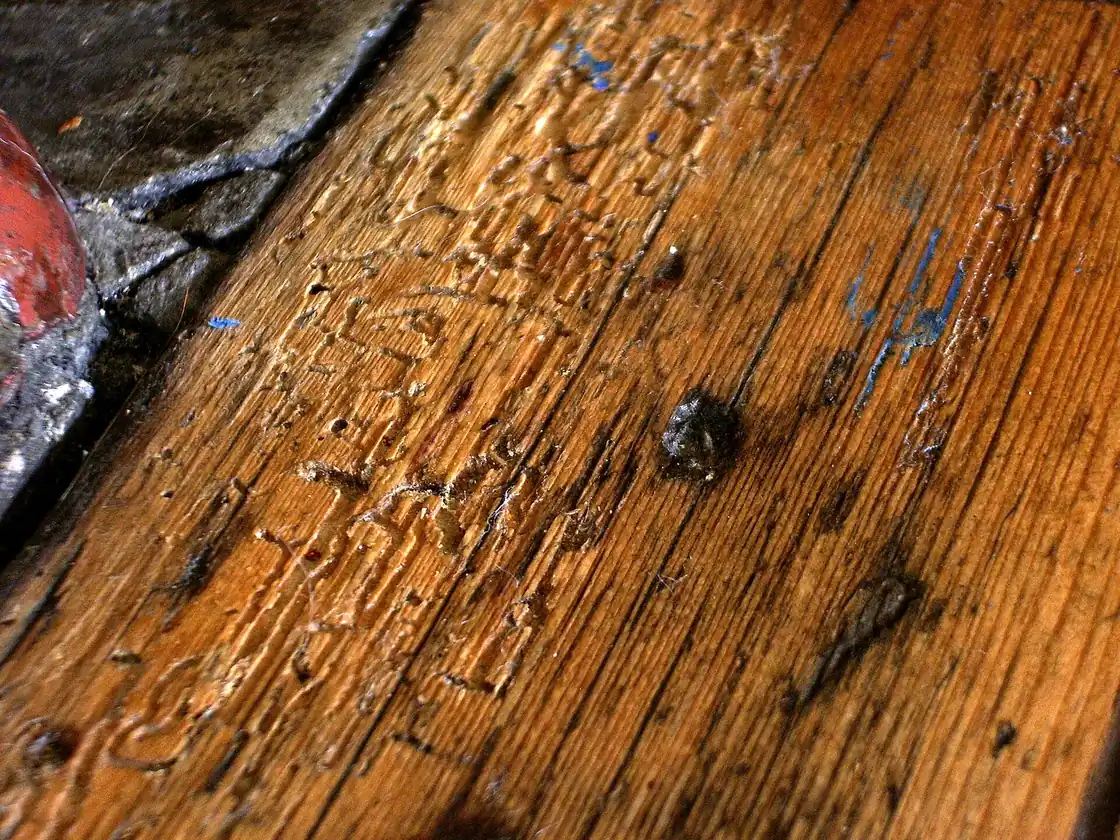
Mobile’s humidity is famous for keeping termite pressure high year-round, but there’s another wood-destroying insect that gets overlooked in the same conversation: powderpost beetles. If you’ve found tiny round holes in a hardwood floor, an antique piece of furniture, or exposed framing in a crawl space, and a fine powder that looks almost like flour sifting out nearby, that combination is worth taking seriously before you paint or refinish over it.
Tiny holes and fine dust in the wood?
Call, enter your 5-digit ZIP on the keypad, and get connected live with a local pest control company. Free to call, 24/7.
What Does Powderpost Beetle Damage Actually Look Like?
A few signs tend to show up together, and the pattern matters more than any single clue:
- Pinhead-sized exit holes. Usually about 1/16 to 1/8 inch across, scattered across the surface of hardwood — flooring, furniture, stair treads, exposed beams.
- Fine, powdery frass. Unlike the coarser sawdust from carpenter ants, powderpost beetle frass is fine and talc-like, often piling in small mounds directly beneath the holes or collecting inside the tunnels themselves.
- Fresh holes appearing over time. Because the larvae feed inside the wood for months before emerging as adults, new holes can show up in a piece of furniture or flooring that seemed fine the year before.
- Weakened or crumbly wood edges. On older infestations, tapping the wood can sound hollow, and edges near heavy damage may crumble under light pressure.
Tap to call (888) 295-0220 — get connected to an independent Mobile exterminator
Why Humidity Makes Mobile Homes Vulnerable
Powderpost beetles target wood with a specific moisture range, and Mobile’s Gulf Coast humidity keeps a lot of untreated lumber sitting right in that sweet spot — especially in crawl spaces, older hardwood flooring installed before kiln-drying standards tightened up, and secondhand or antique furniture that came from a similarly humid environment. Homes built with hardwoods like oak or ash framing, or furnished with older solid-wood pieces, tend to see more activity than homes built mostly with treated softwood.
It’s also common for a powderpost beetle problem to travel into a home on a single piece of furniture or firewood and then spread locally if conditions are right, which is part of why catching it early matters — and why it’s worth knowing how it differs from the more familiar termite treatment process in Mobile, AL, since the two problems don’t get solved the same way.
What to Do If You Find the Signs
A few things worth knowing before you decide on next steps:
Powdery frass under old furniture?
Call, enter your 5-digit ZIP on the keypad, and get connected live with a local pest control company. Free to call, 24/7.
- Don’t just sand, paint, or refinish over active holes. That can mask an ongoing infestation instead of solving it, and larvae already inside the wood keep developing regardless of what’s on the surface.
- Fresh, light-colored frass usually means active feeding; old, discolored frass in holes that haven’t produced new dust in a while may indicate the activity has slowed or stopped — a local pest control company can help tell the difference.
- Isolate suspect furniture pieces from other wood furniture if you can, especially before you know whether the infestation is active.
- Note where you’re seeing damage — flooring, furniture, structural framing — since the treatment approach differs depending on whether it’s a piece of furniture or part of the house itself. A pest inspection in Mobile, AL is the most reliable way to map out how far it’s spread.
Short Answers
Can powderpost beetles infest new lumber?
Yes, if the wood wasn’t properly kiln-dried or has since picked up enough moisture. It’s not only an old-house problem, though older hardwoods and antique furniture do tend to show up more often.
Are powderpost beetles the same as termites?
No. Both are wood-destroying insects, but they behave differently — termites build colonies and often work from the ground up through structural wood, while powderpost beetles lay eggs directly in bare or unfinished wood and the larvae tunnel through it over months. A local pest control company can tell you which one you’re actually dealing with, since the treatment approach isn’t the same.
Can I just replace the damaged board or piece of furniture myself?
Replacing an isolated piece might handle a single item, but if the infestation has spread into structural wood or multiple pieces, a professional inspection is the more reliable way to find out how far it’s gone before you start replacing things piecemeal.
Mobile Alabama Exterminators is a free 24/7 referral line that connects Mobile and Baldwin County homeowners with local pest control companies. We don’t send our own technicians — we get you on the phone with one so a professional can identify exactly what’s in the wood.
Check the company before treatment starts
In Alabama, companies that do structural pest control, including household pest, termite and fumigation work, must hold a Professional Services license from the Alabama Department of Agriculture and Industries (ADAI). Ask for the company’s license and the name of its certified operator, and check with the ADAI Professional Services program before work starts.
Get the treatment plan, the products to be used, any follow-up visits and the price in writing. For termite work, ask what the contract covers, whether it’s retreatment only or includes repair of damage, and how long it lasts.
How the call works
- Call (888) 295-0220. Any time, day or night.
- Enter your 5-digit ZIP code on your phone’s keypad when prompted.
- Get connected live with a local pest control company that serves your ZIP. Describe what happened and ask when they can come out and what the job will cost.
Mobile Alabama Exterminators is a free referral line that connects callers with independent local pest control companies. We don’t perform the work. The company you’re connected with gives the quote, does the work and stands behind it.