Every named-storm landfall on the Gulf Coast produces a predictable wave of pest activity in Mobile and Baldwin counties — and 2026 is shaping up to be an active Atlantic season. Here’s what to expect, in order, and what to do about it.
Dealing with a pest problem right now?
📞 Call now — get matched with a licensed local exterminator: (888) 295-0220When you call, stay on the line for a few seconds while we match you with the licensed local exterminator for your area. Have your address and a quick description of the problem ready.
Licensed local pros · Fast response, subject to availability · No obligation
One call reaches a licensed, local exterminator who covers your address — and a real person answers, 24/7.
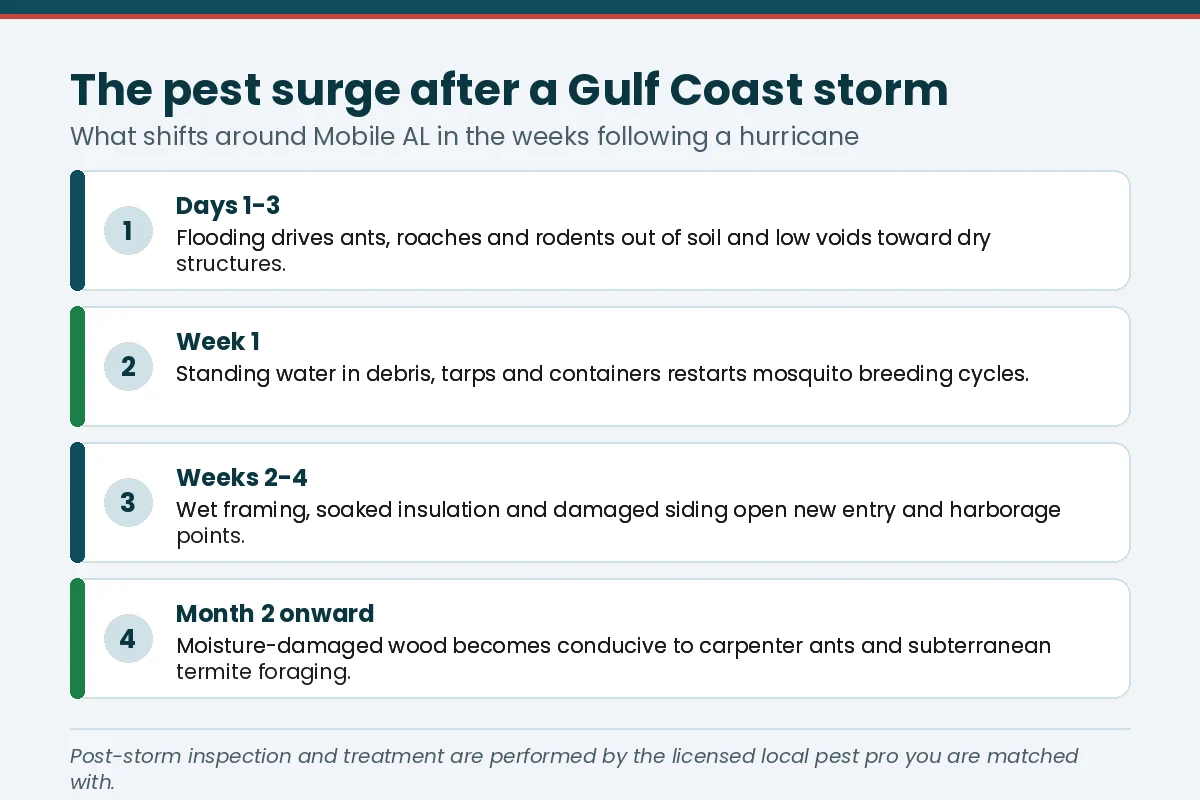
The post-hurricane pest timeline
Pest surge follows a consistent timeline regardless of storm size:
Days 0–3 — rodent displacement. Storm surge and inland flooding force roof rats (Rattus rattus) and Norway rats out of burrows, sewers, and ground-level harborage. They move uphill toward dry structures. Mobile and Baldwin spike rodent calls 30–60 days post-storm.
Days 3–10 — mosquito hatch. Aedes albopictus (Asian tiger mosquito) and Culex quinquefasciatus both lay drought-resistant eggs that reactivate with rainfall. New mosquito populations emerge 7–14 days post-storm. Mobile County Health Department surveillance for West Nile virus and EEE typically shows elevated positives Sept–Nov in post-hurricane years. Mosquito control is outside the scope of our dispatch network — contact a licensed mosquito-abatement provider or your county health department directly for this concern.
Days 7–30 — fire ant raft re-establishment. Both red imported fire ant (Solenopsis invicta) and black imported fire ant (S. richteri) form rafts when flooded — the colony links workers and queens into a buoyant mat. Rafts wash ashore in new locations after waters recede. Neighborhoods that had no fire ant problem before a storm can have one within days.
Days 14–60 — termite acceleration. Water-damaged framing — sill plates, band boards, joists — is the single biggest termite-pressure event a Gulf Coast home faces. Within 30–90 days both Formosan and eastern subterranean colonies will exploit damp wood. The 2003 Fairhope Formosan Watch Program (109 monitoring sites, ~70% positive for Formosan) was set up partly to capture the Hurricane Ivan post-storm signature.
Days 30–90 — wildlife intrusion. Raccoons, opossums, squirrels, bats lose nesting sites and seek shelter in storm-damaged attics, soffits, crawl spaces.
The Sally (2020) baseline
Sally produced ~24″ of rainfall in parts of Mobile and Baldwin. Documented post-Sally pest impacts: severe fire ant raft re-establishment, mosquito surveillance positives elevated through fall, sustained rodent calls through early 2021, and termite-bond claim activity from water-damaged framing elevated through 2022.
What should you do, in order?
This week (pre-season prep):
- Empty containers that hold water (planters, kiddie pools, tarps, kayak storage)
- Trim limbs touching the roof
- Inspect garage door seals and door sweeps
- If you have an active termite bond, schedule a pre-storm bond inspection through your WDC operator
Hour 0 (immediately post-storm):
- Walk perimeter, document new openings with photographs for insurance
- Seal anything you can — door sweeps, plywood over vents, expanding foam
- Place rodent snap traps at perimeter
Days 3–10:
- Drain every standing water source to reduce mosquito breeding
- Walk yard slowly looking for new fire ant mounds — apply two-step bait protocol
Days 14–60:
- Schedule WDC-certified termite inspection if framing was wet
- Address moisture remediation before termite treatment
For the comprehensive playbook see Hurricane Pest Prep for Mobile & Baldwin County and Post-Hurricane Pest Control.
Pricing for post-storm services
- Emergency rodent intercept: mid-to-high hundreds
- Fire ant yard treatment: low-to-mid hundreds
- Termite bond inspection (existing holders): often no charge
- Wildlife removal + exclusion: mid hundreds to low thousands, depending on scope
Full 2026 line-by-line pricing in the Pest Control Cost Guide for Mobile, AL.
Related Mobile pest references
- Complete Pest Control Guide for Mobile, AL
- Pest Control Cost Guide — Mobile, AL
- Hurricane Pest Prep for Mobile
- Red Imported Fire Ant in Mobile, AL
One call reaches a licensed, local exterminator who covers your address — and a real person answers, 24/7.
MobileAlabamaExterminators.com is a dispatch service. We connect callers with licensed Alabama exterminators. We are not a licensed pest control company. The disclaimer in our site footer and our 24/7 dispatch caveat apply to this page.