A sudden cloud of winged insects near a Mobile home’s foundation or porch light triggers the same question every time: termites or just flying ants? The two look similar enough at a glance to cause real confusion, but a handful of physical differences settle it in seconds once you know where to look.
Dealing with a pest problem right now?
📞 Call now — get matched with a licensed local exterminator: (888) 295-0220When you call, stay on the line for a few seconds while we match you with the licensed local exterminator for your area. Have your address and a quick description of the problem ready.
Licensed local pros · Fast response, subject to availability · No obligation
Getting this right matters in Mobile specifically, since coastal Alabama sits in one of the state’s heaviest termite-pressure zones, including a documented concentration of the aggressive Formosan subterranean termite. Confusing a termite swarm for a harmless ant swarm can mean a genuine problem goes unaddressed for months.
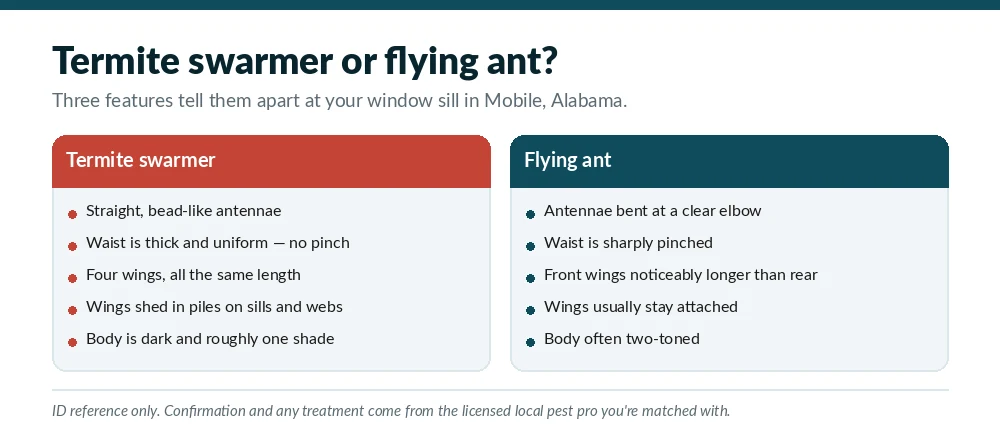
The Three Physical Differences That Actually Matter
Waist shape
A flying ant has a distinctly pinched, narrow waist between its thorax and abdomen. A termite swarmer’s body is straight and broad from front to back, with no pinch at all. This is the single most reliable way to tell them apart if you can get a clear look at the body.
Antennae shape
Flying ants have bent, elbowed antennae. Termite swarmers have straight, bead-like, string-of-pearls antennae with no bend in them.
Wing size and shape
A flying ant has two pairs of wings of noticeably different sizes – the front pair longer than the back pair. A termite swarmer has four wings that are all roughly the same length and shape, extending well past the body, and swarmers frequently shed these wings entirely once they land, leaving small discarded wing piles behind as a telltale sign even after the swarmers themselves are gone.
Where You’re Likely to See Each
Termite swarmers typically emerge near ground level, at foundation cracks, slab expansion joints, or from wood in direct soil contact, often triggered by warm, humid conditions following rain – a pattern common during Mobile’s spring and early summer. Flying ants can emerge from a much wider range of locations, including established colonies well away from any structural concern.
Why Are Discarded Wings a Clue Worth Checking For?
Because termite swarmers shed their wings almost immediately after landing to search for a mate and a new nesting site, a small pile of uniform, translucent wings on a windowsill, porch floor, or foundation ledge – with no ants attached to them – is a strong indicator that a termite swarm occurred nearby, even if you missed seeing the insects themselves.
What to Do If You Suspect a Termite Swarm
Do not disturb or vacuum up the swarmers or wings before a professional has a chance to see them, since their location and concentration help an inspector pinpoint where a colony may be active. A licensed inspector can confirm species and check for the mud tubes, frass, or damaged wood that indicate whether the swarm came from a colony already established in or near your home. See our WDO inspection guide for what a full inspection actually covers, and our termite control overview for Mobile, AL for background on the species active in this area.
Frequently Asked Questions
Can I identify a termite swarmer without catching one?
Often yes, if you can see the general body shape and wing proportions from a short distance, or if you find a pile of discarded, uniform wings without any ant bodies nearby.
Do flying ants damage homes the way termites do?
No. Flying ants are the reproductive form of an ant colony and do not cause the kind of structural wood damage subterranean or drywood termites do, though some ant species can still be a nuisance pest.
What time of year do termite swarms happen in Mobile?
Warm, humid conditions following rain in spring and early summer are the most common trigger locally, though timing can vary by species and specific weather patterns each year.
Is it normal to see a few flying ants but not a full swarm?
Yes, ant colonies can send out scattered winged reproductives rather than one large synchronized swarm, unlike termite colonies which more typically release swarmers together in a single event.
Should I call a professional even if I’m fairly sure it’s just ants?
If there is any uncertainty, a licensed inspection is a reasonable step, since correctly ruling out termite activity is worth confirming rather than assuming, especially in a heavy termite-pressure area like coastal Alabama.
One call reaches a licensed, local exterminator who covers your address — and a real person answers, 24/7.
MobileAlabamaExterminators.com is a dispatch service. We connect callers with licensed Alabama exterminators. We are not a licensed pest control company. The disclaimer in our site footer and our 24/7 dispatch caveat apply to this page.