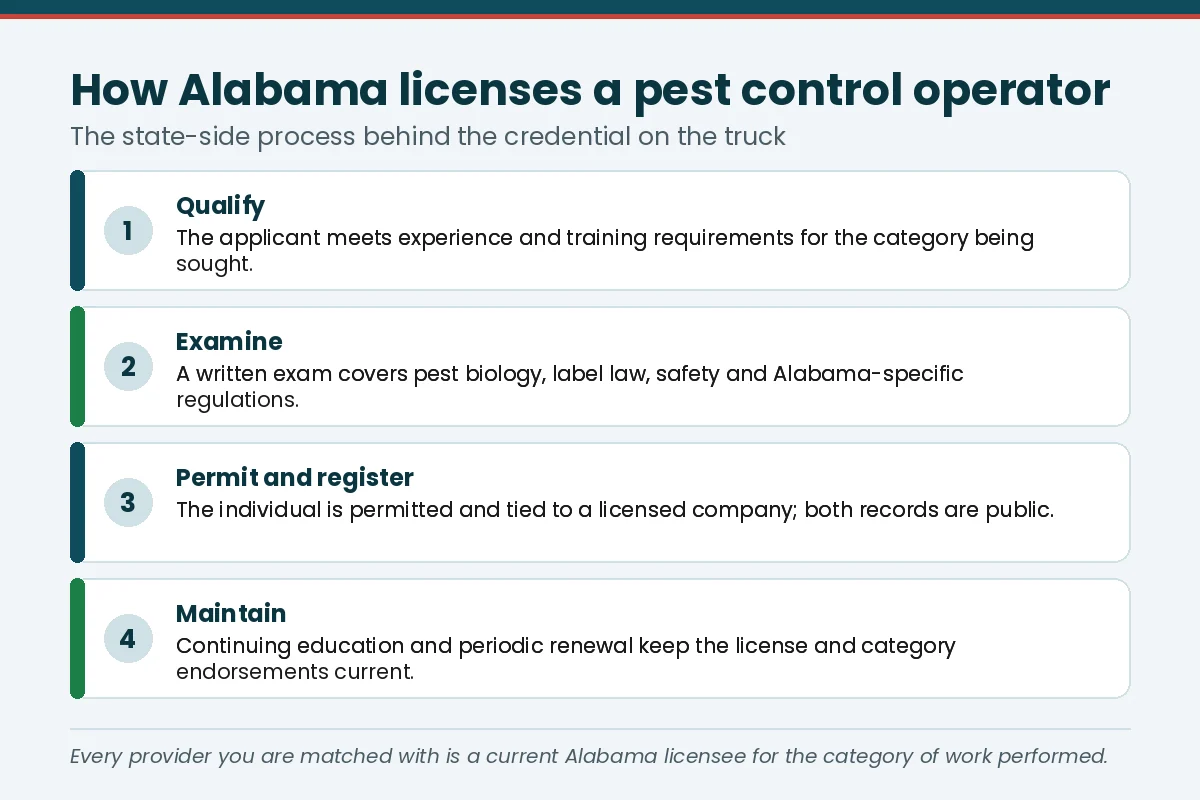
Pest control in Alabama is regulated by the Alabama Department of Agriculture and Industries (ADAI) under Chapter 28, Title 2, Code of Alabama 1975 and Chapter 80-1-13 of the Alabama Administrative Code. The licensing structure matters to homeowners for one specific reason: not every license category authorizes every kind of pest work. Hiring the wrong license category for the wrong job is the most common preventable mistake in the consumer pest-control market.
The three categories that matter
ADAI issues commercial pest-control licenses under several sub-categories. The three that come up most often for Mobile-Baldwin homeowners are:
HPC — Household Pest Control. Authorizes general household pest work: ants, cockroaches, fleas, spiders, occasional invaders, rodents, bed bugs, mosquitoes. The bread-and-butter license for residential service. Does not authorize termite work.
WDC — Wood-Destroying Organi. Authorizes termite inspection, termite treatment, termite bonds, and the official Alabama Wood Infestation Inspection Report (the ‘termite letter’ most Mobile-area lenders ask for). A separate license from HPC. An HPC-only license-holder cannot legally write a termite bond or issue the official Alabama Wood Infestation Inspection Report.
FC — Fumigation. Authorizes structural fumigation — the ‘tenting’ procedure used for severe drywood termite infestations and certain whole-structure pest problems. Most pest-control operators do not hold FC; the fumigation work is typically subcontracted to a licensed FC operator.
How do you verify an ADAI pest control license?
ADAI maintains a public licensee lookup. Before signing any pest-control contract — especially a termite bond or a WDO inspection — search the technician’s company name and the assigned technician’s name in the lookup. The result will show: active license categories, expiration date, any disciplinary actions. The lookup takes 90 seconds and is the strongest protection against unlicensed work.
Why this matters in Mobile-Baldwin specifically
Two reasons. First, Formosan subterranean termite is established here, and the species damages structural lumber on a faster timeline than native subterraneans — making a properly written WDC-category termite bond more valuable than in regions with less aggressive species. Second, Mobile County is a high-volume real-estate market, and most closings call for the official Alabama Wood Infestation Inspection Report. A report issued by a non-WDC operator is not a valid letter under Alabama regulation; the bank can reject it, the closing can be delayed, and the buyer can be on the hook for re-issue.
Questions to ask before hiring
What license categories does the company hold? What category is the on-site technician licensed under? Is the on-site technician the license-holder, or working under another license-holder’s supervision? For termite work specifically: is the bond covered under WDC, and does the bond explicitly include Formosan as a covered species?
Get Matched With a Licensed Exterminator
One call reaches a licensed, local exterminator who covers your address — and a real person answers, 24/7.
Where licensing fits your service decision
License categories map directly onto the services Mobile-area homeowners actually buy. A recurring quarterly pest control plan falls under HPC. A termite treatment or Sentricon bait system installation requires WDC. And if you are buying or selling a home, the WDO inspection and the resulting termite letter must come from a WDC-licensed operator for the paperwork to hold up at closing.
The practical takeaway: match the license category to the job before you compare prices. A low quote from a company licensed in the wrong category is not a deal — it is a document a bank can reject or a treatment that may not be legally warrantied.
Frequently Asked Questions
How do I look up a pest control license in Alabama?
Use the ADAI public licensee lookup. Search both the company name and the technician assigned to your job. The record shows active license categories, the expiration date, and any disciplinary history. It takes about 90 seconds.
Can an HPC-licensed company write a termite bond?
No. Termite bonds, termite treatments, and Alabama Wood Infestation Inspection Reports fall under the WDC (wood-destroying organi) category. An HPC-only operator can treat ants, roaches, rodents, and other household pests, but cannot legally take on termite work.
What is the Alabama WDIR termite letter?
It is the standardized wood-destroying organism inspection report that, under Ala. Admin. Code r. 80-10-9-.18, may be required as a condition of sale financing — and that most Mobile-area lenders do ask for before closing. To be valid under Alabama regulation it must be issued by a WDC-licensed operator.
Is structural fumigation covered by a normal pest control license?
No. Tenting a structure requires the separate FC (fumigation) category. Most local operators subcontract fumigation jobs to a licensed FC specialist — which is normal and worth confirming in writing.
Do Alabama pest control licenses expire?
Yes. Every license carries an expiration date and renewal requirements, and the ADAI lookup displays current status. If a license shows expired or lapsed, do not sign a contract until the operator can show proof of renewal.
Get matched with a licensed pest control pro in Mobile
One call reaches a licensed, local exterminator who covers your address — and a real person answers, 24/7.