Rodent control in Birmingham, AL — one call to a licensed operator.
From Norway rats working North Birmingham’s aging sewer lines to roof rats nesting in Forest Park’s oak canopy, which rodent you have decides how it gets excluded. Our 24/7 dispatch line matches you with an independent, ADAI-licensed exterminator who reads the sign before setting a single trap. You call, we match, the licensed operator inspects and quotes.
One call, and you’re matched
Tell the dispatcher what you’re seeing — scratching in a Crestwood attic since the cold snap, droppings along a North Birmingham foundation, grease rubs on a Redmont garage rafter — and get matched with a licensed operator who covers your street.
☎ Call (888) 295-0220 (888) 295-0220 — answered 24/7Free call · No obligation to hire anyone · The licensed local exterminator you’re matched with inspects and sets the price
Mobile Alabama Exterminators is a free 24/7 dispatch and referral line. Call (888) 295-0220, describe what you’re seeing — droppings, scratching, gnaw marks, where and when — and we match you with an independent exterminator licensed by the Alabama Department of Agriculture & Industries who covers your Birmingham address. The licensed operator, not us, inspects, identifies the species, and sets the price for exclusion and treatment.
Why does Birmingham split so cleanly between Norway rats below and roof rats above?
Birmingham’s rodent calls sort cleanly into two stories, and which one you are in depends less on your zip code than on where the animal actually lives — down in the ground and the infrastructure, or up in the trees and the roofline. Norway rats are the ground-level species: heavy-bodied burrowers that nest in soil, foundations and drainage systems. Roof rats are the climbers: leaner, more agile, and happiest working a tree canopy or a power line into an attic. Birmingham has strong populations of both, and they cluster in different parts of the city for reasons tied directly to the terrain and the building stock.
Norway rats concentrate where Birmingham’s older infrastructure gives them cover and a food source. North Birmingham’s aging sewer and storm-drain lines, some of them close to a century old, provide burrowing rats a network to move through largely undetected, and the industrial edges around Ensley — warehouses, rail corridors, vacant and underused lots — add the harborage and food waste that keep a ground-level population fed year-round. From there it is a short move into a foundation gap, a garage, or a crawlspace on the residential streets nearby.
Roof rats tell a different story in the canopy neighborhoods — Forest Park, Redmont, and the older shaded streets of Crestwood — where mature oaks planted decades ago now form a near-continuous cover between yards. A roof rat rarely touches the ground; it moves tree to tree, tree to power line, power line to roofline, and into an attic through a gap at the soffit, the roof edge, or a gable vent most homeowners never inspect from that angle. Grease rubs along a rafter and droppings concentrated in one attic corner are the classic finds in these neighborhoods, not the foundation-level sign that shows up in North Birmingham.
Elevation compounds the seasonal push. Red Mountain and the surrounding ridgeline mean a real cold snap arrives with some bite, usually by November or early December, and both species respond by moving indoors — Norway rats through the same foundation gaps they have used all year, roof rats down out of a canopy that has just lost its leaf cover. Birmingham’s 1920s bungalow stock, sitting on brick piers with gaps at the sill and around utility penetrations, gives both species an easy way in exactly when they are most motivated to find one.
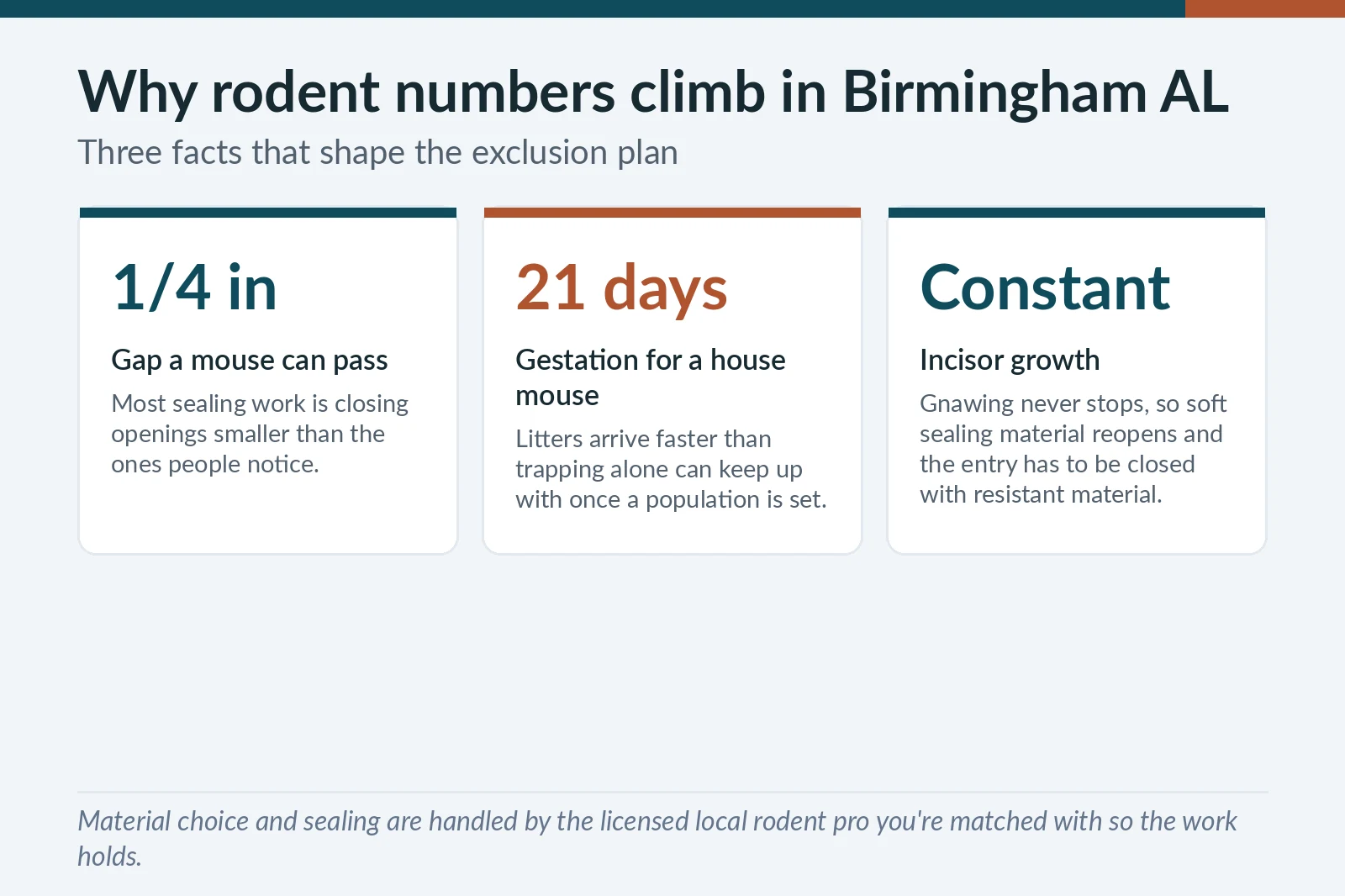
Because the gaps that matter are specific, exclusion has to be too. A mouse can work through a gap the size of a dime; a rat needs something closer to a quarter, and a Norway rat working a foundation can sometimes exploit a gap approaching a half-dollar around a larger utility penetration. Reading the sign first — droppings sized and shaped by species, grease rubs left by an oily coat brushing the same path repeatedly, gnaw marks on wood or wiring — tells an operator which species is present and where it is actually getting in, before any traps go down.
What goes down after that depends on the property. Snap traps, placed along a confirmed travel path, are often the more direct option in an attic or garage with limited household traffic. Secured, tamper-resistant bait stations make more sense around a home’s exterior where kids or pets have access, since the bait stays locked inside a housing a small child or a dog cannot reach.
Either tool fails on its own if the entry points stay open — a trapped-down population simply gets replaced by the next rodent working the same gap. Exclusion first, monitoring after, is the difference between a one-time fix and a repeat call every winter.
Seeing rodent activity in Birmingham right now? Tell the dispatcher where — a Crestwood attic corner, a North Birmingham foundation, a Redmont garage rafter — and whether it is droppings, scratching, or something you actually saw. That narrows the species before the operator arrives.
☎ Call (888) 295-0220Free call · 24/7 · No obligation to hire — the licensed operator you’re matched with gives the quote
How does the rodent dispatch line work in Birmingham?
Total transparency: we answer phones and match. Licensed operators do the work.
You call, we listen
Tap the number, day or night, and tell the dispatcher what you’re seeing in Birmingham — it takes about a minute, costs nothing, and you’re not committing to anything.
We match you locally
Mobile Alabama Exterminators is a dispatch and referral service, not a pest control company. We route your call to an independent operator licensed by the Alabama Department of Agriculture & Industries who covers Birmingham and the surrounding Jefferson County area.
The operator takes over
The licensed operator inspects your property, walks you through what they found, and gives you their own quote. Hiring them is entirely your decision — and you can verify their ADAI license first through the Pesticide Management Section in Montgomery at (334) 240-7240.
What else can you call the Birmingham line about?
The dispatch line routes five core problem types across Birmingham. Each links to a deeper guide on this site.
Pest control in Birmingham →
The parent hub for every pest problem across the city, from North Birmingham’s infrastructure to the oak canopy neighborhoods.
Rodent control →
The statewide rodent guide — species identification, exclusion standards, and trapping versus bait-station logic.
Termite treatment →
The same brick-pier bungalow gaps that let roof rats and mice inside also give termites their entry points.
Roach exterminator →
North Birmingham’s aging sewer infrastructure carries American roaches the same way it carries Norway rats.
Roof rats vs. Norway rats →
A closer look at telling the two species apart and why the distinction changes the exclusion plan.
When does rodent pressure peak in Birmingham?
Species and elevation both shape the calendar.
| Season | What shows up in Birmingham homes |
|---|---|
| Mar-May | Roof rats in Forest Park and Redmont breed as the canopy leafs out; Norway rat activity along North Birmingham’s storm drains picks up with spring rain. |
| Jun-Aug | Steady outdoor activity for both species — Norway rats work the Ensley industrial edges and vacant lots, roof rats stay high in the canopy with plenty of cover and food. |
| Sep-Nov | The cold push begins — by November, both species move toward structures. Attics in the canopy neighborhoods and foundations in North Birmingham see the year’s sharpest rise in calls. |
| Dec-Feb | Indoor season — rodents nest in attic insulation, wall voids and garages through the winter, with activity concentrated wherever a fall exclusion job did not happen. |
Notice it got worse after a cold snap? Say so — Birmingham’s November cold push is when both Norway and roof rats move indoors, and timing helps confirm which one you are dealing with.
☎ Call (888) 295-0220Free call · 24/7 · No obligation to hire — the licensed operator you’re matched with gives the quote
What should you ask the operator about your rodent problem?
Asking these on the first visit gets you a better outcome — and a fairer quote.
- “Is this a Norway rat, a roof rat, or a mouse?” Ground-level burrowers, canopy climbers and mice all need different exclusion approaches. Ask the operator what sign — droppings, grease rubs, gnaw marks — confirmed the species.
- “What’s your ADAI license number?” Every legitimate Alabama operator carries one, and the Pesticide Management Section in Montgomery can confirm it. A pro expects the question.
- “Where exactly are they getting in?” Exclusion only works if every entry point gets found and sealed — a soffit gap, a foundation crack, a utility penetration. Ask to see the specific points on your house, not just where the traps go.
- “Are you using traps, bait stations, or both, and why?” The right mix depends on the location and whether kids or pets have access. A secured bait station belongs outside near a play area; a snap trap along a confirmed attic path often works faster indoors.
- “Is exclusion included, or just trapping?” Trapping without sealing the entry points usually means the problem returns with the next cold snap or the next rat working the same gap. Ask whether the quote includes exclusion work, not just removal.
None of these questions slow down an operator who works Birmingham’s canopy neighborhoods and North Birmingham infrastructure every week — the answers tell you whether the fix will actually hold through next winter.
Rodent control in Birmingham — what do homeowners ask?
Are you a pest control company in Birmingham?
No — Mobile Alabama Exterminators is a free dispatch and referral service. We connect Birmingham homeowners and businesses with independent, ADAI-licensed pest control operators who perform the inspection, exclusion and treatment. We never do the work ourselves, and we encourage you to verify any operator’s license before hiring.
How much does rodent control cost in Birmingham?
The price is set by the independent operator after they have inspected and identified the species and entry points — it depends on the scope of exclusion needed. The call and the match are free; ask the operator what drives their quote.
Why do I hear scratching in the attic every November?
Birmingham’s cold snaps typically arrive by November, and that is when roof rats move down out of neighborhood tree canopies and Norway rats push in from outdoor burrows toward heated structures. It is a predictable seasonal pattern, not a sign your house is unusually vulnerable.
Does living near a wooded, canopy-heavy street change my risk?
Yes — streets in Forest Park, Redmont and older parts of Crestwood with mature, connected tree cover give roof rats an elevated path straight to a roofline, a different risk profile than a ground-level Norway rat problem near North Birmingham’s drainage infrastructure.
Which parts of Birmingham does the line cover?
The line routes across the city — the canopy neighborhoods of Forest Park and Redmont, the North Birmingham and Ensley industrial edges, the older bungalow blocks with pier foundations — plus the rest of Jefferson County. Call and the dispatcher confirms coverage for your address.
Can I get someone after hours in Birmingham?
The dispatch line answers 24/7. Appointment timing is set by the independent operator and depends on their schedule and your location — availability varies by operator and time of day. The operator confirms timing with you directly.
Ready when you are — day or night.
, free to get matched, no obligation to hire. The independent ADAI-licensed operator who covers your Birmingham street inspects and gives the quote.
☎ Call (888) 295-0220(888) 295-0220 — free call, 24/7. The licensed operator inspects and gives the quote.