
It usually starts after dark. You are lying in bed, the house is quiet, and then you hear it — a scratching, scurrying, gnawing sound moving across the ceiling or inside a wall. If you live in Mobile or Baldwin County, there is a good chance the visitor overhead is a rat, and which kind of rat it is tells you a lot about where it is nesting, how it got in, and what it will take to stop it.
The two rodents you are most likely dealing with on the Gulf Coast behave very differently. One is a climber that loves attics; the other is a burrower that sticks to ground level. This guide explains how to tell them apart, the signs each one leaves behind, the entry points common to coastal Alabama homes, why DIY trapping so often stalls out, and what to tell a licensed exterminator so the problem actually gets solved instead of just thinned out.
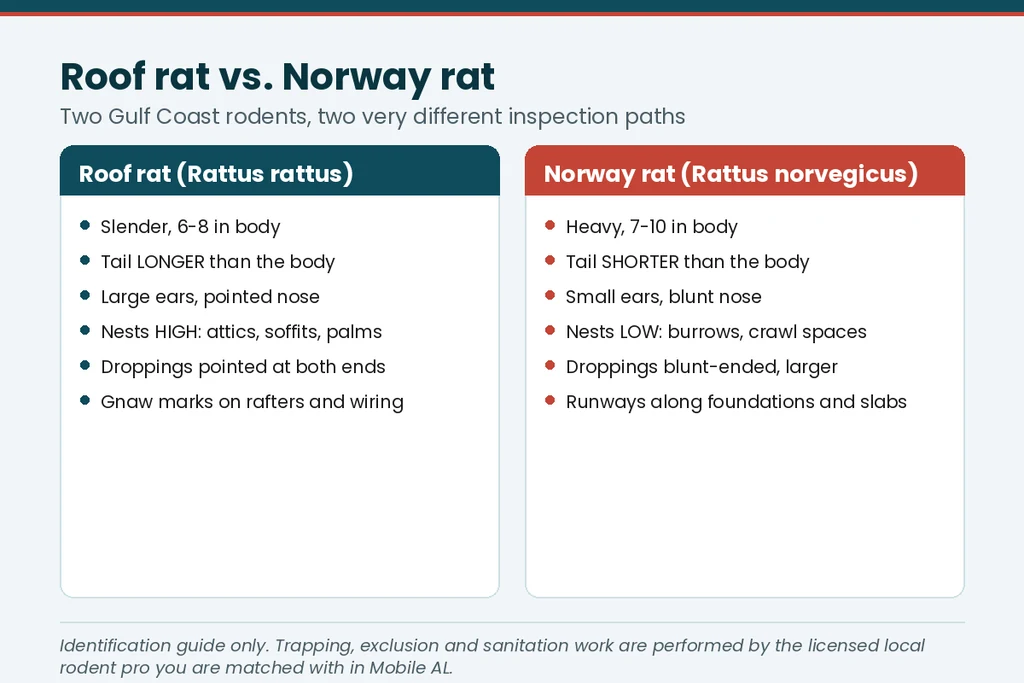
The Two Rats You’ll Meet on the Gulf Coast
Most rat problems in Mobile-area homes come down to two species, and the difference between them is mostly about altitude — where in and around the house they prefer to live.
Roof rats — the climbers
Roof rats are exactly what the name suggests. They are agile, lightweight climbers that prefer to live up high — in attics, soffits, upper wall voids, and the canopy of trees. They have a slender body, large ears, a pointed nose, and a tail that is longer than their head and body combined. In a coastal climate full of mature trees and fruiting plants, roof rats thrive: they are drawn to citrus, fruit, nuts, and ornamental plantings, and they use limbs and wires like sidewalks. If your nighttime noises come from the ceiling or the attic, a roof rat is the leading suspect.
Norway rats — the burrowers
Norway rats are the heavier, stockier cousin. They have a blunt nose, smaller ears, and a tail shorter than their body, and they are built to dig rather than climb. They live low — burrowing in soil along the foundation, under sheds and concrete slabs, in crawlspaces, and around garbage and woodpiles. Indoors they favor ground level: lower walls, beneath kitchen cabinets, and basements or crawlspaces. If your evidence is concentrated at floor level, in a crawlspace, or you are finding burrow openings outside near the foundation, you are likely dealing with Norway rats.
Knowing which one you have shapes everything that follows, because you treat a ceiling-dwelling climber and a foundation-burrowing digger in different places. Both fall under rodent control in Mobile, AL, but the inspection focus is not the same.
The Signs They Leave Behind
Rats are secretive, so you will usually catch the evidence before you ever see the animal. A few signs are reliable, and some even help you tell the two species apart.
Droppings are the most telling. Roof rat droppings are spindle- or sausage-shaped with pointed ends, about half an inch long, and tend to show up in the attic, along ceiling joists, and on top of insulation. Norway rat droppings are larger and more blunt or capsule-shaped, and you will find them at ground level — under sinks, along baseboards, and in the crawlspace. Where the droppings cluster also points you to the nest.
Gnaw marks are a second clue, and they carry a real warning. Rats must gnaw constantly to wear down their ever-growing incisors, and they chew on wood, plastic, and — most dangerously — electrical wiring. Chewed wire insulation in an attic is both a sign of roof rats and a genuine fire risk, which is one reason a rat problem in the ceiling is not something to ride out.
Rub marks are greasy, dark smudges that build up along the routes rats travel repeatedly, where the oil and dirt in their fur transfers to walls, beams, pipes, and the edges of entry holes. Following the rub marks often leads straight to a travel highway or an entry point.
Night noises round it out: scratching, scurrying, and gnawing after dark, with scampering across the ceiling pointing to roof rats and sounds low in the walls or crawlspace pointing to Norway rats. You may also notice a musky odor where activity is heavy, or find shredded insulation, paper, and fabric worked into a nest.
How Do They Get In?
Rats do not need a large opening — a roof rat can pass through a gap about the size of a quarter, and they are relentless about finding one. In Mobile and Baldwin County’s mix of humid weather, mature trees, and older housing stock, a handful of entry routes account for most infestations.
For roof rats, the access is almost always up high. Tree limbs and shrubs that touch the roof give them a direct climb into the canopy and onto the house, and from there they exploit gaps where the soffit meets the fascia, openings around roof vents and the chimney, unscreened gable and attic vents, and the spots where power and cable lines enter. Aging soffit and fascia boards — common on the area’s older homes and anything the coastal humidity has softened — open up gaps that a determined rat will widen.
For Norway rats, the access is at or below grade. They follow utility penetrations, slab edges, and crawlspace vents, slip under garage doors that no longer seal, and exploit gaps where pipes enter through the foundation. Outdoors, they burrow along the foundation and under sheds, decks, and concrete, then work their way in.
The throughline is that overhanging vegetation, deteriorating exterior trim, and unsealed penetrations are doing most of the work. Cutting trees back off the roof and sealing the gaps you can find is the single most effective thing a homeowner can do to make a house less rat-friendly.
Hearing it in the ceiling every night? Get matched with a licensed Mobile exterminator
Why DIY Traps Often Stall
Plenty of homeowners buy a few snap traps, catch a rat or two, and feel like they have the situation handled — and then the scratching comes back a week later. The reason is almost always the same: trapping removes the rats you catch, but it does nothing about the entry point and the nest that keep producing new ones.
Rats reproduce quickly and a structure can host more than you realize, so thinning a few from the attic while the highway they use stays wide open is a temporary dent, not a fix. Trap placement also matters more than people expect; rats are neophobic, meaning they are suspicious of new objects in their environment, so traps set in the wrong spots or handled the wrong way get avoided for days. And catching the animals without finding the rub marks, the chewed wire, and the gap they enter through means you never close the loop.
A licensed exterminator works the problem in a different order: inspect to identify the species and find the actual entry points and travel routes, then exclude — seal those openings with rodent-resistant materials so new rats cannot follow — and trap or treat strategically based on where the rats are actually moving. The exclusion step is the part DIY usually skips, and it is the part that makes the result last. This is the core of professional rodent control in Mobile, AL, and it folds into a home’s broader pest control plan; you can see the full range of accepted pests we connect homeowners with pros for.
What to Tell the Exterminator
The more precisely you can describe the activity, the faster a pro can zero in on the species and the source. Before you reach an exterminator, note a few things.
Tell them where you hear or find evidence — ceiling and attic versus low walls and crawlspace — because that single detail usually distinguishes roof rats from Norway rats. Note when the noises happen and how long it has been going on. Describe any droppings you have found, including their shape and where they were, and mention gnaw marks, especially on wiring, and any greasy rub marks along beams or walls. Flag the outdoor setting too: tree limbs over the roof, a woodpile or shed near the foundation, fruit trees, or aging soffit and fascia. Those observations point the inspection straight at the entry route and turn a general rodent visit into a targeted one.
Need the entry points found and sealed? Get matched with a licensed Mobile exterminator
Frequently Asked Questions
How do I know if I have roof rats or Norway rats? Location is the fastest tell. Roof rats live high — attics, soffits, ceilings — and leave pointed, half-inch droppings up top, while Norway rats stay low in crawlspaces, lower walls, and burrows along the foundation, leaving larger, blunt droppings at ground level. Roof rats are slender with a long tail and big ears; Norway rats are stockier with a blunt nose and a shorter tail.
What is scratching in my ceiling at night in Mobile? Scampering and scratching across the ceiling after dark most often means roof rats, which are agile climbers that nest in attics and upper wall voids. They are active at night, which is when you notice them. Finding spindle-shaped droppings or chewed wiring in the attic helps confirm it.
Are rats in the attic a fire hazard? They can be. Rats gnaw constantly to manage their growing incisors, and they chew on electrical wiring, which can expose conductors and create a fire risk. Chewed wire insulation in an attic is one of the more serious reasons to address a roof rat problem promptly rather than wait it out.
Why do roof rats keep coming back after I trap them? Because trapping removes individual rats but leaves the entry point and nesting site intact, so new rats follow the same route in. Lasting control requires finding and sealing the openings — the exclusion step — in addition to trapping, which is why DIY efforts that skip sealing tend to stall.
How are roof rats getting into my house? Usually from above. Tree limbs touching the roof let them climb onto the house, and they enter through gaps at the soffit and fascia, around roof and gable vents, at the chimney, and where utility lines penetrate. A gap roughly the size of a quarter is enough, and aging or humidity-softened trim widens those openings.
What attracts rats to Mobile and Baldwin County homes? The coastal mix of warm weather, mature trees, and fruiting plants suits roof rats especially, which favor citrus, fruit, and nuts. Both species are drawn to accessible food and water, sheltered nesting sites, and overgrown vegetation, woodpiles, and clutter near the house that offer cover and easy access.
Should I handle a rat problem myself or bring in a pro? A single rat caught quickly may be manageable, but recurring noises, droppings in multiple spots, or chewed wiring point to an established problem that needs professional inspection and exclusion. A licensed exterminator identifies the species, seals the entry points, and traps strategically so the issue does not keep returning.
MobileAlabamaExterminators.com is a dispatch service. We connect callers with licensed Alabama exterminators. We are not a licensed pest control company. The disclaimer in our site footer and our 24/7 dispatch caveat apply to this page.