Fire ant control in Theodore, AL — where the yard meets open field.
A mound rebuilding at the back fence where your lot borders a pasture, a new mound along the tree line near Bellingrath Gardens Road, ant beds spreading across a big rural-adjacent lot faster than you can spot them — Theodore’s mix of suburban streets and open field edges gives fire ants room to spread that denser Mobile neighborhoods don’t have. This free 24/7 dispatch line connects you with an independent, ADAI-licensed pest control operator who treats the colony, not just the mound you can see. They inspect, they quote, they treat. You decide.
Free call, free match — the operator gives the quote. Availability varies by schedule.
Check your ZIP first
One call reaches a licensed, local exterminator who covers your address — and a real person answers, 24/7.
Free to use · No obligation to hire anyone
24/7 dispatch line — real people answer
Free call — the operator gives the quote
Theodore, southwest Mobile & Mobile County
Why Theodore properties grow fire ant mounds so fast
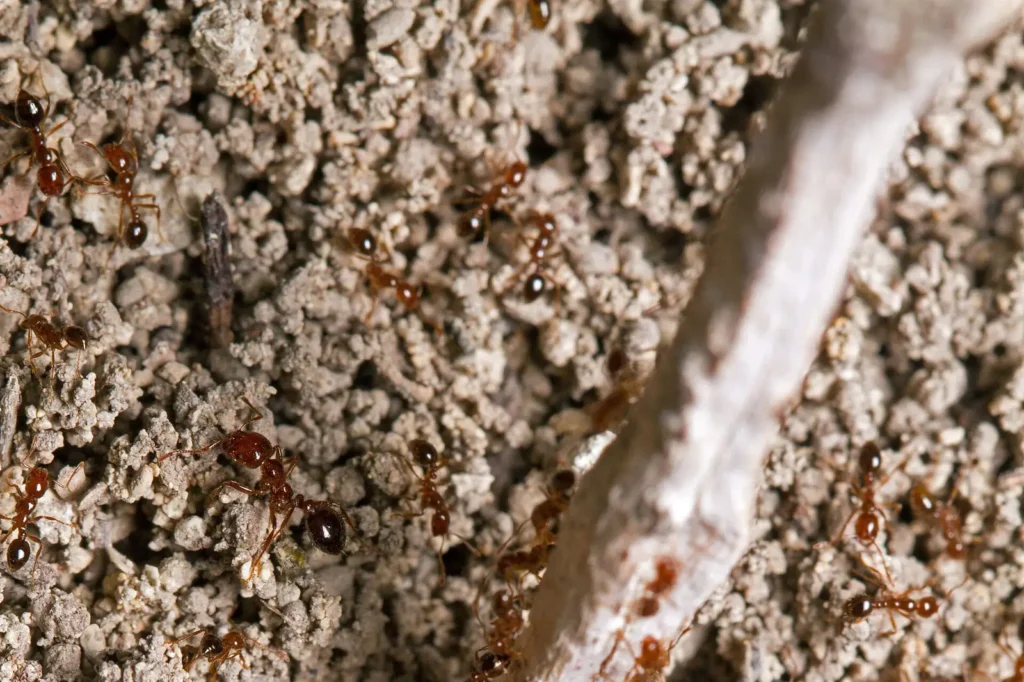
Theodore sits on Mobile’s rural-suburban southwest edge, threaded between subdivision streets and the open pasture, timberland, and undeveloped field edges that run down toward the Dog River and Fowl River watershed near Bellingrath Gardens. Red imported fire ants (Solenopsis invicta) build mounds in loose, sunny, well-drained soil — and in Theodore that habitat doesn’t stop at the property line. A colony living in an unmanaged field or fence row next door has an open path onto a mowed suburban lawn, and a colony on a larger rural-adjacent lot has far more undisturbed ground to spread into than a typical in-city yard ever would.
Three patterns show up again and again in the calls this page gets:
- Field-edge migration. Mounds concentrate along back fence lines, tree lines, and any border where a maintained yard meets pasture, timberland, or a vacant lot — common throughout Theodore’s outer neighborhoods and the properties nearer Bellingrath Gardens Road.
- Bigger lots, more blind spots. Rural-adjacent acreage means more square footage for satellite mounds to establish out of sight — behind a shed, along a drainage ditch, at the edge of a wooded lot line — before anyone notices activity near the house.
- Spot-treating one mound doesn’t touch the rest. On a larger property, treating only the mound you happened to see leaves the rest of the colony network — and any satellite mounds along the field edge — completely untouched, which is why homeowners describe mounds “popping up everywhere” a few weeks later.
Both suburban yards and larger rural-adjacent lots in Theodore deal with this same underlying issue: open, sunny ground bordering unmanaged land gives fire ants a much bigger territory to colonize than a dense in-town block does. A disturbed mound delivers a painful, multi-sting attack from a shared venom sac, which is a real risk for kids, pets, and anyone with a venom allergy — especially on bigger properties where mounds can sit farther from the house and go unnoticed until someone is already standing on one.
Got a fresh mound near a field edge, fence line, or play area? Skip the boiling water or gasoline — neither reliably kills the colony, and both can damage soil and lawn. Note the mound’s location and how many others you can see nearby, then get connected below; the operator treats the colony at the source, not just the visible dirt pile.
How does the dispatch line work?
Total transparency: we answer phones and match. Licensed operators do the work.
You reach out, we listen
Tell us your address and where the mounds are — front yard, back fence, field edge, near a play area. Takes about a minute, no cost, no obligation.
We match you locally
Mobile Alabama Exterminators is a dispatch and referral service, not a pest control company. Your call routes to an independent ADAI-licensed operator who covers Theodore and southwest Mobile County.
The operator takes over
The licensed operator inspects the property, maps active mounds, and gives you their own quote. Verify their ADAI license number directly with the Alabama Department of Agriculture and Industries before work begins.
What a thorough fire ant treatment covers on a Theodore property
Whole-property mound mapping
On larger, rural-adjacent lots this means walking the full boundary — fence lines, tree lines, drainage ditches — not just the mound closest to the house.
Broadcast bait plus mound treatment
A common two-part approach: slow-acting bait workers carry back to the queen, paired with direct mound treatment for faster relief on active mounds.
Field-edge & property-line zones
Where a yard borders pasture, timberland, or a vacant lot, ask the operator about treating the border zone itself to slow re-colonization from untreated adjacent land.
The Theodore fire ant calendar
When mounds appear and spread on Mobile’s southwest edge.
| Season | What drives fire ant activity in Theodore |
|---|---|
| Mar–May | Warming soil wakes overwintering colonies; early mounds appear along sunny field edges and open lawn areas first. |
| Jun–Sep | Peak season — frequent Gulf thunderstorms trigger rapid mound-rebuilding after flooding, and colonies migrate from unmanaged pasture and timberland edges onto maintained lots. |
| Oct–Nov | Activity stays elevated into early fall thanks to Mobile County’s mild autumn temperatures. |
| Dec–Feb | Colonies retreat deeper into the soil during cool spells but rarely go fully dormant on the Gulf Coast. |
What should you ask the operator?
- “Are you treating the whole property or just the mound I called about?” On a larger lot, satellite mounds along the field edge or fence line often haven’t surfaced yet.
- “What’s your ADAI license number?” Confirm it with the Alabama Department of Agriculture and Industries’ Pesticide Management Section before hiring.
- “Bait, mound treatment, or both?” Ask why the operator recommends their approach and how long it takes to see results.
- “Do you treat the property line where it borders open land?” Ask how they handle re-colonization risk from an adjacent pasture, timberland, or vacant lot.
- “How soon should I expect a mound to come back if this doesn’t work?” Ask about re-service terms if activity returns within a set window.
Fire ant control in Theodore — what do homeowners ask?
Are you a pest control company?
No — Mobile Alabama Exterminators is a free dispatch and referral service. We connect Theodore homeowners with independent, ADAI-licensed operators who perform every inspection and treatment.
Why does Theodore seem to have more fire ant mounds than other parts of Mobile?
Many Theodore properties border pasture, timberland, or undeveloped field edges near the Dog River and Fowl River watershed. That open, unmanaged land gives fire ant colonies far more room to spread than a dense in-city lot allows.
Do larger rural-adjacent lots need different treatment than a smaller suburban yard?
Both need a full inspection, but larger lots have more ground for satellite mounds to hide in — along fence lines, drainage ditches, and tree lines — so the inspection typically covers more territory.
Why do fire ant mounds keep coming back after I treat them myself?
Store-bought treatments often kill visible workers but leave the queen and deeper colony structure intact. A licensed operator uses bait methods designed to reach the queen, not just the surface mound.
How much does fire ant control cost in Theodore?
Pricing is set by the independent operator after inspection and depends on property size and the number of active mounds. The call and the match are free.
Are fire ant stings dangerous?
Most people get a painful, itchy pustule that resolves in a few days. Multiple stings or an allergic reaction can be serious — seek medical attention for widespread swelling, difficulty breathing, or dizziness after a sting.
Do the operators serve my Theodore neighborhood?
Yes — the line routes across Theodore’s 36582 ZIP, including areas near Bellingrath Gardens and out toward the Dog River and Fowl River watershed, plus the rest of Mobile County.
Mound spreading from the field edge onto your lawn? Get the colony, not just the mound.
Free to get matched, no obligation to hire. The licensed operator inspects and gives the quote.
Free to use · No obligation to hire anyone
Prefer to send details first? Use the contact form →