
When daytime highs drop into the seventies and Gulf-Coast nights cool into the sixties, roof rats and Norway rats begin a predictable migration. The food supply outdoors thins. The temperature gradient between an attic and the night air becomes attractive. By the third week of October the call volume for rodent activity in Mobile and Baldwin County homes climbs every year. The good news: the migration is predictable, and the homes that get sealed before mid-October are the homes that stay rodent-free through winter.
Dealing with a pest problem right now?
📞 Call now — get matched with a licensed local exterminator: (888) 295-0220When you call, stay on the line for a few seconds while we match you with the licensed local exterminator for your area. Have your address and a quick description of the problem ready.
Licensed local pros · Fast response, subject to availability · No obligation
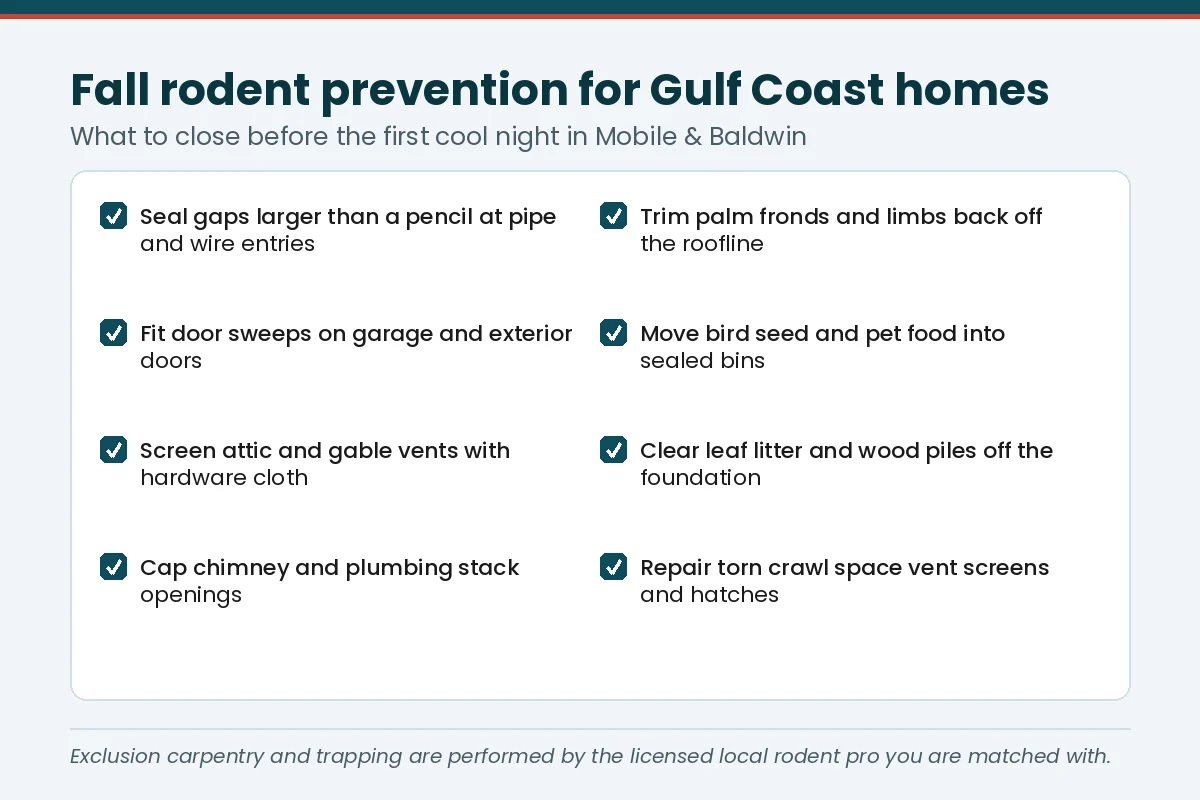
The two species you will deal with
Roof rats (Rattus rattus) are climbers — palm trees, jasmine vines, oak limbs that touch the house, and the gable vents above the soffit. Norway rats (Rattus norvegicus) are ground-level — burrows under slabs, sewer-line breaks, and the gap between the foundation and the bottom of the siding. The Gulf Coast is heavy on roof rats; the inland farmland north of I-10 leans more Norway. Both move indoors when ambient nighttime temperature drops below the body-temperature differential they tolerate, which is roughly the 55-60°F overnight range that arrives in Mobile in early-to-mid October. If you are hearing activity but are not sure which species you are dealing with, our roof rats vs. Norway rats ID guide walks through the droppings, body shape, and location cues that tell them apart.
The four entry points that account for most fall infestations
Exclusion work in coastal Alabama lands on the same handful of failure points season after season. Gable vents with corroded or pulled-away screens. Soffit returns where the wood has rotted around a leaky gutter. The HVAC chase coming through the roof or wall, where the original caulk has shrunk away from the line set. The garage door bottom seal, which becomes a tunnel after a few years of dragging across concrete. Closing these four points before October is the highest-leverage exclusion work on most Mobile-area homes.
Why don’t bait stations alone solve it?
A locked bait station outside the home reduces the rodent population in the immediate area but does not stop new rodents from finding the same entry points. Exterior bait without exclusion treats the symptom. Exclusion without bait can leave a small interior population trapped inside the walls. Most ADAI-licensed pest control technicians in this market run a coordinated protocol: identify the entry points, exclude them, set interior snap or multi-catch traps to capture animals already inside, and place exterior bait stations to reduce outdoor pressure. Interior traps come out within a couple of weeks; exterior stations stay year-round. If you want the steady-state version, an ongoing quarterly pest control plan rolls bait station monitoring into the schedule.
Attic inspection — what to actually look for
Most homeowners can spot the obvious signs from the access hatch with a flashlight: droppings along the top plate, rub marks on the rafters, and stripped insulation near the soffit lines. The signs that matter more are subtler. A faint stained line along the top of the duct trunk indicates a runway. A pile of citrus rind or palmetto-frond fragments under a roof vent is a roof-rat food cache. Chew marks on plastic plumbing vents from the inside confirm activity. A chewed hole in an insulation bat near a chase is a route to a wall void. Auburn Cooperative Extension keeps an overview of home rodent management that lines up with what an inspector will actually look for on site.
Local timing for Mobile and Baldwin
The Gulf-Coast micro-climate shifts the typical fall rodent timeline forward by two to three weeks compared to inland Alabama. In Mobile, Daphne, Fairhope, Foley, and Gulf Shores, the noticeable uptick begins in late September. By the second week of October it is reliable. By mid-November interior populations are usually established. The window for prevention — exclusion done before any animal has come inside — is shorter on the coast than it is north of I-10. Coastal homeowners who book exclusion work in late September or the first week of October avoid the issue entirely. Booking the same work in mid-November is reactive: the animal is already inside.
Frequently Asked Questions
Do moth balls or peppermint oil keep rats out of the attic? No. Both have been tested repeatedly by Alabama Cooperative Extension and university entomology programs, and neither produces a meaningful or durable repellent effect. Sealing the entry points is the only thing that works.
How much does professional rodent exclusion cost on the Gulf Coast? Exclusion cost depends on the number of entry points, the access difficulty (single-story vs. a two-story with a steep pitch), and whether interior trapping and attic decontamination are included. Whole-home exclusion with attic clean-out and insulation replacement costs more than a targeted entry-point seal, reflecting the added scope. The licensed operator you’re matched with sets the actual price after assessing the property.
Are roof rats dangerous? Beyond structural damage to wiring, insulation, and roofline materials, roof rats can transmit leptospirosis, salmonellosis, and rat-bite fever, and they can carry fleas that vector other pathogens. Rodent exposure in living areas is a sanitation problem worth addressing promptly.
Will my homeowner insurance cover rodent damage? In most cases no. Standard homeowner policies in Alabama exclude damage from vermin. The exception is some collateral damage — for example, fire damage caused by rodent-chewed wiring — that may be covered depending on the carrier.
How long does an exclusion job take? A single-story home with three to five entry points is typically a one-day job. A larger home with attic decontamination and interior trapping monitoring spans one to three weeks of follow-up visits before the job is closed out.
Get Matched With a Licensed Exterminator
One call reaches a licensed, local exterminator who covers your address — and a real person answers, 24/7.
Mobile Alabama Exterminators is a 24/7 dispatch and matching service. We connect Mobile and Baldwin County callers with licensed, insured Alabama pest control exterminators. We are not a licensed pest control company and do not inspect, treat, or warranty pest control work.