
✅ Network of ADAI WDC-Licensed Operators • 🛡️ Independent Local Operators • ⚡ fast-dispatch routing • 🔍 no-obligation inspection routing
Transparent pricing: The ADAI-licensed operator you’re connected with quotes treatment pricing after a no-obligation initial inspection routing request. Ask the operator for their ADAI license number and proof of insurance before any work begins; fast-dispatch routing is available in most areas, subject to operator availability.
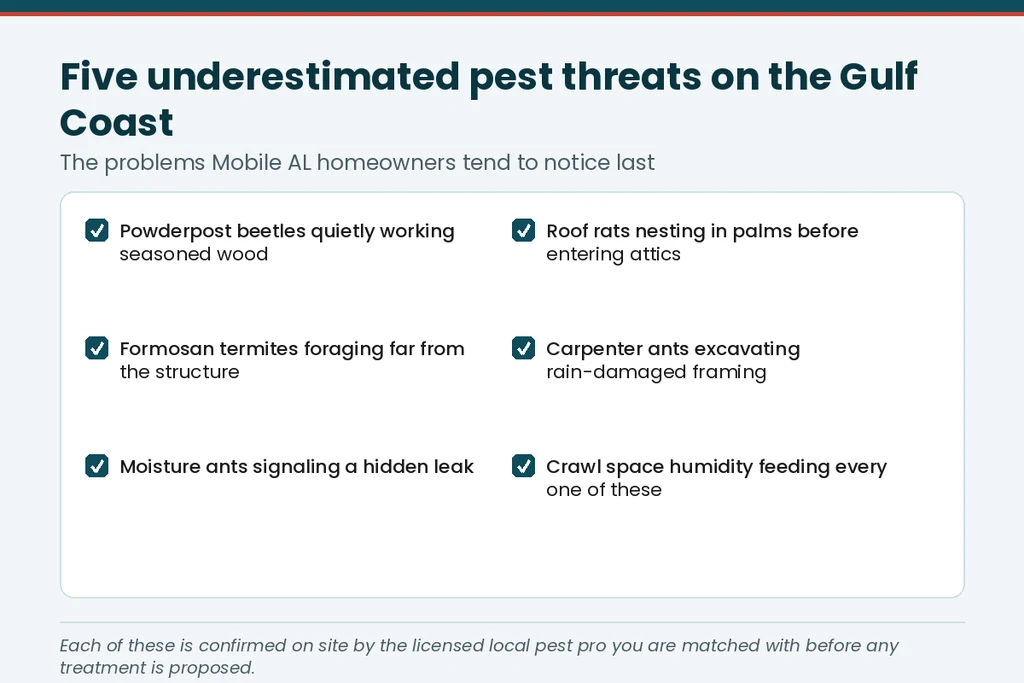
Most pest lists you find online are written for the rest of the country. If you live in Mobile or Baldwin County, the five pests most likely to cost you real money are not the five pests on a national list. Here are the ones that should be on your radar. For the full local rundown, our Mobile pest control overview covers the complete pest pressure picture county-wide.
1. Formosan subterranean termite
The species nobody warns Mobile-area homeowners about until after the damage is done. Now established in every part of both counties. Schedule a WDO inspection every five years. For a deeper look at how this species differs from native subterranean termites and why it does so much more damage so much faster, see our Mobile Formosan termite explainer, and for treatment and bonding options specific to this species, see Formosan termite control in Mobile.
2. Palmetto bug (American cockroach)
The reason they matter is less the cockroach itself and more what their presence indicates. A sudden indoor palmetto-bug problem usually means a plumbing leak, a roof-flashing failure, or a crawlspace ventilation problem. Treat the moisture, not just the cockroach.
3. Drywood termite
Particularly common in coastal Baldwin County and in historic Mobile neighborhoods with original hardwood framing. Drywood termites do not need soil contact — they live entirely inside the wood they are eating. Look for ‘frass’: tiny coffee-ground-like pellets below an infested board. Because drywood and Formosan infestations can look similar to an untrained eye but call for different treatment approaches, a proper WDO inspection is the only reliable way to tell them apart before closing on a home or renewing a termite bond.
4. Brown recluse spider
Confirmed throughout south Alabama, most often found in undisturbed storage. The bite is initially painless but produces a necrotic lesion over the following days. Shake out shoes and gloves before putting them on if they’ve been in storage.
5. Post-hurricane mosquito surge
After Hurricane Sally in 2020, county vector-control crews documented mosquito catch counts 5 to 20 times normal for six weeks. Disease vectors (West Nile, EEE) ride the surge. Pre-storm: eliminate standing water. Post-storm: recheck within 72 hours of water recession. Mosquito control is a DIY and municipal vector-control matter — it falls outside the pest species our dispatch network routes for.
Why do humidity and hurricane season change the math here?
Every one of these five pests is amplified by the same underlying conditions: Gulf Coast humidity that rarely drops below the moisture threshold pests need to thrive, a hurricane season that runs June through November and regularly displaces standing water and debris, and older Mobile-area housing stock with crawlspaces and slab transitions that were not built with today’s termite-pressure levels in mind. Homeowners in states with a real winter get a natural population reset every year — freezing temperatures knock back insect activity for months. Mobile and Baldwin County almost never get that reset, which is why pest pressure here builds cumulatively across years instead of resetting each winter. That is also why an annual or twice-annual inspection cadence matters more here than it would farther north.
Seasonal timing matters too. Late spring through early summer is swarm season for both Formosan and native subterranean termites, so a homeowner who sees winged insects near window sills or light fixtures in April or May should treat that as a same-week priority rather than something to monitor. Late summer and early fall — peak hurricane season — is when the mosquito and standing-water pest pressure peaks, and it is also when storm-damaged roofing and siding create new entry points for rodents and wood-destroying organi alike. If you are trying to decide whether a pest problem is something to handle yourself or something that needs a licensed operator, our exterminator-vs-DIY framework walks through that decision pest by pest.
Connecting the dots
All five share a pattern: the Mobile-Baldwin context changes the math from ordinary nuisance to real cost. None is impossible to manage. The most useful step is knowing which ADAI license category handles which pest — HPC for general household, WDC for wood-destroying, FC for fumigation. If a rodent problem is part of what you are dealing with alongside any of these five, see our rodent control Mobile guide, and for the full county-wide pest picture start at our pest library.