
Scratching in the attic? Mobile is a roof rat city — get it handled right.
Noises overhead at night, droppings in the pantry, chewed wiring in the attic — call the dispatch line to the free 24/7 dispatch line and get connected with an independent, ADAI-licensed rodent operator who works Mobile and Baldwin County. They inspect, seal, trap, and quote. You decide.
Free to check coverage. ADAI-licensed operators serving Mobile & Baldwin County, AL.
Check your ZIP first
One call reaches a licensed, local exterminator who covers your address — and a real person answers, 24/7.
Free to use · No obligation to hire anyone
Roof rat or Norway rat — which one is over your head?
Rodent control starts with knowing which rodent — because the two rats take opposite strategies, and the mouse is a third conversation entirely.
Quick answer: In Mobile, ceiling noise and coastal live-oak canopy point to roof rats; ground-level burrowing near slabs and sheds points to Norway rats; pencil-width gaps and kitchen activity point to house mice. Call the dispatch line and the licensed local operator you’re matched with inspects, confirms the species from droppings and gnaw marks, seals entry points, and traps — exclusion first, not just bait boxes.
According to the University of Florida IFAS Extension, roof rats (Rattus rattus) are the dominant rat species in Gulf Coast port cities and favor elevated travel routes — power lines, fence tops, and tree canopy — while Norway rats (Rattus norvegicus) stay closer to ground level and burrow near foundations and debris piles. Mobile’s live-oak canopy and port traffic make it a textbook roof rat environment. (Source: UF/IFAS Extension.)
Roof rat — Mobile’s signature rodent
Sleek, agile climbers that travel oak limbs, fence tops, and utility lines into the roofline. Mobile’s live-oak canopy plus the port’s grain traffic make this a roof rat town.
- Noise: light scurrying overhead at night
- Droppings: spindle-shaped, pointed ends
- Entry: rooflines, soffit returns, attic vents
Norway rat — the burrower
Heavier-bodied and ground-oriented — burrows under slabs, sheds, and debris piles, working low entries like crawlspace vents and garage-door gaps.
- Noise: low in walls, crawlspace activity
- Droppings: capsule-shaped, blunt ends
- Entry: foundation gaps, drains, low vents
House mouse — the space heater tenant
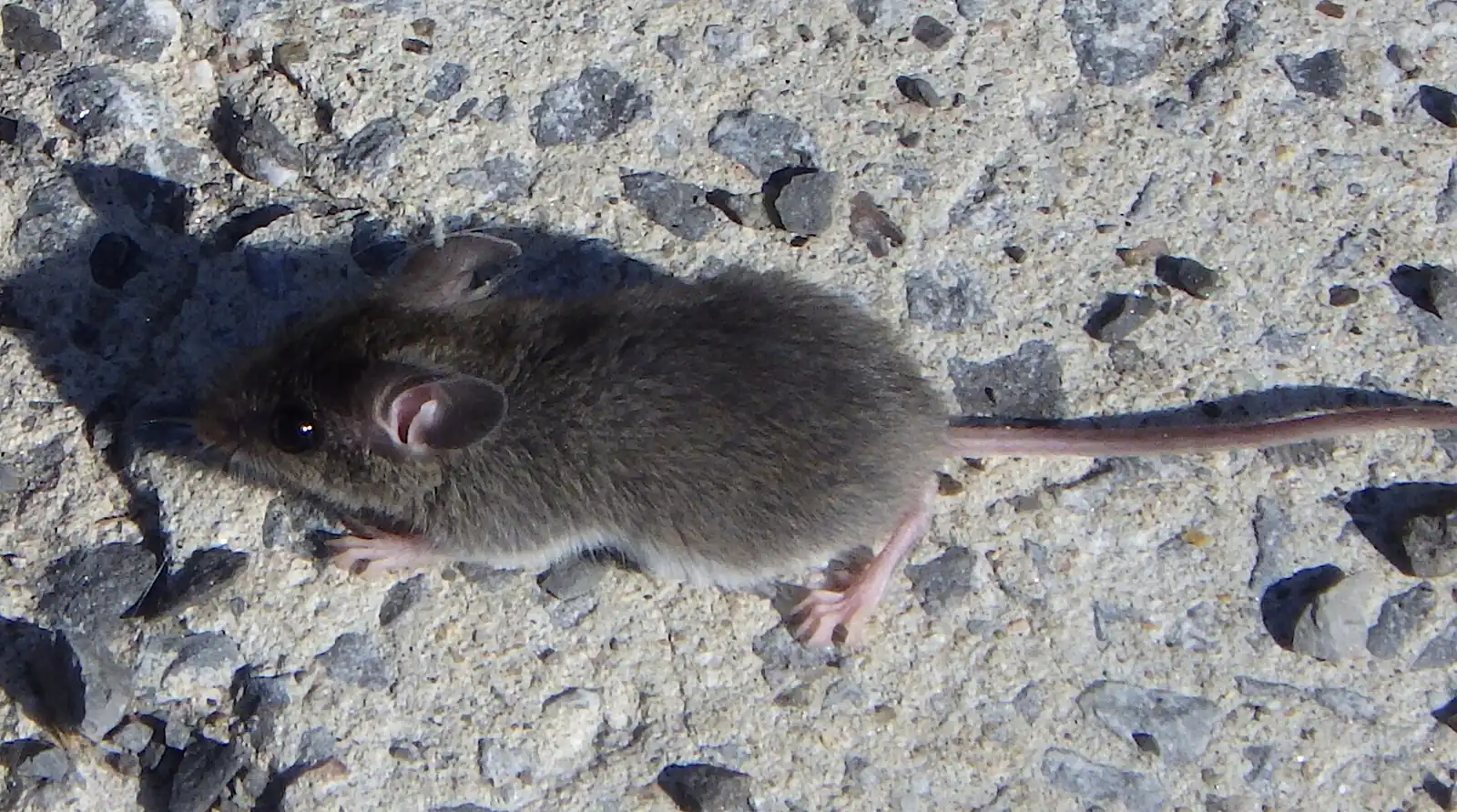
Needs a gap about the width of a pencil. Lives inside walls near warmth and crumbs, breeds fast, and makes up the bulk of cool-season kitchen calls.
- Noise: faint scratching in walls, cabinets
- Droppings: rice-grain size, scattered
- Entry: pipe penetrations, door sweeps
Tell dispatch what you’re hearing and where. “Scurrying over the ceiling at 2 AM” routes differently than “droppings under the kitchen sink” — the operator shows up with the right traps, sealants, and ladder work planned instead of a second trip.
Free to check coverage. ADAI-licensed operators serving Mobile & Baldwin County, AL.
What does real rodent control work look like in Mobile?
Bait boxes alone are a subscription, not a solution. Here’s the integrated approach the good operators run.
- Full-perimeter inspection. Roofline, soffit returns, gable vents, AC chases, crawlspace vents, garage-door sweeps, and the oak limbs touching the roof. On Midtown and Old Dauphin Way pier-and-beam homes, under the house is half the story.
- Exclusion — sealing the entries. Hardware cloth over vents, metal flashing at gnawed corners, copper mesh in pipe gaps, door sweeps. This is the step that actually ends the problem; everything else manages it.
- Knock-down trapping. Snap traps or multi-catch stations placed on runways (rub marks and droppings mark them), checked and re-set on a defined schedule — ask what the follow-up cadence is.
- Exterior baiting where appropriate. Locked, anchored stations placed by a licensed operator, with product choices and placement that account for kids, pets, and Mobile’s owls and hawks. Ask the operator about secondary-exposure precautions — a good one has a ready answer.
- Sanitation & habitat notes. Pet food storage, pine straw against the slab, wood piles, and limb trimming — the homeowner homework that keeps the fix permanent.
If a proposal is just “we’ll drop some bait boxes and see you next quarter,” you’re allowed to ask where the exclusion work is — or to get a second opinion. The quote is the operator’s; the decision is yours.
When and why does rodent pressure spike in Mobile, AL?
| Window | What’s happening in Mobile & Baldwin County |
|---|---|
| Oct–Dec | The big move-in: first cool nights push roof rats off the canopy and into attics. Attic-noise calls triple on this line after the first real front. |
| Jan–Mar | Indoor populations peak — established nests, active gnawing (wiring damage risk), mice deep in wall voids near kitchens and water heaters. |
| Apr–Jun | Breeding season outdoors; burrow activity around sheds and slabs. Exclusion work done now pays off before fall. |
| Jul–Sep | Hurricane season — storm-damaged soffits, lifted flashing, and debris piles open new entries. Post-storm inspections catch them before October’s move-in. |
Five questions to ask the rodent operator
- “Which species did you confirm, and from what evidence?” Droppings shape, gnaw marks, and runway height tell roof rat from Norway rat from mouse — and the plan follows the species.
- “What entry points did you find, and what gets sealed?” Ask for the list — photos ideally. Exclusion is the fix; if it’s missing from the proposal, ask why.
- “What’s the follow-up cadence?” Trapping without scheduled re-checks strands dead rodents in walls and lets survivors re-breed. Get the visit schedule in writing.
- “What’s your ADAI license number?” Verify it on ADAI’s Structural Pest Control Section website before work begins — a legitimate operator expects the question.
- “How are bait stations secured, and what about pets and wildlife?” Locked, anchored, labeled stations and a clear answer on secondary exposure separate pros from bait-scatterers.
Rodent control in Mobile — common questions
Are you a rodent control company?
No — Mobile Alabama Exterminators is a free dispatch and referral service. We connect you with independent, ADAI-licensed operators in Mobile and Baldwin County who perform the inspections, exclusion, trapping, and treatments. Verify any operator’s license with ADAI before hiring — we encourage it.
How much does rodent control cost in Mobile?
It depends on species, entry points, and how much exclusion work the structure needs — and the price is set by the independent operator after inspecting, not by us. The call and match are free; the operator’s quote comes before any work, and comparing quotes is reasonable.
I hear scratching at night — rats or mice?
Rhythmic scurrying across the ceiling after dark leans roof rat, faint scratching inside a kitchen or bathroom wall leans mouse, and low thumping or crawlspace noise leans Norway rat. The operator confirms with droppings, rub marks, and gnaw evidence — leave those in place.
Can I just put out poison myself?
Store-bought rodenticide often kills rodents inside your walls (the smell lasts weeks) and poses secondary risks to pets and raptors. Licensed operators use locked stations, placement rules, and — more importantly — exclusion, which ends the problem instead of cycling it.
Do the operators handle attic cleanup after rodents?
Many do — droppings removal, contaminated insulation, and sanitizing are commonly offered alongside exclusion. Mention it when you call so dispatch routes you to an operator who offers it, and ask for it as a line item on the quote.
How fast can someone come out?
The dispatch line answers 24/7, and appointment timing is set by the independent operator — availability is not guaranteed, and the operator confirms scheduling directly with you. Fall move-in season books fastest; submitting your ZIP at the first noise helps.
Stop the ceiling traffic tonight.
Free to submit, free to get matched, no obligation. The licensed operator inspects and gives the quote.
Free to check coverage. ADAI-licensed operators serving Mobile & Baldwin County, AL.
Prefer to send details first? Use the contact form →