The roof rat — the one running the wires above your ceiling.
One call reaches a licensed, local exterminator who covers your address — and a real person answers, 24/7.
Free to check coverage — the operator gives the quote after inspecting.
Check your ZIP first
One call reaches a licensed, local exterminator who covers your address — and a real person answers, 24/7.
Free to use · No obligation to hire anyone
The dominant rat on the Alabama coast
Scientific name: Rattus rattus. Also called: black rat, ship rat. Family: Muridae. Status in Mobile-Baldwin: the dominant rat species in coastal Alabama, well established across both counties and especially thick in waterfront and citrus-adjacent neighborhoods.
Roof rats came to the Gulf the way they came everywhere — by ship — and the coast suits them perfectly. They are climbers, not burrowers, and that single trait dictates everything: where they nest, how they get in, what an inspection looks like, and why a ground-level bait station often misses them entirely.
Their stronghold is exactly what you’d guess from a coastal map: palm-frond skirts, attic spaces, garage rafters, dense ivy and bougainvillea, old citrus trees, and any mature canopy that touches a roofline. Gulf Shores, Orange Beach, Dauphin Island, Bayou La Batre, and the downtown Mobile waterfront hold year-round populations. Inland, roof rats show up wherever tree limbs bridge to the house.
The population math is the urgency: females produce three to six litters a year of five to eight young, sexual maturity hits at three to four months, and an outdoor population can double in as little as two months under good conditions. They’re nocturnal with a 6 PM to 2 AM peak, and — usefully for the operator — they are creatures of habit, running the same wires, the same fence tops, the same eaves night after night. Those consistent runways are what a good inspection reads.
Roof rat or Norway rat? The distinction changes the whole plan
One climbs, one burrows. Treating a climber like a burrower is how rodent jobs fail.
| Feature | Roof rat | Norway rat |
|---|---|---|
| Tail | Longer than the body — the fastest tell | Shorter than the body |
| Body | 13–17 in. total, slender; dark brown to nearly black | 12–18 in. total, heavy and stocky; brown to gray-brown |
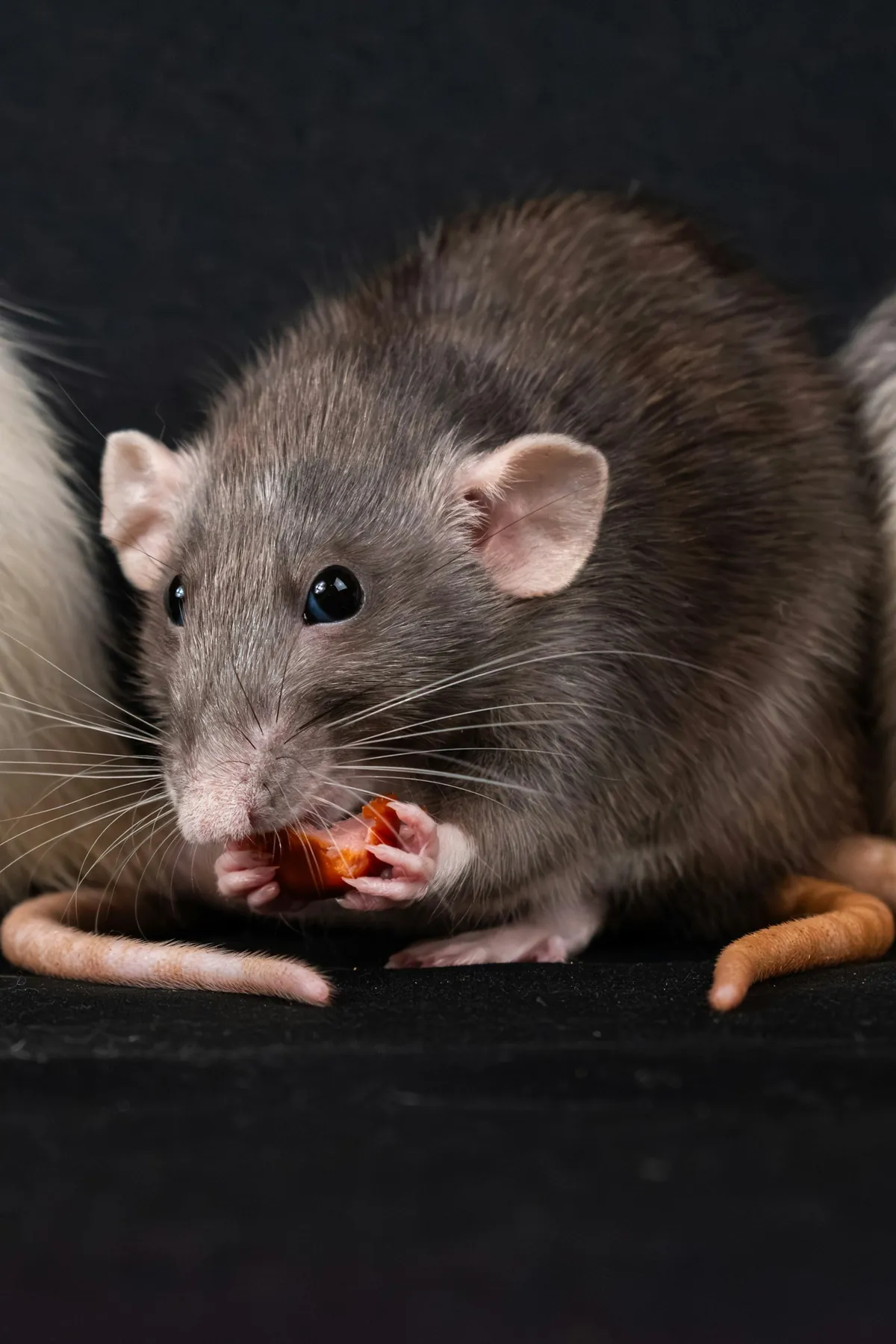
| Ears & snout | Large hairless ears (long enough to pull forward over the eye); pointed snout | Small hairy ears; blunt snout |
| Droppings | ~12 mm with pointed ends | ~18 mm with blunt ends |
| Where it lives | Above ground — attics, rafters, palms, vines, canopy | Ground — burrows at foundations, slabs, storm drains |
| What you hear | Scratching overhead and in walls at night | Activity at ground level, garages, crawlspaces |
If the noise is above your head, start with roof rat. If it’s at floor level and you’re finding burrows against the foundation, read the Norway rat guide instead — the exclusion work is a different job entirely.
The roof rat year on the coast — and the hurricane spike
Pressure isn’t flat across the calendar here. Storms rewrite it.
| Season | What roof rats are doing around Mobile Bay |
|---|---|
| Mar–Jun | Breeding accelerates as citrus sets fruit and palms put on new growth — elevated cover plus food, the roof rat’s favorite combination. |
| Jul–Sep | Populations peak just as hurricane season ramps. Storm winds knock palm fronds and dead citrus limbs off — destroying nests and pushing displaced rats to find new above-ground harborage fast, often in attics and soffits they’d never entered before. |
| Oct–Dec | The second shift: outdoor food and cover thin out, and roof rats move indoors more aggressively. This is why attic-scratching calls climb every fall — the population didn’t explode, it relocated. |
| Jan–Feb | Established indoor populations settle into attics and wall voids; gnawing damage to wiring and stored goods accumulates quietly through the cool months. |
Scratching overhead after a storm? Don’t just set traps — find the entry.
One call reaches a licensed, local exterminator who covers your address — and a real person answers, 24/7.
Free to check coverage. ADAI-licensed operators serving Mobile & Baldwin County, AL.
What a licensed operator does about roof rats
Educational only — the independent operator recommends and performs the work, and every structure is different.
Read the runways
Rub marks on rafters and wires, droppings with pointed ends, gnaw marks at soffit edges, greasy trails along fence tops. Roof rats repeat routes — the map is right there for anyone who looks up.
Seal the roofline
Gable vents, soffit gaps, roof-to-fascia junctions, plumbing vent boots, and the limb bridges that get them there. Exclusion is the durable half of the job — trapping without it just makes room for the next one.
Remove and monitor
Trapping placed on the actual runways (not randomly), removal of what’s inside, then monitoring to confirm the structure is closed. Attic sanitation and insulation assessment where contamination is heavy.
Your homework is mostly outdoors and mostly free: trim limbs back from the roofline (they need the bridge), skirt or clean palm fronds, pull ivy off walls, pick up fallen citrus, and get bird seed and pet food into sealed containers. Roof rats are excellent climbers but they can’t use a bridge that isn’t there. The rodent control page covers the full program.
What should you ask the operator?
You’ll get a better outcome — and a fairer quote — if you ask these on the first visit.
- “Roof rat or Norway rat — and what told you?” Tail length, ear size, dropping shape, and where the activity is. The answer determines whether this is a roofline job or a foundation job.
- “Where exactly are they getting in?” Ask them to name and show the entry points. A rodent plan with no exclusion component is a trapping subscription.
- “What’s bridging them to the roof?” Limbs, vines, fence lines, power drops. If nobody looked up, the inspection isn’t finished.
- “What’s your ADAI license number?” Every legitimate Alabama operator has one, and the Alabama Department of Agriculture & Industries’ Pesticide Management Section — (334) 240-7240 in Montgomery — can confirm it. Pros answer without blinking.
- “What about the attic contamination and the wiring?” Droppings, urine-soiled insulation, and gnawed wiring are part of the real scope. Ask what’s included and what’s a separate conversation.
Roof rats — what do homeowners ask?
Are you a pest control company?
No — Mobile Alabama Exterminators is a free dispatch and referral service. We connect Mobile and Baldwin County callers with independent pest control operators licensed by the Alabama Department of Agriculture & Industries. Every inspection and every treatment is performed by the operator, never by us — and we suggest verifying any operator’s license with ADAI before you hire.
How do I know if it’s a roof rat or a Norway rat?
Three quick checks: the tail (roof rat’s is longer than its body; Norway’s is shorter), the droppings (roof rat ~12 mm with pointed ends; Norway ~18 mm blunt), and the location (roof rats overhead in attics and rafters; Norway rats at ground level in burrows). Noise above the ceiling almost always means roof rat.
Why did rats suddenly appear in my attic after a hurricane?
Storm winds destroy the palm-frond and canopy nests roof rats prefer, and the displaced animals immediately hunt for new above-ground harborage — frequently an attic or soffit they had never entered before. It’s a displacement event, and the fix is finding and sealing the new entry, not just trapping.
Will traps alone solve a roof rat problem?
They remove what’s currently inside, but the entry point and the limb bridge stay open, so the vacancy gets filled. Exclusion — sealing the roofline and cutting the access route — is what makes the removal stick. Licensed operators do both in sequence.
How much does roof rat removal cost in Mobile?
Pricing is set by the independent operator after inspecting — the extent of exclusion work, roof access difficulty, attic contamination, and monitoring schedule all move the number. The match is free, and the operator’s quote comes before any work.
Are roof rats a health risk?
Yes — they contaminate stored food and surfaces, their droppings and urine soil attic insulation, and their constant gnawing on wiring is a documented fire risk. Prompt removal plus exclusion is the standard response, and attic sanitation is worth asking about when contamination is heavy.
They run the same route every night. Close it.
Free to check coverage, free to get matched, no obligation. The licensed operator inspects and gives the quote.
Free to check coverage. ADAI-licensed operators serving Mobile & Baldwin County, AL.
Prefer to send details first? Use the contact form →