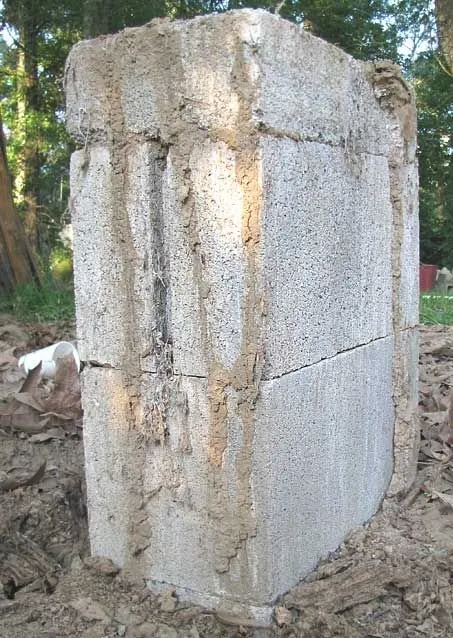
Formosan termites in Mobile, AL — the swarm the port brought home.
Wings on the windowsill on a humid May evening, mud lines climbing a pier, a live oak that sounds hollow when you knock — Mobile carries one of the heaviest Formosan subterranean termite loads in the continental U.S. This free 24/7 dispatch line connects you with an independent, ADAI-licensed termite operator who works your part of town. They inspect, they quote, they treat. You decide.
Free to check coverage. ADAI-licensed operators serving Mobile & Baldwin County, AL.
Free call, free match — the operator gives the quote. Availability varies by operator schedule and is not guaranteed.
Check your ZIP first
Enter your Mobile-area ZIP to confirm operator coverage, then tap to call.
Free to use · No obligation to hire anyone
24/7 dispatch line — availability varies by operator schedule
Free call — the operator gives the quote
Mobile & Baldwin County coverage
Why Formosan termites are Mobile’s termite problem
Formosan subterranean termites didn’t start here — they arrived through the Port of Mobile after World War II, riding home in crates and salvaged material from the Pacific. Eighty years later, Mobile is one of the most heavily infested Formosan cities in the continental U.S. If you own a home anywhere from Midtown to Theodore, this is the termite species your inspection, your treatment, and your bond should be built around.
Three things make Formosans a different animal from the native Eastern subterranean termites Alabama has always had:
- Colony size. A mature Formosan colony can run into the millions of termites — several times the size of a native colony. That is the difference between wood damage that creeps over years and damage that shows up in a single season. When Mobile old-timers talk about a porch column that “went soft in one summer,” this is usually the species they mean.
- Aerial carton nests. Formosans build carton nests — a sponge-like material of chewed wood, saliva, and soil — and they don’t need ground contact to survive if the nest holds moisture. In Mobile they turn up in live oak crotches, flat roofs, and wall voids fed by a slow flashing or plumbing leak. A soil treatment alone can miss an aerial colony completely, which is why a real Formosan inspection goes places a basic pest visit never does.
- Swarm behavior. Native subterraneans swarm in daylight from roughly February through April. Formosans swarm on humid, still evenings in May and June, right around dusk, and they pile up under porch lights and streetlights by the hundreds. If your windowsills are dusted with wings the morning after a warm, sticky night, the calendar alone is telling you which species to suspect. See our Gulf Coast Termite Swarm & Pest-Pressure Data Reference for the county-level swarm data behind this timing.
One more distinction worth knowing before you call: mud versus sawdust. Termites — Formosan or native — build pencil-width mud tubes up piers, foundation walls, and slab joints, and they pack their galleries with soil. Carpenter ants do the opposite: they excavate clean galleries and push out coarse, sawdust-like frass. Mud means termites. Sawdust piles usually mean carpenter ants — still worth a call, but a different problem with a different fix.
All of this is why the annual termite bond is practically a Mobile institution. A bond is a renewable contract with a licensed operator: they inspect the structure every year, and if termites show up on their watch, the retreatment terms in the bond kick in. In a city with this much Formosan pressure, lenders, buyers, and real-estate agents all expect to see one — and the operator this line matches you with can explain exactly what theirs covers before you sign anything.
Wings or mud right now? Don’t sweep them up. Note the date and time of the swarm, take photos of the wings and any mud tubes, and leave everything in place. Formosan swarmers are yellow-brown and swarm at dusk; the operator can often make the species call from your photos before they even arrive — and the species call drives everything that follows.
Free to check coverage. ADAI-licensed operators serving Mobile & Baldwin County, AL.
How does the dispatch line work?
Total transparency: we answer phones and match. Licensed operators do the work.
You reach out, we listen
Reach out any hour. Tell us your address and what you’re seeing — wings, mud tubes, soft wood, a hollow oak. It takes about a minute, and there’s no cost and no obligation.
We match you locally
Mobile Alabama Exterminators is a dispatch and referral service, not a pest control company. Your call routes to an independent operator licensed by the Alabama Department of Agriculture & Industries who handles termite work in your part of Mobile.
The operator takes over
The licensed operator inspects the property, shows you what they found, and gives you their own quote and bond terms. Hiring them is entirely your call — and you can verify their ADAI license first at (334) 240-7240.
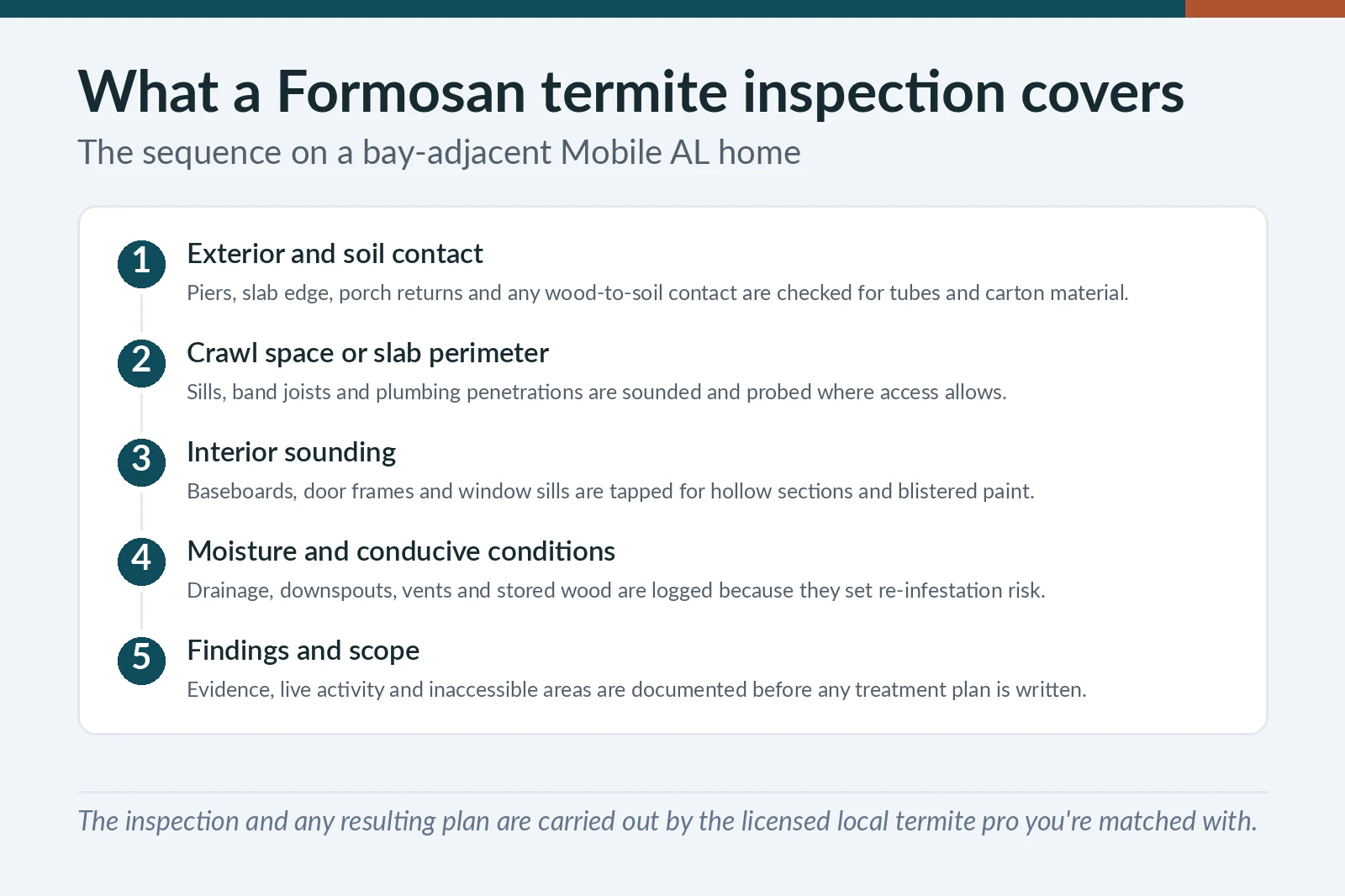
What a real Formosan inspection covers in Mobile
If the visit stays at ground level, it wasn’t a Formosan inspection.
Because Formosans nest above ground as readily as below it, a thorough Mobile termite inspection covers territory a standard pest visit skips entirely. When the operator walks your property, here’s what should be on their list:
- The attic and rooflines. Carton nests love wall voids and rafter bays fed by a slow roof or flashing leak. An inspector who never asks for the attic access panel is doing half the job.
- Live oaks and tree crotches. Mobile’s signature oaks are prime Formosan real estate. The operator should probe old pruning wounds, crotches, and hollow-sounding trunks on any tree within striking distance of the house — an infested oak is often the launch pad for the swarm that ends up in your walls.
- Slab expansion joints and bath traps. On slab homes in West Mobile and newer subdivisions, the expansion joint and the plumbing penetrations under tubs are the hidden highways. These get probed, not glanced at.
- Piers, sills, and the crawlspace. On pier-and-beam houses in Oakleigh, Midtown, and Old Dauphin Way, that means physically getting under the house with a light and a probe — checking mud tubes on piers, moisture at sill plates, and damage at joist ends.
- A written report with findings. What they found, where, photos of the evidence, the treatment they propose — bait system, liquid barrier, direct nest treatment, or a combination — and the bond terms. Pricing is the operator’s, set after inspection, which is exactly why we don’t publish prices on this site.
If a visit skips the attic, ignores the oaks, and produces a quote without findings, you’re allowed to say no thanks. The quote belongs to the operator, and the decision belongs to you.
The Mobile termite year
Termite pressure in Mobile never really stops — it just changes shape. Here’s the cycle worth knowing.
| Season | What the termite year looks like in Mobile |
|---|---|
| Feb–Apr | Native Eastern subterranean swarm season — daytime flights, often after a warm rain. Dark-bodied swarmers on windowsills this early in the year usually point native, not Formosan. |
| May–Jun | Formosan swarm season — the big one. Humid, still evenings right at dusk, yellow-brown swarmers mobbing porch lights and streetlights by the hundreds. Most of Mobile’s “termites in the house” calls land in these weeks. |
| Jul–Sep | Peak feeding. Colonies work hardest in the heat, and carton nests in wall voids and oaks grow fastest. This is when summer renovation projects open a wall and find the damage. |
| Oct–Nov | Soil stays warm, feeding continues. A smart window for bond renewals, re-inspections, and WDO letters ahead of winter closings. |
| Dec–Jan | Mobile winters are too mild to stop a Formosan colony — feeding slows but never quits, and colonies are quietly staging next spring’s swarmers. |
Free to check coverage. ADAI-licensed operators serving Mobile & Baldwin County, AL.
What should you ask the operator?
Formosan work is specialized. These five questions sort the pros fast.
- “Is this Formosan or native?” The species call drives colony size, treatment design, and bond terms. A good operator explains how they made the call — swarm timing, swarmer color, soldier head shape — instead of shrugging it off.
- “What’s your ADAI license number?” Termite work in Alabama requires the right license category from the Department of Agriculture & Industries, and the Pesticide Management Section in Montgomery — (334) 240-7240 — can confirm it. A pro expects this question.
- “Show me the evidence.” Mud tubes, carton material, damaged wood, swarmers in a bag — a Formosan quote should come attached to findings you can see with your own eyes or in photos.
- “Bait system, liquid barrier, or both — and why here?” Both approaches are legitimate in Mobile. What matters is the reasoning for your structure — and whether an aerial carton nest needs direct treatment on top of the soil program.
- “What exactly does the bond cover?” Retreatment-only or repair bond? What’s the annual renewal, what voids it, and does it transfer to a buyer if you sell? In Mobile, the bond fine print matters as much as the treatment.
Formosan termites in Mobile — what do homeowners ask?
Are you a termite control company?
No — Mobile Alabama Exterminators is a free dispatch and referral service. We connect Mobile and Baldwin County homeowners with independent, ADAI-licensed operators who perform the termite inspections, treatments, and bonds. We never do the work ourselves, and we encourage you to verify any operator’s license with ADAI before hiring.
How do I know if my termites are Formosan?
Timing and appearance are the big clues. Formosan swarmers are yellow-brown and fly on humid May and June evenings around dusk, mobbing lights in large numbers. Native subterranean swarmers are darker and fly in daylight, February through April. A licensed operator confirms the species from swarmers or soldiers — which is why it helps to save a few in a bag instead of sweeping them up.
Do Formosan termites really infest live oak trees?
Yes. Formosans build carton nests in tree crotches, pruning wounds, and hollow trunks — Mobile’s live oaks are classic hosts. An infested oak near the house matters because it can seed swarms straight at your roofline, so a thorough inspection includes the trees, not just the structure.
How much does Formosan termite treatment cost in Mobile?
It depends on the structure, the extent of activity, and the treatment design — and the price is set by the independent operator, not by us. A real number requires an inspection. The call and the match are free, the operator gives you their quote in writing, and you’re free to compare it before deciding.
What is a termite bond and do I really need one here?
A bond is a renewable contract with a licensed operator: annual inspection plus defined retreatment (and sometimes repair) terms if termites return. Given Mobile’s Formosan pressure, most local lenders, buyers, and agents expect a home to carry one — and letting a bond lapse is one of the more expensive mistakes a Mobile homeowner can make.
Are the flying insects in my house termites or ants?
Check three things: termites have straight antennae, a thick waist, and four equal-length wings; flying ants have elbowed antennae, a pinched waist, and unequal wings. Either way, don’t spray — photograph them, save a few, and let the operator make the ID. Winged carpenter ants get mistaken for termites in Mobile every spring.
Wings tonight or mud tomorrow — the line answers either way.
, free to get matched, no obligation to hire. The licensed operator inspects and gives the quote.
Free to check coverage. ADAI-licensed operators serving Mobile & Baldwin County, AL.
Prefer to send details first? Use the contact form →