Rodent control in Montgomery, AL — one call to a licensed operator.
From Norway rats working the alleys behind downtown’s vacant riverfront warehouses to roof rats in the canopy attics of Cloverdale and the Garden District, our 24/7 dispatch line matches Montgomery households with an independent, ADAI-licensed rodent operator who works these neighborhoods every week. You call, we match, the licensed operator inspects and quotes.
One call, and you’re matched
Tell the dispatcher what you’re seeing — scratching in an attic over Cloverdale, rats near a downtown dumpster, mice moving in after the first fall cool snap — and get matched with a licensed operator who covers Montgomery.
☎ Call (888) 295-0220 (888) 295-0220 — answered 24/7Free call · No obligation to hire anyone · The licensed local exterminator you’re matched with inspects and sets the price
Mobile Alabama Exterminators is a free 24/7 dispatch and referral line. Call (888) 295-0220, describe your Montgomery rodent problem, and we match you with an independent exterminator licensed by the Alabama Department of Agriculture & Industries who covers your street. The licensed operator — not us — inspects your property, sets the price, and does the work. Calling costs nothing and you’re never obligated to hire anyone.
Why does Montgomery have two distinct rat problems?
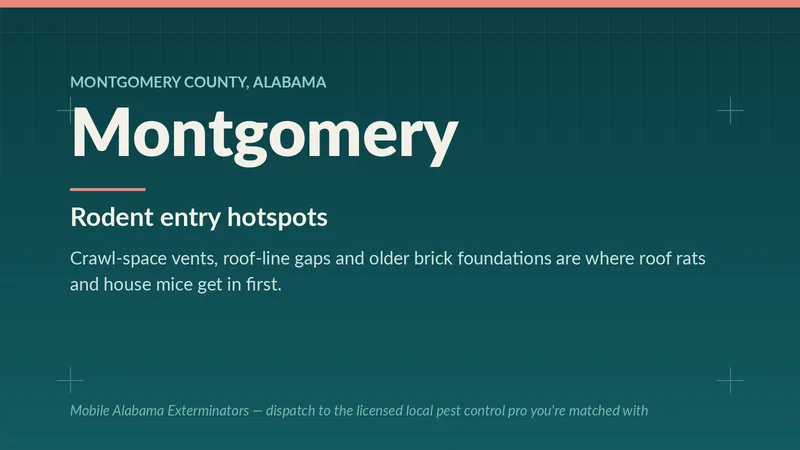
Montgomery’s rodent pressure splits cleanly along two different housing and habitat patterns, and knowing which one applies to a property is most of the diagnosis. At ground level, Norway rats work the alleys and loading areas behind downtown’s vacancy-heavy blocks and the warehouse and riverfront district near the Alabama River. Empty buildings, old utility chases, and dumpster corridors give this heavier, ground-dwelling rat exactly the cover and food access it needs, and it moves between structures through foundation gaps and sewer connections rather than climbing.
A few miles away, in the Garden District and Cloverdale, the story runs upward instead of along the ground. These neighborhoods are built almost entirely on pier-and-beam foundations dating to the 1900s through the 1930s, with mature oak canopy overhanging the rooflines. Roof rats are agile climbers that travel tree limb to roofline and into attics, and a century-old pier-and-beam house simply has more potential entry points than a modern slab home — soffit gaps, roof-to-wall junctions, and vents patched piecemeal for decades. Attic noise at night in this part of town points toward roof rats far more often than the ground-level Norway rat.
Montgomery’s Black Belt farmland surroundings add a seasonal push that shows up at the city’s edge. After fall harvest clears the fields and the first real cool snaps arrive, field rodents that spent the growing season in crop rows and fence lines move toward whatever shelter is nearest — which, on the outskirts of Montgomery, is often a house. That seasonal shift tends to arrive milder and later here than it does farther north in Alabama, tracking the region’s longer, warmer fall rather than an early plateau frost.
Because the two rat problems favor such different construction, exclusion work looks different depending on the property:
- Century-old pier-and-beam houses in the historic districts need a roofline-focused inspection — soffit returns, roof-wall junctions, chimney chases, and vent screens — since that’s where roof rats are actually getting in.
- Slab ranches and newer construction, more common on the east side and outer subdivisions, are more likely to see ground-level entry through garage gaps, utility penetrations, and foundation vents.
Reading sign correctly matters as much as sealing the right gap — fresh droppings versus old, grease marks along a beam, gnaw patterns on a specific material — because it tells an operator whether activity is current or historic, and roughly how large the population is. Bait-station placement follows its own rules too: stations belong along travel paths and structural edges, secured and tamper-resistant, not scattered wherever is convenient. And around downtown especially, sanitation decides whether a fix holds. As long as dumpsters in the alleys behind commercial blocks stay uncovered or overflowing, exclusion on one building won’t stop rats from simply moving next door.
Hearing scratching or seeing rats in Montgomery right now? Be specific with the dispatcher — “noise in the attic over Cloverdale,” “rats near a downtown dumpster,” “mice since the first cold snap.” A specific report gets you matched with the right operator the first time.
☎ Call (888) 295-0220Free call · 24/7 · No obligation to hire — the licensed operator you’re matched with gives the quote
How does the rodent dispatch line work in Montgomery?
Total transparency: we answer phones and match. Licensed operators do the work.
You call, we listen
Tap the number, day or night, and tell the dispatcher what you’re seeing in Montgomery — it takes about a minute, costs nothing, and you’re not committing to anything.
We match you locally
Mobile Alabama Exterminators is a dispatch and referral service, not a pest control company. We route your call to an independent operator licensed by the Alabama Department of Agriculture & Industries who covers Montgomery and the surrounding Montgomery County area.
The operator takes over
The licensed operator inspects your property, walks you through what they found, and gives you their own quote. Hiring them is entirely your decision — and you can verify their ADAI license first through the Pesticide Management Section in Montgomery at (334) 240-7240.
What else can you call the Montgomery line about?
The dispatch line routes five core problem types in Montgomery. Each links to a deeper guide on this site.
Pest control in Montgomery →
The main Montgomery hub page for every pest type the dispatch line covers, from termites and roaches to rodents and mosquitoes.
Rodent control →
The Mobile Alabama Exterminators rodent hub, covering roof rat and Norway rat identification and exclusion approaches statewide.
Termite treatment →
Blackland clay cycles and century-old pier-and-beam sills make termite pressure in Montgomery worth understanding alongside any rodent problem.
Roach exterminator →
American roaches in the same downtown alleys and storm drains that Norway rats favor, plus the smokybrown roaches sharing the Garden District canopy with roof rats.
Roof rats vs. Norway rats →
A closer identification guide for telling Montgomery’s two rat problems apart by sign, behavior, and where each one enters a house.
When is rodent pressure worst in Montgomery?
Montgomery’s rodent calendar tracks the Black Belt growing season and the River Region’s milder fall.
| Season | What shows up in Montgomery homes |
|---|---|
| Mar–May | Spring litters build populations in field edges and fence rows around the city’s outskirts; downtown alley activity stays fairly steady year-round. |
| Jun–Aug | Warm-weather breeding continues on farmland at the city edge; roof rats are active in the Garden District and Cloverdale tree canopy. |
| Sep–Nov | The signature season — fall harvest clears the fields and the first cool snaps, arriving later and milder than north Alabama, push field rodents toward the nearest shelter. |
| Dec–Feb | Indoor season — rodents nest in attics and wall voids through the mild River Region winter, and downtown alley activity concentrates around uncovered dumpsters. |
Recognize your season? Tell the dispatcher what you’re seeing and where — ground-level or attic activity points to two different rat problems in Montgomery.
☎ Call (888) 295-0220Free call · 24/7 · No obligation to hire — the licensed operator you’re matched with gives the quote
What should you ask the operator you’re matched with?
Asking these on the first visit gets you a better outcome — and a fairer quote.
- “Is this a roof rat or a Norway rat problem?” Roof rats climb into attics through the roofline; Norway rats work the ground and foundation. Montgomery has both, and the entry points an operator checks should match which one is active.
- “Where exactly are you finding entry points?” In century-old pier-and-beam houses, that’s usually the roofline — soffits, roof-wall junctions, vents. Ask to see the specific gaps, not just where bait or traps are placed.
- “How are you reading the sign — droppings, grease marks, gnaw damage?” Fresh versus old sign tells an operator whether activity is current and roughly how large the population is. A vague answer here is a red flag.
- “Where will bait stations be placed, and are they secured?” Stations belong along travel paths and structural edges, tamper-resistant and away from casual reach. Ask why each location was chosen.
- “What’s your ADAI license number?” Every legitimate Alabama operator carries one, and the Pesticide Management Section in Montgomery can confirm it. A pro expects the question.
None of these questions slow a good operator down. The ones who work Montgomery’s historic districts, slab subdivisions, and downtown alleys every week answer them without blinking.
Rodent control in Montgomery — what do homeowners ask?
Are you a pest control company in Montgomery?
No — Mobile Alabama Exterminators is a free dispatch and referral service. We connect Montgomery homeowners and businesses with independent, ADAI-licensed pest control operators who perform rodent inspections and treatments. We never do the work ourselves, and we encourage you to verify any operator’s license before hiring.
How much does rodent control cost in Montgomery?
The price is set by the independent operator after they’ve inspected — it depends on the species, the extent of activity, and the scope of exclusion work needed. The call and the match are free.
Why do I hear scratching in my attic in Cloverdale or the Garden District?
These neighborhoods are largely pier-and-beam construction with mature oak canopy overhanging the roofline, which gives roof rats an easy climb from tree limb to attic. A roofline-focused inspection usually finds the entry point.
Why do rats show up near my downtown Montgomery business every fall?
Norway rats work the alleys and loading areas behind vacancy-heavy downtown blocks and the riverfront warehouse district, and uncovered or overflowing dumpsters keep that population fed. Sanitation matters as much as any trap or bait placement.
Does living near farmland outside Montgomery increase rodent risk?
It can, seasonally. After fall harvest and the first cool snaps — which tend to arrive later and milder here than farther north — field rodents move from cleared crop rows toward the nearest shelter, including houses at the city’s edge.
Can I get someone after hours in Montgomery?
The dispatch line answers 24/7. Appointment timing is set by the independent operator and depends on their schedule and your location. The operator confirms timing with you directly.
Ready when you are — day or night.
Whether it’s roof rats over Cloverdale or Norway rats behind a downtown block, one call matches you with a licensed operator who covers Montgomery.
☎ Call (888) 295-0220(888) 295-0220 — free call, 24/7. The licensed operator inspects and gives the quote.