Pest control in Jacksonville, AL — one call to a licensed operator.
From the 1830s public square to the rental blocks around Jacksonville State, our 24/7 dispatch line matches Jacksonville households and landlords with an independent, ADAI-licensed exterminator who works this college town every week. You call, we match, the licensed operator inspects and quotes.
One call, and you’re matched
Tell the dispatcher what you’re seeing — small roaches in a just-leased kitchen, winged insects by a window, scratching in the attic — and get matched with a licensed operator who covers Jacksonville.
☎ Call (904) 943-3349 (904) 943-3349 — answered 24/7Free call · No obligation to hire anyone · The licensed local exterminator you’re matched with inspects and sets the price
Mobile Alabama Exterminators is a free 24/7 dispatch and referral line. Call (904) 943-3349, describe your Jacksonville pest problem, and we match you with an independent exterminator licensed by the Alabama Department of Agriculture & Industries who covers your street. The licensed operator — not us — inspects, sets the price, and does the work. Calling costs nothing and you’re never obligated to hire anyone.
Why does Jacksonville’s pest calendar run on the university’s schedule?
Jacksonville has been a town since the 1830s — its public square, ringed with churches and storefronts that remember the stagecoach era, is one of the oldest town centers in northeast Alabama. But for the last century its rhythm has been set by Jacksonville State University, the campus on the hill that swells the population every August and drains it every May. Between the square and the campus sits the housing that serves both: student rentals carved out of older frame houses, apartment complexes off Pelham Road, and the neighborhoods that took the direct hit when the EF-3 tornado of March 2018 tore across the campus and the north side of town. The rebuild that followed left Jacksonville with a distinctive patchwork — brand-new roofs and slabs standing shoulder to shoulder with houses that date to the Eisenhower administration and earlier — and the Chief Ladiga Trail runs its tree-lined corridor right through the middle of it all.
Three local realities drive most of the calls coming off this page:
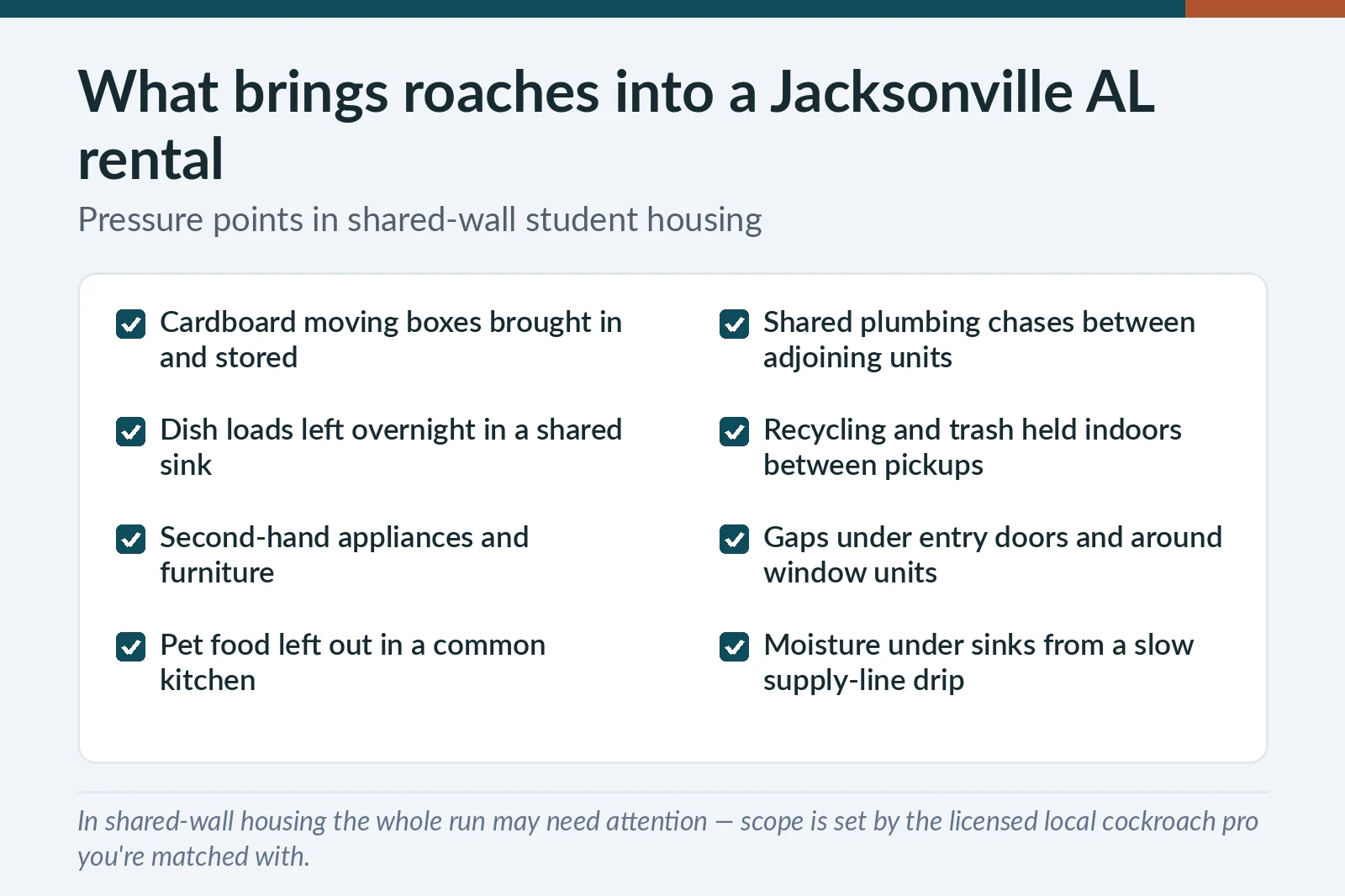
- August lease turnover is the German roach event of the year. German cockroaches travel with people — in moving boxes, hand-me-down couches, thrift-store microwaves and grocery bags — and no town in this corner of the state moves more households in a single month than Jacksonville does when the fall semester starts. One seeded kitchen in a multi-unit building becomes a building-wide problem through shared walls and plumbing chases, and the population that arrives in August is thoroughly established by midterms. Landlords who put units on a monitoring program between tenants, and students who report the first sighting instead of the fiftieth, are the ones who stay ahead of it.
- The 2018 tornado rebuilt half the housing stock — and reset its pest clocks. The rebuild blocks carry new-construction pressure: fire ants colonizing regraded, resodded ground, and slab pre-treatments that are already several years into their working life. The older survivors carry the opposite exposure — original sills and crawlspaces that give the eastern subterranean termite quiet access, in houses whose owners have had other priorities since the storm. A licensed operator reads which clock a given house is on before anything gets treated.
- The trail corridor and the campus edge keep the wild pressure up. The Chief Ladiga Trail’s wooded right-of-way, the creek branches that feed it, and the hardwood ridges behind campus are productive edge habitat. First frosts push mice into student rentals, attics and garages — older frame houses are the easiest targets — and the same shaded, damp corridor holds mosquitoes from May through October.
Add odorous house ants trailing into kitchens after summer rain and American roaches working the older buildings around the square, and a Jacksonville operator needs a college town’s full toolkit: multi-unit German roach protocols, exclusion on mid-century foundations, and termite work that can tell a 2019 slab from a 1949 crawlspace.
That’s who this line matches you with — an independent, ADAI-licensed exterminator who already works Jacksonville’s rental blocks, square and campus edge every week.
Seeing activity in Jacksonville right now? Be specific with the dispatcher — “small roaches in the kitchen of a unit we just leased,” “shed wings on a windowsill,” “scratching over the ceiling at night.” A specific report gets you matched with the right operator the first time.
☎ Call (904) 943-3349Free call · 24/7 · No obligation to hire — the licensed operator you’re matched with gives the quote
How does the dispatch line work in Jacksonville?
Total transparency: we answer phones and match. Licensed operators do the work.
You call, we listen
Tap the number, day or night, and tell the dispatcher what you’re seeing in Jacksonville — it takes about a minute, costs nothing, and you’re not committing to anything.
We match you locally
Mobile Alabama Exterminators is a dispatch and referral service, not a pest control company. We route your call to an independent operator licensed by the Alabama Department of Agriculture & Industries who covers Jacksonville and the surrounding Calhoun County area.
The operator takes over
The licensed operator inspects your property, walks you through what they found, and gives you their own quote. Hiring them is entirely your decision — and you can verify their ADAI license first through the Pesticide Management Section in Montgomery at (334) 240-7240.
Which pest problems can you call about in Jacksonville?
The dispatch line routes five core problem types in Jacksonville. Each links to a deeper guide on this site.
Cockroach control →
German roaches riding August’s lease turnover through the student rental blocks; American roaches in the older buildings around the square. The operator IDs species first.
Termite control →
Eastern subterranean termites in the pre-tornado housing stock’s original sills and crawlspaces. Inspections, treatments and termite letters for closings.
Rodent control →
Mice off the Chief Ladiga corridor and the campus-edge ridges at first frost. Trapping plus exclusion built for mid-century frame rentals.
Ant control →
Fire ants colonizing the regraded, resodded ground of the tornado rebuild blocks; odorous house ants trailing indoors after rain. Baiting programs matched to the species.
Mosquito reduction →
The trail corridor, creek branches and shaded rental yards hold mosquitoes May through October. See the pest library for what programs involve.
When do pests peak in Jacksonville?
Jacksonville’s calendar runs on two schedules — the seasons, and the semesters.
| Season | What shows up in Jacksonville homes |
|---|---|
| Mar–May | Termite swarm season — winged swarmers at windows in the pre-tornado blocks; odorous house ants start trailing after rain. May move-out leaves abandoned food and roach populations behind in emptied units. |
| Jun–Aug | Fire ants spread through rebuilt yards; mosquitoes peak on the trail corridor; then August turnover seeds German roaches through the rental blocks in moving boxes and used furniture. |
| Sep–Nov | Roach populations seeded in August surface by midterms. First frosts push mice off the trail and campus ridges into rentals and attics — October is exclusion month on the older frame houses. |
| Dec–Feb | Indoor season — winter break leaves units quiet while rodents nest in insulation and German roach populations keep breeding in heated kitchens. Termites work on below, unbothered by the calendar. |
Recognize your season? Tell the dispatcher what you’re seeing and what month it started — in a college town, the semester calendar is a genuine diagnostic clue.
☎ Call (904) 943-3349Free call · 24/7 · No obligation to hire — the licensed operator you’re matched with gives the quote
What should you ask the operator you’re matched with?
Asking these on the first visit gets you a better outcome — and a fairer quote.
- “What species is this?” German vs. American roach, termite vs. flying ant — each pair takes a different protocol and budget. In Jacksonville’s mix of rentals, rebuilds and old square-side buildings, species ID comes before everything.
- “What’s your ADAI license number?” Every legitimate Alabama operator carries one, and the Pesticide Management Section in Montgomery — (334) 240-7240 — can confirm it. A pro expects the question.
- “Are the neighboring units being treated too?” In multi-unit buildings, German roaches move through shared walls and plumbing chases. Treating one apartment in isolation fails — ask how the operator handles the building, not just the unit.
- “Where are they getting in?” Rodent work on a mid-century frame rental is exclusion work — foundation gaps, crawlspace vents, utility penetrations. Ask to see the entry points, not just the traps.
- “Is this a one-time knockdown or a recurring plan?” Both are legitimate in a turnover town. A single introduced roach population and a building on an annual reseeding cycle call for different programs — what matters is the why.
None of these questions are rude, and none of them slow a good operator down. The ones who work Jacksonville’s rental blocks and the square every week answer them without blinking — and the answers tell you who you’re dealing with before any money changes hands.
Pest control in Jacksonville — what do homeowners ask?
Are you a pest control company in Jacksonville?
No — Mobile Alabama Exterminators is a free dispatch and referral service. We connect Jacksonville homeowners, landlords and businesses with independent, ADAI-licensed pest control operators who perform the inspections and treatments. We never do the work ourselves, and we encourage you to verify any operator’s license before hiring.
How much does pest control cost in Jacksonville?
The price is set by the independent operator after they’ve inspected — it depends on the pest, the property and the scope. The call and the match are free, the operator gives you their own quote before any work starts, and you’re free to compare it against anyone else’s.
My student rental has roaches — is that the landlord’s job or mine?
Alabama lease agreements vary, so check yours — many put ongoing pest control on the tenant but initial habitability on the landlord. Practically, German roach treatment in a multi-unit building works better when the owner coordinates it building-wide. Either way, the call and match are free, and the operator can advise on scope once they’ve seen the unit.
Did the 2018 tornado change Jacksonville’s pest picture?
Meaningfully, yes. The rebuild replaced a large slice of the housing stock with new slabs and regraded lots — which favors fire ants early and puts those homes on a fresh termite pre-treatment clock — while the surviving older houses kept their original crawlspace exposure. Two houses on the same street can need entirely different work, which is why the inspection comes first.
Which parts of Jacksonville does the line cover?
The line routes across the city — the public square and downtown, the rental blocks and complexes around Jacksonville State, Pelham Road, the rebuilt north-side neighborhoods, and the streets along the Chief Ladiga Trail — plus the rest of Calhoun County. Call and the dispatcher confirms coverage for your address.
Can I get someone after hours in Jacksonville?
The dispatch line answers 24/7. Appointment timing is set by the independent operator and depends on their schedule and your location — availability varies by operator and time of day. The operator confirms timing with you directly.
Nearby coverage & related pages
Ready when you are — day or night.
, free to get matched, no obligation to hire. The independent ADAI-licensed operator who covers your Jacksonville street inspects and gives the quote.
☎ Call (904) 943-3349(904) 943-3349 — free call, 24/7. The licensed operator inspects and gives the quote.