Mosquito control in Baldwin County, AL — what county spraying covers and what your yard still needs
Baldwin County runs from the Mobile-Tensaw Delta to the Gulf beaches, and nearly every mile of it has standing water somewhere. County and city spraying knocks down adult mosquitoes along roads, but it was never built to treat your shrubs, gutters or retention pond edge. This free referral line connects you with an independent local pest control company for yard-level mosquito work.
Yes, Baldwin County sprays for mosquitoes, but mostly in unincorporated areas and mostly along public roads. Some cities, including Orange Beach and Fairhope, handle spraying inside their own limits. Truck fogging kills adults flying at that moment and leaves little behind in your yard. For breeding sources and resting spots on your own lot, call (888) 295-0220, enter your ZIP, and get connected live with an independent local pest control company that serves your area.
Mosquitoes worse after every Baldwin rain?
Call, enter your 5-digit ZIP on the keypad, and get connected live with a local pest control company. Free to call, 24/7.
Does Baldwin County spray for mosquitoes?
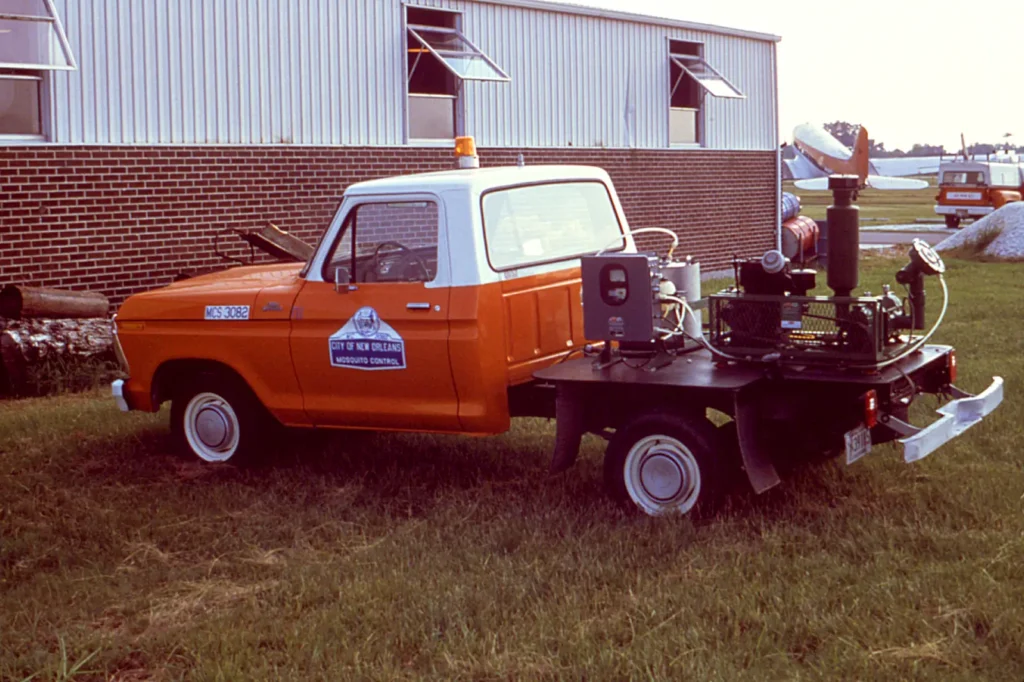
It does. The Baldwin County Commission operates a mosquito control program for the unincorporated parts of the county. Public information from the county describes surveillance trapping, larviciding of breeding water, and truck-mounted ultra-low-volume (ULV) spraying, and local news has covered aerial spraying in heavy seasons. The work is carried out by a contracted vector control company, and the county rebids that contract from time to time, so the vendor name can change.
A 2023 county notice said that homes on roads maintained by the Baldwin County Highway Department were eligible to have their road sprayed under the program. If your street is private, gated, or maintained by an HOA, it may not be on the list. The county’s own website is the place to confirm current eligibility and how to ask about your road.
Inside city limits, the picture changes. Orange Beach runs its own mosquito program in cooperation with the Baldwin County Health Department. Fairhope’s Public Works department handles mosquito control in that city and has said spraying generally follows complaints, weather and rainfall rather than a fixed calendar. Other towns set their own approach. If you live in Daphne, Spanish Fort, Foley, Gulf Shores, Robertsdale, Loxley, Summerdale or Bay Minette, check with city hall or public works before assuming the county truck covers you.
Why county fogging doesn’t fix a backyard problem
ULV spraying releases a fine mist of tiny droplets from a truck or aircraft. Those droplets kill adult mosquitoes that are flying through the cloud when it passes. That is useful during an outbreak, and it is the right tool for covering miles of roadside. It is not designed to leave a lasting residue in a yard.
Most backyard mosquitoes are not flying at 9 p.m. down the middle of the road. During the day they rest low and in shade:
- under decks and inside dense azaleas, ligustrum and Indian hawthorn
- in the cool band of St. Augustine grass along a fence line
- beneath raised homes and in crawl space openings
- in tree holes in live oaks and water oaks
The Asian tiger mosquito, the striped daytime biter behind many Baldwin complaints, breeds in containers that hold a cup of water or less: a clogged gutter, a flowerpot saucer, a kayak left upright, a tarp over the boat. A truck on the county road will never touch those. That is why a family in a sprayed subdivision can still get chewed up at an afternoon cookout. Yard-level work targets the breeding water and the resting spots on your lot. For the biology behind the summer spikes, see why mosquito activity jumps after summer rain.
Where Baldwin County mosquitoes come from
The county has almost every kind of mosquito habitat the Gulf Coast offers.
The Delta edge. Spanish Fort, Stockton and the Causeway sit beside the Mobile-Tensaw Delta, a huge freshwater swamp and marsh system. Mosquitoes bred there do not respect property lines.
Bay and river marsh. Weeks Bay, Fish River, Magnolia River and Bon Secour hold brackish marsh where salt-marsh mosquitoes hatch in large broods after high tides and heavy rain. Some of these species fly miles inland on an evening breeze.
New subdivisions. Much of the growth between Daphne and Foley comes with stormwater retention ponds. A well-kept pond with moving water and fish is not the worst offender. A pond with a weedy, shallow margin, a clogged outfall, or a dry bottom that floods after a storm is a different story.
Low farm country. Around Robertsdale, Summerdale, Elberta and Loxley, drainage ditches, stock ponds and low fields hold floodwater after summer storms. Floodwater mosquitoes lay eggs in damp soil that hatch when it floods again.
Beach towns. In Gulf Shores and Orange Beach, the big pressure is often man-made: pool covers, boat bilges, AC condensate lines, irrigation boxes and planters around raised homes and condos.
Can’t sit on your own porch after sundown?
Call, enter your 5-digit ZIP on the keypad, and get connected live with a local pest control company. Free to call, 24/7.
What a yard mosquito program from a local company usually includes
Programs vary, and the company you’re connected with sets the details. A sound visit generally covers four things:
- Inspection. Walking the lot to find water that holds for more than a few days: gutters, French drain grates, low spots, tire swings, buckets, bromeliads, and the corner of the yard where the downspout empties.
- Source reduction. Dumping or flipping what can be dumped, and pointing out what you need to fix, like a sagging gutter or a blocked drain.
- Larvicide. Treating water that can’t be removed, such as a decorative pond, a drain inlet or a low area, with a product labeled for mosquito larvae.
- Barrier treatment. Applying a residual product to the shaded foliage and structures where adults rest, keeping off blooming plants where the label calls for it.
In this climate, programs usually repeat every few weeks from spring into fall. Ask how often the company returns, which products it uses, and what it does about pollinators and fish ponds. Get the plan in writing. City-specific pages go deeper: Daphne, Fairhope, Spanish Fort, Foley and Gulf Shores.
What Baldwin homeowners can do between visits
Treatment works better when the yard stops producing new mosquitoes. After every soaking rain, take a short walk around the lot:
- Clean gutters, especially under live oak and pine litter.
- Tip out flowerpot saucers, wheelbarrows and toys.
- Change birdbath water weekly.
- Store kayaks and paddleboards upside down, and pull tarps tight.
- Check AC condensate lines, pool equipment pads and drain grates.
- Trim dense shrubs off the foundation and fill low spots that stay wet.
If you live next to marsh or the Delta, no amount of yard cleanup will stop mosquitoes flying in. That is where a barrier program earns its keep. For a wider look at Gulf Coast species and seasons, the Gulf Coast mosquito guide lays it out.
Mosquito-borne illness and when to pay attention
Most Baldwin bites are a nuisance, not a medical issue. Still, Gulf Coast mosquitoes can carry West Nile virus and eastern equine encephalitis, and state and county health officials post advisories when testing finds virus activity. When an advisory is out, the usual public health advice applies: use an EPA-registered repellent, cover up at dusk and dawn, and drain standing water. If someone in your home has fever, severe headache or confusion after bites, call a doctor. That is a medical question, not a pest control one.
Horse owners in north and central Baldwin should talk with their veterinarian about EEE and West Nile vaccines. Dogs need heartworm prevention year round here, because mosquitoes are active in almost every month.
From a pest control view, an advisory is a good time to get serious about the yard. The company you’re connected with can find breeding water you missed and treat resting areas. Scheduling is set by the company you’re connected with.
Baldwin County mosquito season at a glance
| Months | What to expect |
|---|---|
| Feb–Apr | First broods on warm spells. Container breeders wake up as gutters fill with oak pollen and spring rain. |
| May–Jun | Pressure climbs. Afternoon storms begin and retention ponds and ditches start cycling broods. |
| Jul–Sep | Peak season. Tropical rain and high tides drive marsh and floodwater broods across the county. |
| Oct–Jan | Tapers with cool fronts, but warm spells can bring bites in December. Good time to fix drainage. |
Baldwin County mosquito control — what do homeowners ask?
Does Baldwin County spray for mosquitoes?
Yes. The County Commission runs a program for unincorporated areas that includes surveillance, larviciding and truck spraying, with aerial work in some seasons. A 2023 county notice said homes on roads maintained by the county highway department were eligible for road spraying. Cities such as Orange Beach and Fairhope run their own programs. Check the county or your city’s website for current details.
How do I get my road sprayed in Baldwin County?
Start with the county’s mosquito control information on the Baldwin County Commission website, which explains eligibility and how to ask about a road. If you live inside a city, contact that city’s public works department instead. Private and gated roads may not be covered by either.
Is county mosquito spraying enough for my yard?
Usually not by itself. Truck fogging kills adults that are flying when the truck passes and leaves little residue. Mosquitoes resting under your deck or breeding in your gutters are not reached. A yard program focuses on breeding water and the shaded resting spots on your lot.
Is spraying your yard for mosquitoes safe for pets?
Ask the company for the product name and follow the label. Most labels say to keep pets and children off treated areas until the spray has dried. Tell the company about fish ponds, beehives and vegetable gardens so they can be avoided or handled per the label.
How often should a yard be treated for mosquitoes in Baldwin County?
Barrier programs here usually repeat every few weeks from spring through fall, because rain and growth break down residue and new broods keep coming. The exact interval is set by the company you’re connected with based on the product and your property.
Why are mosquitoes so bad after a storm?
Heavy rain fills containers, ditches and low ground, and floodwater mosquito eggs waiting in damp soil hatch when they get wet. A week or so after a big rain, a new wave of adults shows up. Draining water within a few days of a storm cuts that wave down.
Is this the county mosquito office?
No. Mobile Alabama Exterminators is a free referral line, not a government office and not a pest control company. Call (888) 295-0220, enter your ZIP, and get connected live with an independent local pest control company. For county or city spraying, contact the government office directly.
Check the company before treatment starts
In Alabama, companies that do structural pest control, including household pest, termite and fumigation work, must hold a Professional Services license from the Alabama Department of Agriculture and Industries (ADAI). Ask for the company’s license and the name of its certified operator, and check with the ADAI Professional Services program before work starts.
Get the treatment plan, the products to be used, any follow-up visits and the price in writing. For termite work, ask what the contract covers, whether it’s retreatment only or includes repair of damage, and how long it lasts.
How the call works
- Call (888) 295-0220. Any time, day or night.
- Enter your 5-digit ZIP code on your phone’s keypad when prompted.
- Get connected live with a local pest control company that serves your ZIP. Describe what happened and ask when they can come out and what the job will cost.
Mobile Alabama Exterminators is a free referral line that connects callers with independent local pest control companies. We don’t perform the work. The company you’re connected with gives the quote, does the work and stands behind it.