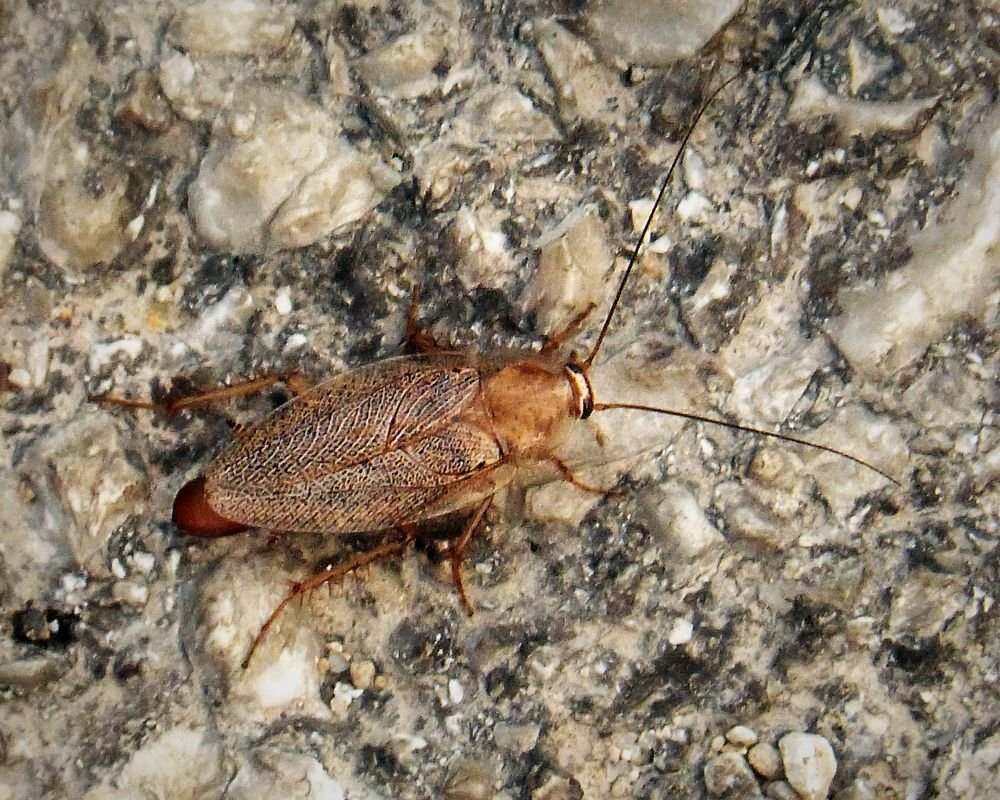
The German cockroach — the one that outbreeds your spray can.
One call reaches a licensed, local exterminator who covers your address — and a real person answers, 24/7.
Free to check coverage — the operator gives the quote after inspecting.
Check your ZIP first
One call reaches a licensed, local exterminator who covers your address — and a real person answers, 24/7.
Free to use · No obligation to hire anyone
Identification — the two stripes tell you what you’re fighting
Scientific name: Blattella germanica. Family: Ectobiidae. Status in Mobile-Baldwin: common indoor pest, concentrated in multi-unit housing, food service, and any structure with persistent kitchen moisture.
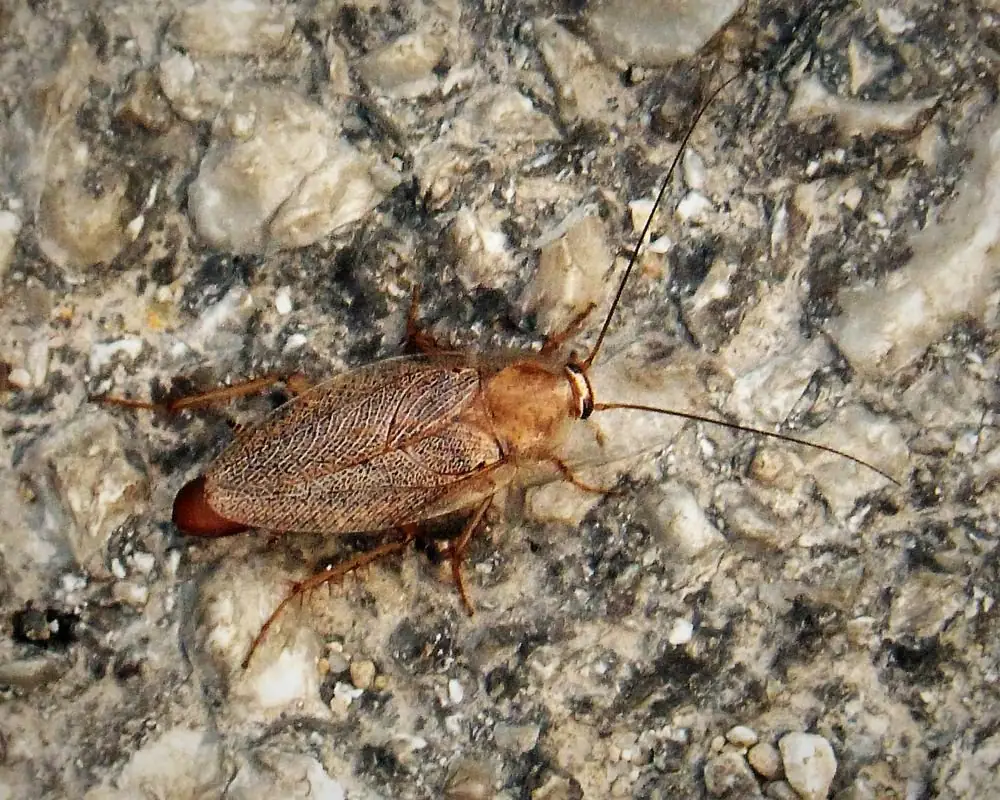
Adults run 1/2 to 5/8 inch — much smaller than the palmetto bugs Mobile is famous for — light brown to tan, with two dark parallel stripes running lengthwise on the shield behind the head. Both sexes have wings but essentially never fly. Nymphs are miniature, darker versions with the same striping, molting five to seven times on the way to adulthood.
The detail that drives everything else: the female carries her egg case (ootheca) attached to her body until just before hatch, protecting it from most treatments, then releases 30–40 nymphs at once. Egg to breeding adult takes 50–60 days. One female produces four to eight oothecae in her lifetime. Run that math forward and a single egg case carried in on a grocery sack or a used appliance becomes a thousand-plus roaches within six months.
That math is also the diagnostic: German roaches are nocturnal, so seeing them in daylight means the harborage is over capacity — the population is already several hundred strong. A daylight sighting is not an early warning; it’s a late one. Not sure which roach you have? The American vs. German comparison and the three-way Gulf Coast roach ID guide settle it in two minutes.
Where they come from — and where they hide once inside
German cockroaches are an indoor-obligate species — they can’t survive long outdoors in any climate, Gulf Coast included. Every infestation traces back to an introduction: cardboard from a storage unit, a used refrigerator or microwave, secondhand furniture, a grocery delivery, a suitcase from an infested rental — or, in multi-unit housing, the neighbors’ unit via plumbing chases and shared walls.
In the Mobile metro, the concentration map follows exactly that logic: apartment stock in West Mobile and midtown, rental turnover in Gulf Shores and Orange Beach vacation properties, and food-service kitchens across the metro that receive supplier deliveries weekly. None of that is a hygiene verdict — introduction is about traffic, not cleanliness. Persistence, though, is about resources.
Once inside, they compress into tight, warm, humid crevices within a few feet of food and water: behind the refrigerator and its motor housing, inside the dishwasher insulation, under the sink around the plumbing, in cabinet hinges and corner seams, behind the coffee maker, in the microwave clock housing. Droppings that look like coffee grounds in cabinet corners, a musty odor in heavy infestations, and casings from molted nymphs are the sign set worth photographing for the operator.
Why the spray can loses: repellent consumer sprays kill the roaches you see and scatter the ones you don’t — driving the colony deeper into voids and, in apartments, into the next unit. Meanwhile the carried oothecae hatch untouched, protected from contact sprays entirely. The species reproduces faster than any over-the-counter knockdown cycle. This is the one Mobile roach where the DIY route reliably makes the problem harder to solve.
What a licensed operator does differently
Educational only — the independent operator recommends and performs the treatment, and every kitchen is different.
Find the harborage
Flashlight-and-flush inspection of the kitchen and bath crevice map — appliance motors, hinge lines, plumbing penetrations — to locate where the population actually lives, not where it wanders.
Bait, don’t blast
Gel baits placed in the harborage traffic lanes, paired with insect growth regulators that break the ootheca-to-adult cycle. No repellent scatter — the colony feeds and collapses in place over weeks.
Verify and follow up
Monitors confirm the trend, follow-up visits rotate bait formulations to prevent bait aversion, and in multi-unit housing the operator will talk adjacent-unit coordination — the difference between clearing a building and chasing roaches around it.
Your homework matters here more than with any other pest: strict overnight sanitation (no dishes in the sink, sealed dry goods, nightly trash), fixing the drip under the sink, and inspecting anything secondhand before it comes through the door. Bait competes with crumbs — a clean kitchen makes the treatment work faster.
Free to check coverage. ADAI-licensed operators serving Mobile & Baldwin County, AL.
Why it matters beyond the ick factor
Asthma and allergens. German cockroach allergen — shed skins, droppings, saliva — is one of the best-documented indoor asthma triggers in children, with urban epidemiological studies tying childhood asthma rates directly to infestation levels. Clearing an established population is a health intervention, not just a comfort upgrade.
Food contamination. Mechanical transfer of E. coli, Salmonella, and Pseudomonas from drains and droppings to counters and utensils is documented wherever German roaches and food share a kitchen.
The trajectory. Untreated German roach populations do not plateau or burn out — the reproductive rate guarantees growth until resources run short, which in a functioning kitchen is never. The gap between “saw one at night” and “several hundred in the walls” is a couple of breeding cycles — weeks, not seasons.
What should you ask the operator?
You’ll get a better outcome — and a fairer quote — if you ask these on the first visit.
- “German or American — and how do you know?” Size and stripes settle it in seconds, and the treatments barely overlap. An operator who doesn’t name the species isn’t done inspecting.
- “Where’s the harborage, and can you show me?” Good operators point a flashlight at the hinge line or appliance housing and show you. If the plan is “spray the baseboards,” keep shopping — that’s the scatter recipe.
- “What’s the bait-plus-IGR plan, and what’s the follow-up schedule?” German roach work is a campaign, not a visit. Ask how many follow-ups are included and what triggers a return.
- “What’s your ADAI license number?” Every legitimate Alabama operator has one, and the Alabama Department of Agriculture & Industries’ Pesticide Management Section — (334) 240-7240 in Montgomery — can confirm it. Pros answer without blinking.
- “I’m in a multi-unit building — what happens about the neighbors?” Roaches commute through plumbing chases. Ask how the operator coordinates with management or adjacent units, because a single-unit treatment in an infested building is a revolving door.
German cockroaches — what do homeowners ask?
Are you a pest control company?
No — Mobile Alabama Exterminators is a free dispatch and referral service. We connect Mobile and Baldwin County callers with independent pest control operators licensed by the Alabama Department of Agriculture & Industries. Every inspection and every treatment is performed by the operator, never by us — and we suggest verifying any operator’s license with ADAI before you hire.
Does seeing German cockroaches mean my house is dirty?
No — introduction is about traffic: used appliances, cardboard, deliveries, luggage, or a neighboring unit. Sanitation determines how fast they grow once inside, not whether they arrive. That said, strict kitchen sanitation is your biggest lever in making treatment work quickly.
Why do the roaches come back after I spray?
Repellent sprays scatter the colony into voids and adjacent units while the protected egg cases keep hatching. Each spray cycle kills the visible fraction and disperses the breeding core. Gel baits plus growth regulators — placed at the harborage by a licensed operator — collapse the colony instead of relocating it.
How fast can a German cockroach infestation grow in Mobile?
Egg to breeding adult runs 50–60 days, each egg case releases 30–40 nymphs, and one female produces four to eight cases. A single introduced ootheca can become a thousand-plus roaches within six months — which is why early daylight sightings deserve a same-week response, not a wait-and-see.
How much does German cockroach treatment cost in Mobile?
Pricing is set by the independent operator after inspecting — infestation extent, unit type, and follow-up schedule all move the number, and multi-unit coordination is scoped differently than a single kitchen. The match is free, and the operator’s quote comes before any work.
Are German cockroaches dangerous?
They don’t bite, but their allergens are a documented childhood asthma trigger and they mechanically transfer bacteria like Salmonella and E. coli from drains to food surfaces — the health case for prompt treatment is real, especially in homes with kids or asthma sufferers.
They breed on a 50-day clock. Start yours now.
Free to check coverage, free to get matched, no obligation. The licensed operator inspects and gives the quote.
Free to check coverage. ADAI-licensed operators serving Mobile & Baldwin County, AL.
Prefer to send details first? Use the contact form →