Ant control in Madison, AL — one call to a licensed operator.
From the first fire ant mounds waking up in a Clift Farm lawn to Argentine trails working through a slab weep hole near Wall Triana Road, our 24/7 dispatch line matches Madison households with an independent, ADAI-licensed exterminator who already works this end of Madison County. You call, we match, the licensed operator identifies the species and quotes the fix.
One call, and you’re matched
Tell the dispatcher what you’re seeing — a fresh mound in sod that went down only a season or two ago near Town Madison, a trail of ants coming through a weep hole along the slab, or activity in a common-ground strip your HOA maintains — and get matched with a licensed operator who covers your part of Madison.
☎ Call (888) 295-0220 (888) 295-0220 — answered 24/7Free call · No obligation to hire anyone · The licensed local exterminator you’re matched with inspects and sets the price
Mobile Alabama Exterminators is a free 24/7 dispatch and referral line. Call (888) 295-0220, describe what you’re seeing — a mound, a trail, or where it’s coming from — and we match you with an independent exterminator licensed by the Alabama Department of Agriculture & Industries who covers your Madison address. The licensed operator, not us, identifies the ant species and sets the price for treatment.
Why does Madison’s fastest growth create its own fire ant problem?
Madison is one of the fastest-growing cities in Alabama, and that growth is exactly what drives its most distinctive ant pattern: a wave of fire ant mounds appearing in lawns that, a year or two earlier, were bare construction dirt. Every new subdivision needs sod and fill dirt trucked in from somewhere, and that borrowed soil routinely carries fire ant colonies along with it. The mounds do not usually show up the week the sod goes down — they show up the first warm spring after move-in, once the transplanted colony has settled into its new lawn and started building. Homeowners in Clift Farm and the newer construction around Town Madison are the ones most likely to see this pattern firsthand.
Construction itself keeps generating fresh opportunity even after a subdivision is finished. The Balch Road and Wall Triana Road corridors have carried years of continuous grading, utility trenching and new-home construction, and every time a colony gets displaced by an excavator, it looks for the next patch of disturbed, sun-exposed ground to recolonize — often the yard of whichever house went up most recently nearby. That makes ongoing construction activity a useful clue for a homeowner trying to figure out why fire ants keep finding a lawn that seemed clear the year before.
Indoors, the more common nuisance is the Argentine ant, which builds shallow, high-population colonies in mulch beds and foundation plantings and sends workers trailing in through whatever gap it can find once the ground gets saturated. Madison’s newer housing stock is overwhelmingly slab construction, and a slab hides ant entry points behind brick veneer and inside the small weep holes left for wall-cavity drainage — gaps a homeowner rarely notices until ants start using one as a doorway after a hard rain. Older lots around Madison Station’s original downtown core, with more mature landscaping and shadier yards, see a similar Argentine ant pattern but less of the fresh-mound fire ant activity that defines the newer construction zones.
Madison’s HOA-governed subdivisions add a wrinkle that comes up constantly on dispatch calls: whose lawn is it, exactly, when a mound sits on a common-ground strip, a retention pond bank, or a shared entrance median rather than an individual yard. A licensed operator can treat what a homeowner is responsible for, but a colony working a shared common area often needs to be raised with the HOA or its landscaping contractor directly, since a mound on association-maintained ground may not fall under any one resident’s treatment call.
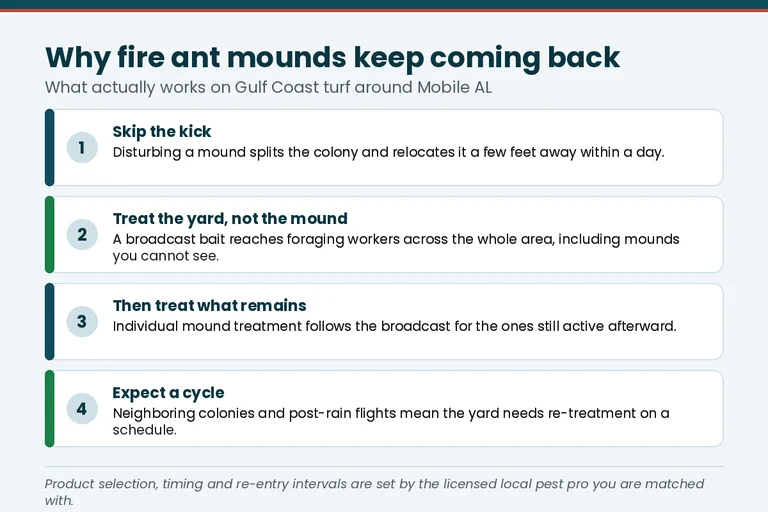
Whether the colony arrived in trucked-in sod, migrated in after construction disturbed a neighboring lot, or trailed in through a slab weep hole, the underlying treatment logic stays the same: a non-repellent bait carried back into the colony reaches queens that a surface spray on a visible trail or mound edge never touches, and treating an unidentified colony with the wrong product risks scattering it into several smaller nests instead of solving the problem.
A few things distinguish an operator who actually works Madison’s growth corridors:
- They ask how old the sod is. A lawn less than two years old with a fresh mound points straight at transplanted colonies, not a new infestation from scratch.
- They separate a homeowner’s yard from HOA common ground before quoting anything, since treatment authority differs between the two.
- They check slab weep holes and expansion joints on newer construction, not just visible outdoor trails.
Seeing a fresh mound or a trail in Madison right now? Tell the dispatcher how old your sod is and whether it’s on your lawn or HOA common ground — it changes who can treat it and how.
☎ Call (888) 295-0220Free call · 24/7 · No obligation to hire — the licensed operator you’re matched with gives the quote
How does the ant control dispatch line work in Madison?
Total transparency: we answer phones and match. Licensed operators do the work.
You call, we listen
Tap the number, day or night, and tell the dispatcher what you’re seeing in Madison — it takes about a minute, costs nothing, and you’re not committing to anything.
We match you locally
Mobile Alabama Exterminators is a dispatch and referral service, not a pest control company. We route your call to an independent operator licensed by the Alabama Department of Agriculture & Industries who covers Madison and the surrounding Madison County area.
The operator takes over
The licensed operator inspects your property, walks you through what they found, and gives you their own quote. Hiring them is entirely your decision — and you can verify their ADAI license first through the Pesticide Management Section in Montgomery at (334) 240-7240.
What else can you call the Madison line about?
The dispatch line routes several core problem types across Madison. Each links to a deeper guide on this site.
Pest control in Madison →
The parent hub for every pest problem across the city, from Town Madison to Madison Station.
Fire ant control →
The statewide fire ant guide — mound behavior and treatment logic that applies to Madison’s new-sod lawns too.
Ant control in Huntsville →
How the same species mix plays out just east, including limestone-driven pavement ant activity.
Termite treatment in Madison →
How aging builder pretreatments on Madison’s newer slabs create a separate, unrelated pest risk.
Pest identification guide →
A broader look at the species active across Alabama, useful for confirming what’s trailing through your yard.
When is ant pressure worst in Madison?
Construction timing and species drive the pattern; the calendar sets it in motion.
| Season | What shows up in Madison homes |
|---|---|
| Mar-Apr | The first warm spring after new sod goes down is when transplanted fire ant colonies build their first visible mounds in Clift Farm and Town Madison-area lawns. |
| May-Aug | Fire ant mounds peak in open, sun-exposed turf across the newer subdivisions; Argentine ant colonies in mulch beds forage hardest through the humid summer. |
| Sep-Oct | Cooling nights and fall rain push Argentine ant trails through slab weep holes and expansion joints in search of dry, high ground indoors. |
| Nov-Feb | Outdoor mound activity slows sharply, but a colony that already found its way indoors through a weep hole can keep foraging near a warm utility chase. |
Not sure which ant it is? Describe where it’s coming from — a weep hole, a mulch bed, or open turf — and let the operator confirm the species on inspection.
☎ Call (888) 295-0220Free call · 24/7 · No obligation to hire — the licensed operator you’re matched with gives the quote
What should you ask the operator about your ant problem?
Asking these on the first visit gets you a better outcome — and a fairer quote.
- “Is this a new-construction fire ant colony?” Sod and fill dirt on a recently built lot can carry colonies from wherever that soil originated. Ask whether the operator treats the whole yard given how new the lawn is, not just the visible mound.
- “Is this mound on my property or HOA common ground?” Treatment authority differs between an individual yard and an association-maintained strip or pond bank. Ask the operator to help you figure out which applies before assuming they can treat it.
- “Are you using bait or a repellent spray, and why?” A non-repellent bait carried back to the nest reaches queens a surface spray never touches, and spraying an unidentified colony risks splitting it into several nests. Ask which approach fits your situation.
- “Have you checked the slab weep holes and expansion joints?” Madison’s newer slab homes hide ant entry points behind brick veneer. Ask whether the inspection covers those spots, not just visible outdoor trails.
- “What’s your ADAI license number?” Every legitimate Alabama operator carries one, and the Pesticide Management Section in Montgomery can confirm it. A pro expects the question and answers without hesitation.
None of these questions slow down an operator who already works Madison’s new-construction corridors every week — the answers tell you who you’re dealing with before any product goes down.
Ant control in Madison — what do homeowners ask?
Are you a pest control company in Madison?
No — Mobile Alabama Exterminators is a free dispatch and referral service. We connect Madison homeowners with independent, ADAI-licensed pest control operators who identify the ant species and perform any treatment. We never do the work ourselves, and we encourage you to verify any operator’s license before hiring.
Why do I have fire ants in a lawn that’s only a year or two old?
New sod and the fill dirt trucked in with it can carry fire ant colonies from their original source, and the first mounds usually appear the following spring once the colony has settled in. It is one of the most common surprises for new Madison homeowners.
Who is responsible for treating a mound on the HOA common ground?
That depends on the subdivision’s governing documents and who maintains that specific strip of land. An operator can treat what you are responsible for, but a mound on association-maintained ground is usually a question for the HOA or its landscaping contractor as well.
How are the ants getting into my new house if it’s a slab?
Slab construction hides entry points behind brick veneer, most often at the small weep holes left for wall-cavity drainage or at expansion joints. A trail indoors after rain usually traces back to one of those spots.
Does Madison get fewer ants than the Huntsville side of the county?
The two share most of the same species, but Madison’s ongoing construction growth generates more new-sod fire ant activity than an established Huntsville neighborhood typically sees.
Can I get someone after hours in Madison?
The dispatch line answers 24/7. Appointment timing is set by the independent operator and depends on their schedule and your location — availability varies by operator and time of day. The operator confirms timing with you directly.
Ready when you are — day or night.
, free to get matched, no obligation to hire. The independent ADAI-licensed operator who covers your Madison neighborhood identifies the species and gives the quote.
☎ Call (888) 295-0220(888) 295-0220 — free call, 24/7. The licensed operator inspects and gives the quote.