Termite treatment in Madison, AL — one call to a licensed operator.
From the slab subdivisions rising around Town Madison and Clift Farm to the century-old cottages of the Madison Station Historic District downtown, our 24/7 dispatch line matches Madison homeowners who suspect termites with an independent, ADAI-licensed exterminator who already works Madison County every week. You call, we match, the licensed operator inspects, identifies the species, and quotes the fix.
One call, and you’re matched
Tell the dispatcher what you’re seeing — wings scattered across a Clift Farm patio after a warm April rain, a soft baseboard in a Madison Station cottage near the old depot, mud tunneling up a slab seam off Wall Triana Highway — and get matched with a licensed operator who works your part of Madison.
☎ Call (888) 295-0220 (888) 295-0220 — answered 24/7Free call · No obligation to hire anyone · The licensed local exterminator you’re matched with inspects and sets the price
Mobile Alabama Exterminators is a free 24/7 dispatch and referral line. Call (888) 295-0220, describe what you’re seeing — mud tubes, wings, damaged wood — and we match you with an independent exterminator licensed by the Alabama Department of Agriculture & Industries who covers your Madison address. The licensed operator, not us, inspects, identifies the termite species, and sets the price for treatment.
Why does a young, fast-growing city like Madison still have a real termite problem?
Madison is one of the fastest-growing cities in Alabama, and that growth is exactly what makes its termite risk easy to underestimate. Most of the housing stock standing today did not exist thirty years ago — it went up on slab foundations across subdivisions radiating out from Hughes Road, Balch Road and the Town Madison corridor along I-565 as farmland gave way to rooftops one phase at a time. A slab poured in the late 1990s or early 2000s got a builder’s termite pretreatment on the day it was poured, and that pretreatment’s real protection window runs five to ten years, not the life of the house. A homeowner who bought new in 2012 and has never called anyone about termites since is not necessarily termite-free — they may simply be sitting on a lapsed pretreatment nobody has re-checked.
Downtown, the Madison Station Historic District along the old railroad is the exception to the slab rule — a cluster of early-1900s cottages and depot-era buildings built on raised piers, where the crawlspace access, sill plates and open foundation vents give termites a very different, much older path indoors than anything a 2015 subdivision offers. An operator working one of these homes is trenching and rodding an open perimeter, not drilling a slab.
Underneath all of it, Madison County sits on karst limestone bedrock with a chert-and-clay overburden that varies block to block. That rocky substrate can make a continuous soil trench harder to run cleanly than it would be in pure clay, which is part of why in-ground bait stations — placed in the pockets of workable soil around a slab’s perimeter rather than trenched straight through rock — are a common call in Madison’s newer neighborhoods. The Bradford Creek greenway corridor and the drainage swales cut for newer subdivisions add their own moisture, holding water against foundation edges longer in low-lying stretches than the higher chert ridges nearby.
Active construction itself is a live variable here in a way it is not in an older, built-out city. Grading and clearing at Town Madison and Clift Farm disturbs existing colonies in the wooded lots and fence lines still being converted, and displaced colonies tend to move toward the nearest standing structure — often a finished home at the edge of a new phase, along Balch Road or Wall Triana Highway, where established wood framing looks a lot more appealing than a freshly graded lot.
Swarm season follows the same April-to-May window seen across north Alabama, timed to the first warm rain after a cool snap. A pile of shed, translucent wings on a Clift Farm patio or a Madison Station windowsill is usually the first real sign a colony gives, and it is evidence of an established problem announcing itself, not a brand-new one.
Madison also turns homes over faster than most Alabama cities, driven by relocations tied to Redstone Arsenal and the surrounding research and manufacturing corridor. That churn makes bond transferability a real closing-table question: a retreat bond that promised to follow the house on resale is only worth something if it was actually kept current, and a buyer’s inspector who does not ask about it can miss a lapsed pretreatment entirely.
An operator who works Madison every week reads all of it together — slab age against pier-and-beam downtown, rocky chert against creek-corridor clay, and a subdivision still under construction against one that has been settled for twenty years — before recommending a protocol.
Seeing wings or mud tubes in Madison right now? Tell the dispatcher exactly where — a Clift Farm patio, a Madison Station crawlspace, a slab seam off Wall Triana Highway — so you’re matched with an operator who already knows that foundation type.
☎ Call (888) 295-0220Free call · 24/7 · No obligation to hire — the licensed operator you’re matched with gives the quote
How does the termite dispatch line work in Madison?
Total transparency: we answer phones and match. Licensed operators do the work.
You call, we listen
Tap the number, day or night, and tell the dispatcher what you’re seeing in Madison — it takes about a minute, costs nothing, and you’re not committing to anything.
We match you locally
Mobile Alabama Exterminators is a dispatch and referral service, not a pest control company. We route your call to an independent operator licensed by the Alabama Department of Agriculture & Industries who covers Madison and the surrounding Madison County area.
The operator takes over
The licensed operator inspects your property, walks you through what they found, and gives you their own quote. Hiring them is entirely your decision — and you can verify their ADAI license first through the Pesticide Management Section in Montgomery at (334) 240-7240.
What else can you call the Madison line about?
The dispatch line routes several core problem types across Madison. Each links to a deeper guide on this site.
Pest control in Madison →
The parent hub for every pest problem across the city, from Town Madison slabs to the Madison Station depot district.
Termite control →
The full statewide termite guide — species, protocols, and what a licensed inspection actually covers.
Termite treatment (Huntsville) →
Madison’s neighbor across the county line shares the same eastern subterranean pressure and karst geology.
Rodent control →
Field-to-subdivision conversion along Balch Road and Wall Triana pushes rodents into new construction the same way it pushes termites.
Termite swarming season →
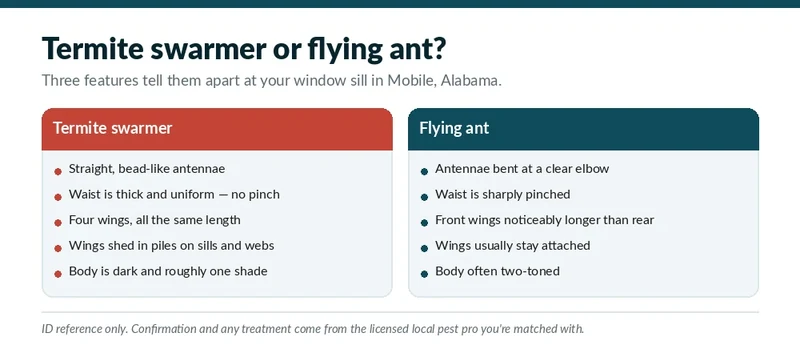
When and why Alabama termites swarm, and how to tell a termite swarmer from a flying ant.
When is termite pressure worst in Madison?
Construction timing and pretreatment age set the risk; the calendar sets the swarm window.
| Season | What shows up in Madison homes |
|---|---|
| Mar-May | Swarm season — winged termites and shed wings turn up on Clift Farm patios, Madison Station windowsills and slab-home porches after the first warm rain following a cold snap. |
| Jun-Aug | Colonies feed hardest through the humid summer; mud tubes climb fastest on shaded slab seams and around foundation plantings in established subdivisions. |
| Sep-Nov | Grading and clearing on active phases at Town Madison and Clift Farm continue to disturb colonies in wooded fence lines, pushing activity toward nearby finished homes. |
| Dec-Feb | Colonies retreat into warmer soil beneath heated slabs; a house with a lapsed pretreatment can still show quiet winter activity that goes unnoticed until spring. |
Not sure how old your pretreatment is? Tell the dispatcher roughly when your house was built — a builder pretreatment loses real protection after five to ten years, and that alone changes what the operator recommends.
☎ Call (888) 295-0220Free call · 24/7 · No obligation to hire — the licensed operator you’re matched with gives the quote
What should you ask the operator about your slab or foundation?
Asking these on the first visit gets you a better outcome — and a fairer quote.
- “How old is my slab’s original pretreatment, and does that matter here?” A builder pretreatment protects for roughly five to ten years, not the life of the house. Ask the operator whether your home’s age puts it past that window and what that means for the protocol.
- “What’s your ADAI license number?” Every legitimate Alabama operator carries one, and the Pesticide Management Section in Montgomery can confirm it. A pro expects the question and answers without hesitation.
- “Does Madison’s rocky chert soil call for bait stations instead of a full trench?” Karst limestone and chert can make a continuous soil trench harder to run than it would be in pure clay. Ask the operator whether bait placement or trenching fits your specific lot.
- “Is this a retreat bond or a repair bond, and does it transfer on resale?” Madison’s fast turnover makes this a real closing-table question. Ask which bond applies, what triggers it, and whether it follows the house to the next owner.
- “Did the inspection account for nearby active construction?” Grading at Town Madison or Clift Farm can displace colonies toward finished homes at a phase’s edge. An inspection that ignores nearby construction may be missing the source.
None of these questions slow down an operator who actually works Madison’s mix of new slabs and depot-era piers every week — the answers tell you who you’re dealing with before any work starts.
Termite treatment in Madison — what do homeowners ask?
Are you a pest control company in Madison?
No — Mobile Alabama Exterminators is a free dispatch and referral service. We connect Madison homeowners with independent, ADAI-licensed pest control operators who perform the termite inspection and treatment. We never do the work ourselves, and we encourage you to verify any operator’s license before hiring.
How much does termite treatment cost in Madison?
The price is set by the independent operator after they have inspected and identified the extent of the problem — it depends on the foundation type, the treatment method and the size of the structure. The call and the match are free; ask the operator what drives their quote.
My house is only fifteen years old — can it still have termites?
Yes. A builder’s pretreatment loses most of its real protection within five to ten years, and a home built during Madison’s subdivision boom can be well past that window without ever having been re-checked.
Does the rocky soil in Madison change how termites get treated?
It can. Karst limestone and chert layers make a continuous soil trench harder to run in some yards, which is part of why bait stations are common here. An operator working your specific lot should explain which approach fits.
Which parts of Madison does the line cover?
The line routes across the city — the newer subdivisions around Town Madison, Clift Farm and Hughes Road, the historic cottages near Madison Station — plus the rest of Madison County. Call and the dispatcher confirms coverage for your address.
Can I get someone after hours in Madison?
The dispatch line answers 24/7. Appointment timing is set by the independent operator and depends on their schedule and your location — availability varies by operator and time of day. The operator confirms timing with you directly.
Ready when you are — day or night.
, free to get matched, no obligation to hire. The independent ADAI-licensed operator who covers your Madison foundation type inspects and gives the quote.
☎ Call (888) 295-0220(888) 295-0220 — free call, 24/7. The licensed operator inspects and gives the quote.