Termite treatment in Fairhope, AL — pier cottages, live oaks and Formosan swarms.
From the pier-set 1920s cottages of downtown’s old arts-colony streets to the live-oak canopy of the Fruit & Nut District and the bayfront estates of Point Clear, Fairhope’s oldest wood and its newest slabs face the same Formosan pressure differently. Mobile Alabama Exterminators is a free referral line that connects Fairhope homeowners with an independent operator.
Mobile Alabama Exterminators is a free referral line. Seeing mud tubes, wings, a nest in a tree or damaged wood? Call (888) 295-0220, enter your ZIP, and get connected live with an independent local pest control company that covers your Fairhope address. The pest control company, not us, inspects, identifies the species, and sets the price for treatment.
Termites in your Fairhope house?
Call, enter your 5-digit ZIP on the keypad, and get connected live with a local pest control company. Free to call, 24/7.
Why do Fairhope’s live oaks and pier-built cottages carry such different termite risk?
Fairhope was founded in 1894 as a single-tax colony that drew writers, artists and idealists to build on the bluff above Mobile Bay, and a surprising number of the cottages from that era — small-footprint homes set up on brick or masonry piers — are still standing in the streets around downtown and the old colony core. That pier-and-beam construction, common through the 1920s and 1930s, gives Formosan and eastern subterranean termites alike an easy path indoors: open soil contact at every pier, sills within a few inches of grade, and, on many of these century-old lots, decades of settled garden beds pressed right up against the foundation.
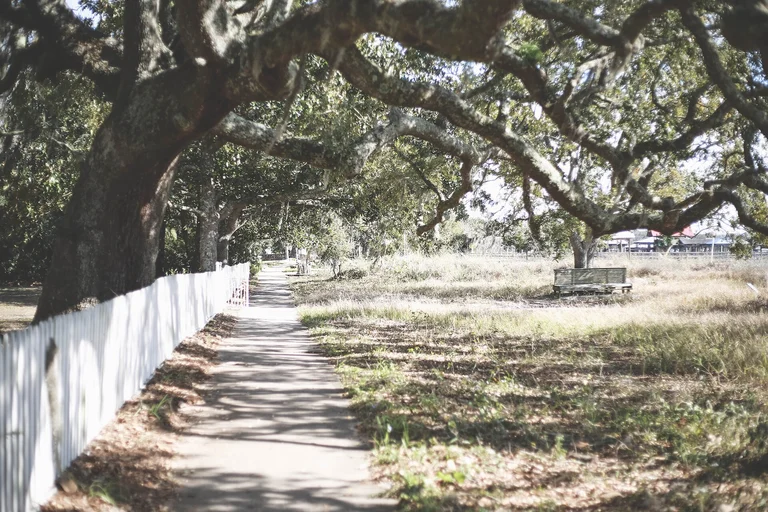
A few blocks inland, the Fruit & Nut District earns its name from the pecan trees, fig trees and old fruit-bearing plantings that canopy its streets, and that mature tree cover is exactly the kind of habitat a Formosan colony favors when it builds an aerial nest. Unlike the ground-based mud tubes most homeowners picture, a Formosan colony can pack chewed wood and soil into a tree cavity or a wall void and sustain itself there without ever touching the ground, which means a canopy street like this can carry termite pressure an inspector has to look up for, not just down.
Fairhope’s geography splits sharply between the bluff and the water below it. Homes set back on the bluff itself drain toward the Bay and tend to stay drier than the handful of bayfront properties down near the water’s edge, where humidity and soil moisture stay elevated most of the year. That bluff-versus-bayfront split matters for treatment as much as for the view: a high water table near the shoreline can complicate trenching a liquid termiticide barrier, while the drier bluff lots trench more conventionally.
South of downtown, Point Clear’s bayfront estates, some dating back generations near the Grand Hotel grounds, often carry termite bonds that have been renewed for decades under the same family ownership — and just as often, a property that changes hands finds that bond lapsed with the sale, leaving a large, mature structure with old-growth heart pine and no active coverage until someone checks.
Meanwhile Fairhope’s growth edge, out along Twin Beech Road and County Road 181, is filling in with new slab construction where builder-installed soil pretreatments are still within their effective window for now — but that window runs five to ten years depending on the chemistry and soil, and a house bought in the first wave of that growth is approaching the point where the original treatment needs a second look.
Formosan alates swarm at night from roughly May through July, and in Fairhope that shows up as dense clusters of shed wings on porches and windowsills the morning after a warm, humid evening, most often in the canopy neighborhoods and along the bluff where mature trees and lit porches both draw a swarm in.
Because of that split between old pier-built cottages, canopy streets with aerial-nest risk, and new slab construction on the growth edge, Fairhope homeowners see real variety in what a local pest control company recommends: a single trenched liquid tank around an exposed cottage perimeter, versus an ongoing in-ground bait system monitored annually where the water table or a canopy nest makes liquid treatment less practical.
Seeing wings or a nest in a tree right now? Note exactly where — downtown on a pier-built cottage, in a Fruit & Nut District oak, on a Point Clear porch — and point it out to the company you’re connected with.
Call (888) 295-0220 · Enter your ZIP · Connected live with an independent local company that quotes the job
What else can you call the Fairhope line about?
The referral line also covers five core problem types across Fairhope. Each links to a deeper guide on this site.
Pest control in Fairhope →
The parent hub for every pest problem across the city, from downtown to Point Clear.
Termite control (statewide) →
The full Alabama termite guide — species, protocols, and what a professional inspection actually covers.
Termite inspection in Fairhope →
A closer look at what a Fairhope inspection covers, from pier cottages to bayfront estates.
Roach exterminator in Fairhope →
The same live-oak canopy that shelters Formosan nests also shelters smokybrown roaches downtown.
Is a termite bond worth it? →
A closer look at retreat and repair bonds — useful reading before an older Fairhope bond lapses.
When is termite pressure worst in Fairhope?
Canopy, bluff and bayfront each carry the season a little differently.
| Season | What shows up in Fairhope homes |
|---|---|
| Mar-Apr | Early eastern subterranean activity can appear on warm afternoons along the bluff and in the Twin Beech growth corridor. |
| May-Jul | Peak Formosan swarm season — dense wing clusters show up on downtown porches and in the Fruit & Nut District after warm, humid nights. |
| Aug-Oct | Feeding stays active through late summer; bayfront lots near Point Clear and the water’s edge hold moisture longest. |
| Nov-Feb | Activity slows as colonies retreat into deeper soil, mature tree cavities or established aerial nests; canopy-nest colonies can still show some winter activity. |
Buying an older Fairhope home? Call and ask the company you’re connected with about a pre-purchase inspection — a lapsed bond on a century-old cottage is one of the most common surprises in this market.
Free call · 24/7 · You decide whether to hire — the pest control company you’re connected with gives the quote
Need a termite bond in Fairhope?
Call, enter your 5-digit ZIP on the keypad, and get connected live with a local pest control company. Free to call, 24/7.
What should you ask the operator about your Fairhope property?
Asking these on the first visit gets you a better outcome — and a fairer quote.
- “Is this Formosan or eastern subterranean?” A local pest control company should identify the species from the swarmers, tubes or wood damage on site, since the two call for different urgency and sometimes different protocols.
- “What’s your ADAI license number?” Every legitimate Alabama operator carries one, and the Pesticide Management Section in Montgomery can confirm it. A pro expects the question and answers without hesitation.
- “Did you check the trees for aerial carton nests?” A canopy street in the Fruit & Nut District can carry a Formosan nest well above ground level. An inspection that only checks the foundation may miss it.
- “Is my property’s existing bond still active after the sale?” Older Point Clear and downtown bonds sometimes lapse when a property changes hands. Ask the operator to verify current coverage rather than trust old paperwork.
- “Does my lot call for trenched liquid or an in-ground bait system?” The bluff-versus-bayfront split in soil moisture, plus any nearby canopy nest, changes which protocol fits. Ask the operator to explain the reasoning for your specific lot.
None of these questions slow down an operator who actually works Fairhope’s mix of pier cottages, canopy streets and bayfront estates every week — the answers tell you who you’re dealing with before any work starts.
Termite bonds in Fairhope
Fairhope’s housing makes the fine print of a bond matter more than usual. On a pier-built cottage near downtown or in the Fruit & Nut District, the framing may be old heart pine that already has some termite damage from decades ago. Most bonds exclude damage that existed before they started, so ask the company to record existing damage in writing, with photos, on the first inspection. That way old damage is not confused with new.
Under the big live oaks and pecans, ask whether the contract covers a colony found nesting above ground, in a wall or attic, and not just termites coming up from the soil. Formosans can do both.
Point Clear and the bayfront properties often carry bonds that have been renewed for many years. When one of those homes sells, the buyer needs to confirm the bond actually transferred and that the yearly inspection is still on the calendar.
On newer slab homes east of town along State Highway 181 and Twin Beech Road, the question is what happens after the builder’s soil treatment runs out, and whether you want retreatment-only or repair coverage from then on. More detail: is a termite bond worth it?
Termite treatment in Fairhope — what do homeowners ask?
Are you a pest control company in Fairhope?
No — Mobile Alabama Exterminators is a free referral line. We connect Fairhope homeowners with independent pest control operators who perform the termite inspection and treatment. We never do the work ourselves, and we encourage you to verify any operator’s license before hiring.
How much does termite treatment cost in Fairhope?
The price is set by the independent operator after they have inspected and identified the species and the foundation type — it depends on the protocol and the extent of the problem. The call is free; ask the operator what drives their quote.
Why did I find a nest inside a tree in my yard?
That is consistent with a Formosan carton nest, which the species builds in tree cavities or wall voids without needing ground contact. It is worth a professional inspection of the tree and the nearest structure.
Is my downtown cottage’s old termite bond still good?
Not necessarily. Many older Fairhope bonds lapse when a property changes hands or simply go unrenewed for years. Ask the operator to verify current coverage and inspect regardless of what the paperwork says.
Which parts of Fairhope does the line cover?
The line takes calls from across the city — downtown and the Fruit & Nut District, Point Clear, the Twin Beech and County Road 181 growth corridor — plus the rest of Baldwin County. Call and enter your ZIP to confirm coverage for your address.
Can I get someone after hours in Fairhope?
The referral line is open 24/7. Appointment timing is set by the independent operator and depends on their schedule and your location — availability varies by operator and time of day. The operator confirms timing with you directly.
Check the company before treatment starts
In Alabama, companies that do structural pest control, including household pest, termite and fumigation work, must hold a Professional Services license from the Alabama Department of Agriculture and Industries (ADAI). Ask for the company’s license and the name of its certified operator, and check with the ADAI Professional Services program before work starts.
Get the treatment plan, the products to be used, any follow-up visits and the price in writing. For termite work, ask what the contract covers, whether it’s retreatment only or includes repair of damage, and how long it lasts.
How the call works
- Call (888) 295-0220. Any time, day or night.
- Enter your 5-digit ZIP code on your phone’s keypad when prompted.
- Get connected live with a local pest control company that serves your ZIP. Describe what happened and ask when they can come out and what the job will cost.
Mobile Alabama Exterminators is a free referral line that connects callers with independent local pest control companies. We don’t perform the work. The company you’re connected with gives the quote, does the work and stands behind it.