Termite treatment in Spanish Fort, AL — one call to a licensed operator.
From the bluff-top cottages above the Causeway to the 1960s-70s ranches of Spanish Fort Estates and the new slabs going up in Stonebridge and Highland Park, our 24/7 dispatch line matches homeowners who suspect termites with an independent, ADAI-licensed exterminator who already works this stretch of the Eastern Shore. You call, we match, the licensed operator inspects, identifies the species, and quotes the fix.
One call, and you’re matched
Tell the dispatcher what you’re seeing — mud tubes on a bluff-lot pier near the Causeway, a swarm of winged termites battering a porch light after dark, blistered baseboards in a Spanish Fort Estates ranch — and get matched with a licensed operator who knows this side of Mobile Bay.
☎ Call (888) 295-0220 (888) 295-0220 — answered 24/7Free call · No obligation to hire anyone · The licensed local exterminator you’re matched with inspects and sets the price
Mobile Alabama Exterminators is a free 24/7 dispatch and referral line. Call (888) 295-0220, describe what you’re seeing — mud tubes, swarming termites, damaged wood — and we match you with an independent exterminator licensed by the Alabama Department of Agriculture & Industries who covers your Spanish Fort address. The licensed operator, not us, inspects, identifies the species, and sets the price for treatment.
Why does Spanish Fort’s bay-edge moisture make this Formosan termite country?
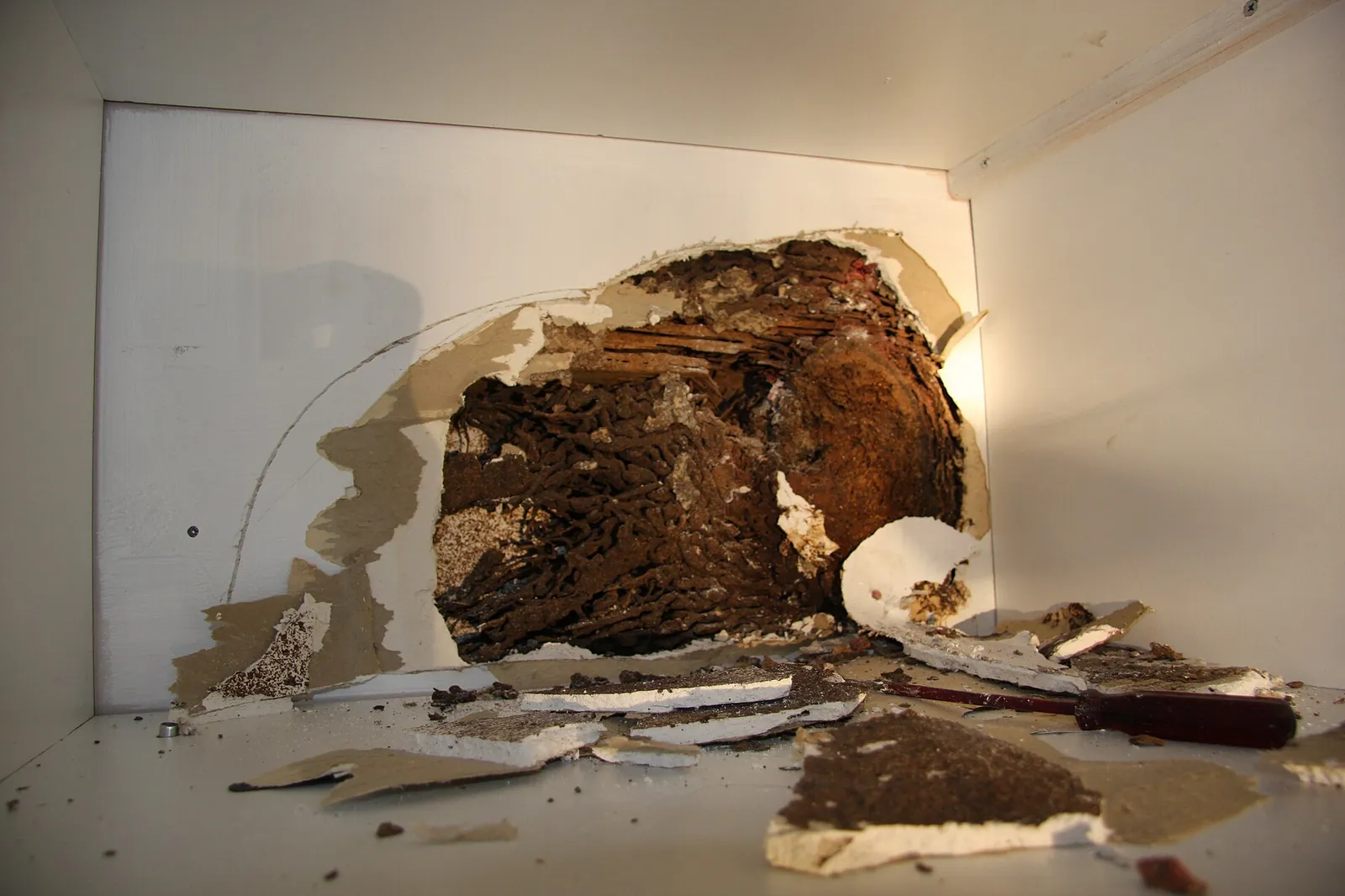
Spanish Fort sits where the Mobile-Tensaw Delta drains into Mobile Bay, and that geography is the single biggest reason a termite call here is a different animal than one 30 miles inland. This is Formosan subterranean termite territory — the same aggressive, delta-adjacent species that has worked its way up the Eastern Shore for decades. A Formosan colony can run well into the hundreds of thousands of workers, dwarfing a native eastern subterranean colony, and it does not need constant soil contact to survive. Given enough ambient moisture, a Formosan colony builds an aerial carton nest — a papery, soil-free structure tucked inside a wall void or attic framing — that lets it keep feeding on a structure even after the ground-level connection is treated. That is the fact that should drive every Spanish Fort termite conversation: this is not the same threat homeowners in Birmingham or Huntsville are dealing with.
The bluff-top lots overlooking the Causeway and Mobile Bay carry some of the area’s older stock — cottages and raised houses built to catch the water view and the breeze, many on pier foundations with crawlspaces that stay humid nearly year-round thanks to the bay’s proximity and the D’Olive Creek watershed draining past below. That damp, shaded crawlspace air is exactly what a subterranean colony wants, Formosan or otherwise, and pier construction gives it dozens of individual entry points to check rather than one continuous slab edge.
Spanish Fort Estates, the 1960s-70s ranch subdivision that fills out the older core of the city, is mostly slab-on-grade, and slab construction hides termite entry at expansion joints, plumbing penetrations and the seam where brick veneer meets the foundation. A licensed operator working these streets typically drills the slab at intervals to treat the soil beneath it rather than trenching an open perimeter, because there usually is no open perimeter to trench.
Stonebridge, Highland Park and the newer construction filling in east of Highway 31 are almost entirely slab as well, but on a very different timeline — these houses got a builder’s pretreatment when they went up, and that treatment’s effective window is finite. A slab poured in the early 2010s is now well past the point where that original barrier can be assumed to still be doing its job, which is exactly the kind of house that turns up a first-time termite discovery with no warning.
May through July is swarm season for Formosan colonies here, and it looks different than the daytime, weather-triggered swarms that get spotted inland. Formosan alates fly at night and are drawn hard to light — homeowners along the Causeway and around Mobile Bay report clouds of winged termites battering porch lights, garage sensor lights and dock lights on warm, still evenings, often before anyone finds a mud tube. That nighttime swarm is frequently the very first evidence a Spanish Fort homeowner gets, and it is worth taking seriously rather than dismissing as flying ants.
The high water table along the bay and delta edge shapes which protocol a licensed operator recommends. Liquid soil termiticide, trenched and rodded around a structure, works well where the soil stays consistently workable, but on the wettest bluff and lowland lots an in-ground bait system is sometimes the more practical long-term choice because it does not depend on an unbroken liquid barrier staying intact in saturated ground. Either way, because Formosan colonies can bridge a soil treatment with an aerial nest, ask whether the inspection specifically checked attic framing and wall voids for carton material, not just the crawlspace and slab perimeter.
- Bluff-top and Causeway-adjacent pier houses: humid, shaded crawlspaces, older pretreatments
- Spanish Fort Estates ranches: slab-on-grade, decades past any original barrier
- Stonebridge / Highland Park new construction: slab, builder pretreatments now aging out
Bay-edge moisture, a high water table and a termite species that does not play by the same rules as the rest of Alabama make Spanish Fort a market where the species identification matters as much as the foundation type. An operator who works this stretch of Baldwin County every week checks for carton nests before calling any job finished.
Seeing swarming termites at a porch light in Spanish Fort? Tell the dispatcher when it happened and what kind of foundation your house sits on — bluff-lot pier, Spanish Fort Estates slab, or new Stonebridge construction — so you’re matched with an operator who already works that lot type.
☎ Call (888) 295-0220Free call · 24/7 · No obligation to hire — the licensed operator you’re matched with gives the quote
How does the termite dispatch line work in Spanish Fort?
Total transparency: we answer phones and match. Licensed operators do the work.
You call, we listen
Tap the number, day or night, and tell the dispatcher what you’re seeing in Spanish Fort — it takes about a minute, costs nothing, and you’re not committing to anything.
We match you locally
Mobile Alabama Exterminators is a dispatch and referral service, not a pest control company. We route your call to an independent operator licensed by the Alabama Department of Agriculture & Industries who covers Spanish Fort and the surrounding Baldwin County area.
The operator takes over
The licensed operator inspects your property, walks you through what they found, and gives you their own quote. Hiring them is entirely your decision — and you can verify their ADAI license first through the Pesticide Management Section in Montgomery at (334) 240-7240.
What else can you call the Spanish Fort line about?
The dispatch line routes five core problem types across Spanish Fort. Each links to a deeper guide on this site.
Pest control in Spanish Fort →
The parent hub for every pest problem across the city, from the Causeway bluffs to Stonebridge.
Termite inspection in Spanish Fort →
What a termite inspection covers here and how it differs from routine treatment.
Termite control →
The full statewide termite guide — species, protocols, and what a licensed inspection covers.
Termite treatment in Daphne →
Formosan pressure just up the Eastern Shore in neighboring Daphne.
Formosan termite guide →
A deeper look at the species driving termite risk on the coastal side of the bay.
When is termite pressure worst in Spanish Fort?
Foundation type and bay-edge moisture set the risk; the calendar sets the timing.
| Season | What shows up in Spanish Fort homes |
|---|---|
| Mar-Apr | Ground moisture from spring rain keeps bluff-lot and lowland crawlspaces saturated, and mature colonies begin building toward the coming swarm. |
| May-Jul | Formosan swarm season — winged termites fly at night and cluster at porch lights, dock lights and garage lights around the Causeway and Mobile Bay. |
| Aug-Oct | Colonies feed hardest through the hottest, most humid stretch of the year; carton nests in attic framing grow fastest in this window. |
| Nov-Feb | Above-ground activity slows but rarely stops entirely in a delta-adjacent climate this mild — a heated crawlspace or attic can still show winter feeding. |
Found mud tubes but no swarm? Tell the dispatcher where on the structure and how high off the ground — Formosan carton nests can sit well above grade, and that detail changes what the operator checks first.
☎ Call (888) 295-0220Free call · 24/7 · No obligation to hire — the licensed operator you’re matched with gives the quote
What should you ask the operator about a Formosan-country house?
Asking these on the first visit gets you a better outcome — and a fairer quote.
- “Did the inspection check for aerial carton nests, not just soil-level evidence?” Formosan colonies can maintain a nest above ground in a wall void or attic that no longer needs soil contact. An inspection that only walks the crawlspace can miss it entirely.
- “Is this Formosan or eastern subterranean?” The two species call for different urgency and sometimes different protocols. A licensed operator should identify the species from the wings or workers found, not assume.
- “What’s your ADAI license number?” Every legitimate Alabama operator carries one, and the Pesticide Management Section in Montgomery can confirm it. A pro expects the question and answers without hesitation.
- “Does my lot call for liquid trenching or bait stations?” High water table on bay-edge and lowland lots can make a bait system more practical than a liquid barrier. Ask the operator to explain the reasoning for your specific lot.
- “Is this a retreat bond or a repair bond?” A retreat bond covers the operator coming back and re-treating; a repair bond also covers damage discovered later. Ask which one applies and how the annual reinspection works.
None of these questions slow down an operator who already works the Causeway, Spanish Fort Estates and Stonebridge every week — the answers tell you who you’re dealing with before any work starts.
Termite treatment in Spanish Fort — what do homeowners ask?
Are you a pest control company in Spanish Fort?
No — Mobile Alabama Exterminators is a free dispatch and referral service. We connect Spanish Fort homeowners with independent, ADAI-licensed pest control operators who perform the termite inspection and treatment. We never do the work ourselves, and we encourage you to verify any operator’s license before hiring.
Why do I see termites swarming at night instead of during the day?
Formosan termites, the species established along Mobile Bay, fly at night and are drawn strongly to light. A cloud of winged termites at a porch or dock light on a warm evening between May and July is a common way Spanish Fort homeowners first notice a colony.
How much does termite treatment cost in Spanish Fort?
The price is set by the independent operator after they have inspected and identified the extent of the problem — it depends on the foundation type, colony size and treatment method. The call and the match are free; ask the operator what drives their quote.
Does it matter if my house is on a bluff lot versus a slab in Stonebridge?
Yes. Bluff-lot pier houses have an open crawlspace an operator can trench and rod around; Stonebridge and Spanish Fort Estates slabs need drilling through the slab itself to treat the soil beneath it. Ask which approach applies to your foundation.
Can Formosan termites really survive without touching the soil?
Yes — a mature Formosan colony can build an aerial carton nest inside a wall void or attic space that sustains itself on ambient moisture alone. That is why an inspection here should check above the crawlspace, not just the ground-level perimeter.
Can I get someone after hours in Spanish Fort?
The dispatch line answers 24/7. Appointment timing is set by the independent operator and depends on their schedule and your location — availability varies by operator and time of day. The operator confirms timing with you directly.
Ready when you are — day or night.
, free to get matched, no obligation to hire. The independent ADAI-licensed operator who covers your Spanish Fort address inspects and gives the quote.
☎ Call (888) 295-0220(888) 295-0220 — free call, 24/7. The licensed operator inspects and gives the quote.