Pest control in Clanton, AL — one call to a licensed operator.
From the frame blocks around the courthouse to the peach ridges outside town, our 24/7 dispatch line matches Clanton households with an independent, ADAI-licensed exterminator who works Chilton County’s sandy hills every week. You call, we match, the licensed operator inspects and quotes.
One call, and you’re matched
Tell the dispatcher what you’re seeing — fresh mounds in the yard after rain, droppings in the shed or pantry, wings on a windowsill — and get matched with a licensed operator who covers Clanton.
☎ Call (888) 295-0220 (888) 295-0220 — answered 24/7Free call · No obligation to hire anyone · The licensed local exterminator you’re matched with inspects and sets the price
Mobile Alabama Exterminators is a free 24/7 dispatch and referral line. Call (888) 295-0220, describe your Clanton pest problem, and we match you with an independent exterminator licensed by the Alabama Department of Agriculture & Industries who covers your road. The licensed operator — not us — inspects, sets the price, and does the work. Calling costs nothing and you’re never obligated to hire anyone.
Why do Clanton’s sandy peach ridges breed so many fire ants?
Everybody on I-65 knows Clanton by the peach-shaped water tower, and the tower isn’t just a landmark — it’s a soil map. Chilton County grows peaches because its ridges carry deep, sandy, well-drained loam, a rare thing between Birmingham and Montgomery’s heavy clays, and the same warm, fast-draining ground that suits an orchard suits the red imported fire ant even better. Add the county-seat pattern — an early-1900s frame-and-brick downtown around the courthouse, mid-century neighborhoods spreading off US-31, and farm edges that start within a mile of the square — and Clanton’s pest calendar reads like its agricultural one: it follows the harvest, the rain and the first frost.
Three local realities drive most of the calls coming off this page:
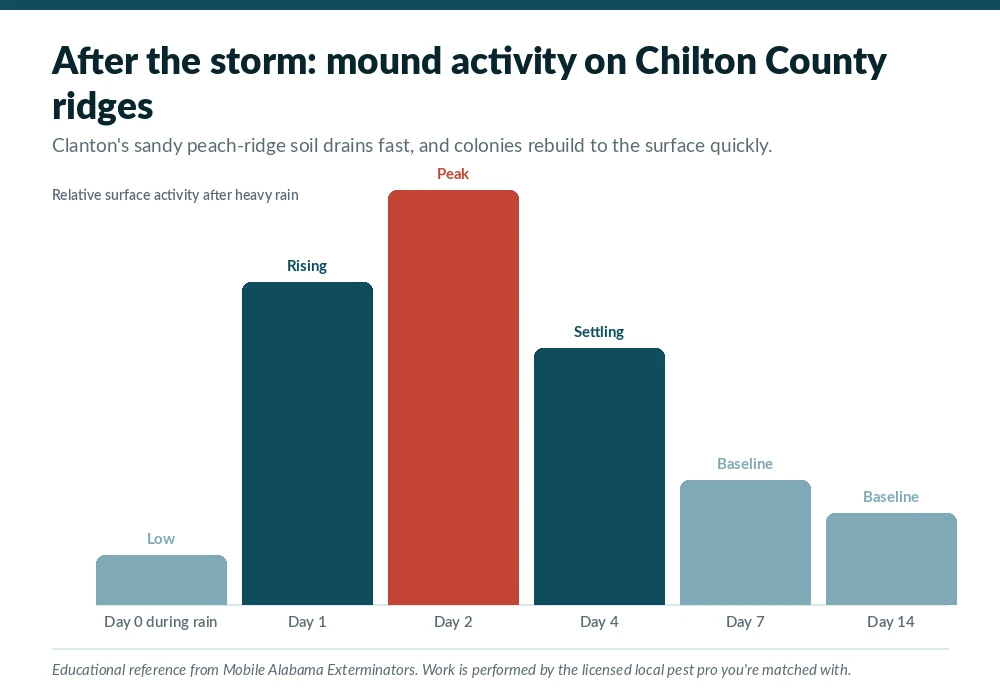
- Fire ants love the sandy ridge soils as much as the peaches do. Warm, well-drained, full-sun ground is prime mound habitat, and every summer thunderstorm triggers a fresh crop of mounds in yards, pastures, orchard rows and roadside strips — often overnight. Sandy soil also lets colonies dig deep and rebound after amateur pot-of-boiling-water treatments, which is why the operators who do well here run broadcast baiting programs on a calendar rather than chasing mounds one by one. If mounds keep reappearing in the same yard, that’s the program to ask about.
- Harvest’s end starts the rodent clock. Clanton is ringed by working agriculture — orchards, produce stands, packing sheds, hay barns and feed storage — and when the fruit is in and the fields go quiet, the rats and mice that spent summer living well outdoors go looking for winter quarters. Farm-edge homes, sheds and shops feel it first, usually in October and November: droppings along a garage wall, gnawing in a well house, scratching over a kitchen ceiling. Trapping alone rarely settles a farm-edge problem; exclusion and outbuilding sanitation are the durable half of the work.
- The old frame blocks downtown carry classic termite exposure. The early-1900s houses and storefronts around the courthouse square are pier-and-beam and slab-front construction with decades-old wood, and eastern subterranean termites work them the way they work every old Alabama county seat — through damp crawlspaces, settled grading and hidden wood-to-soil contact. Shed wings on a March windowsill or mud tubes on a pier deserve a prompt licensed inspection, especially on houses that haven’t been crawled under in years.
Around town, American and smokybrown roaches work the older blocks and outbuildings on humid nights, odorous house ants trail into kitchens after rain, and mosquitoes hold the low creek bottoms and the sloughs over toward Lake Mitchell on the Coosa side of the county. It’s a working-town pest load, and it rewards an operator who understands both sides of the fence line — the yard and the orchard beyond it.
That’s who this line matches you with — an independent, ADAI-licensed exterminator who already works Clanton, Thorsby, Jemison and the ridge roads between them every week.
Seeing activity in Clanton right now? Be specific with the dispatcher — “new mounds all over the yard after Tuesday’s storm,” “droppings in the packing shed,” “wings on the porch sill.” A specific report gets you matched with the right operator the first time.
☎ Call (888) 295-0220Free call · 24/7 · No obligation to hire — the licensed operator you’re matched with gives the quote
How does the dispatch line work in Clanton?
Total transparency: we answer phones and match. Licensed operators do the work.
You call, we listen
Tap the number, day or night, and tell the dispatcher what you’re seeing in Clanton — it takes about a minute, costs nothing, and you’re not committing to anything.
We match you locally
Mobile Alabama Exterminators is a dispatch and referral service, not a pest control company. We route your call to an independent operator licensed by the Alabama Department of Agriculture & Industries who covers Clanton and the surrounding Chilton County area.
The operator takes over
The licensed operator inspects your property, walks you through what they found, and gives you their own quote. Hiring them is entirely your decision — and you can verify their ADAI license first through the Pesticide Management Section in Montgomery at (334) 240-7240.
Which pest problems can you call about in Clanton?
The dispatch line routes five core problem types in Clanton. Each links to a deeper guide on this site.
Fire ant control →
Clanton’s signature call — mounds erupting in sandy ridge yards, pastures and orchard edges after every summer rain. Broadcast baiting programs beat mound-by-mound chasing on this soil.
Rodent control →
Rats and mice moving off orchards, packing sheds and hay barns into farm-edge homes after harvest. Trapping plus exclusion for houses, well houses and outbuildings.
Termite control →
Eastern subterranean termites in the early-1900s frame blocks around the courthouse and aging slabs off US-31. Inspections, treatments and termite letters for closings.
Cockroach control →
American and smokybrown roaches out of outbuildings, mulch and the older downtown blocks on humid nights; German roaches in kitchens and food businesses. The operator IDs species first.
Mosquito reduction →
Creek bottoms and the sloughs toward Lake Mitchell keep mosquitoes active May through October. See the pest library for what reduction programs involve.
When do pests peak in Clanton?
Clanton’s calendar follows the orchard year — bloom, harvest, and the quiet after — with the pest load tracking every step.
| Season | What shows up in Clanton homes |
|---|---|
| Mar–May | Termite swarm season on the old frame blocks; fire ant colonies wake with the peach bloom and mounds reappear with the first warm rains; odorous house ants start trailing indoors. |
| Jun–Aug | Peak fire ant season — new mounds after every thunderstorm in yards, pastures and orchard rows. Mosquitoes hold the creek bottoms; big roaches fly in on humid nights. |
| Sep–Nov | Harvest ends and the rodent push begins — rats and mice move off the farms into homes, sheds and shops at first frost. October is the month for exclusion work. |
| Dec–Feb | Indoor season — rodents nest in insulation and outbuildings, German roach pressure continues in heated kitchens, and termites keep working damp crawlspaces quietly. |
Recognize your season? Tell the dispatcher what you’re seeing and what month it started — in a farm town, the calendar is half the diagnosis.
☎ Call (888) 295-0220Free call · 24/7 · No obligation to hire — the licensed operator you’re matched with gives the quote
What should you ask the operator you’re matched with?
Asking these on the first visit gets you a better outcome — and a fairer quote.
- “Are you baiting or just knocking down mounds?” On sandy ridge soil, mound-by-mound treatment is a treadmill — colonies rebound and daughter mounds pop up nearby. Ask whether the plan is a broadcast baiting program on a calendar, and when the follow-up pass happens.
- “What’s your ADAI license number?” Every legitimate Alabama operator carries one, and the Pesticide Management Section in Montgomery — (334) 240-7240 — can confirm it. A pro expects the question.
- “Where are the rodents getting in?” Farm-edge rodent work is exclusion work — garage corners, sill gaps, well houses, the daylight under a shed door. Ask to see the entry points, not just the traps.
- “Did you check the outbuildings too?” On a Chilton County lot, the shed, barn or packing shelter is usually the reservoir. An inspection that stops at the house wall missed half the property.
- “Is this a one-time knockdown or a recurring plan?” Both are legitimate answers here. What matters is the why — a fall mouse intrusion and a yard that regrows fire ant mounds every June call for different programs.
None of these questions are rude, and none of them slow a good operator down. The ones who work the ridge roads between Clanton, Thorsby and Jemison every week answer them without blinking — and the answers tell you who you’re dealing with before any money changes hands.
Pest control in Clanton — what do homeowners ask?
Are you a pest control company in Clanton?
No — Mobile Alabama Exterminators is a free dispatch and referral service. We connect Clanton homeowners and businesses with independent, ADAI-licensed pest control operators who perform the inspections and treatments. We never do the work ourselves, and we encourage you to verify any operator’s license before hiring.
How much does pest control cost in Clanton?
The price is set by the independent operator after they’ve inspected — it depends on the pest, the property and the scope. The call and the match are free, the operator gives you their own quote before any work starts, and you’re free to compare it against anyone else’s.
Why does my yard grow new fire ant mounds after every rain?
Rain softens the soil and pushes colonies to rebuild and expand upward, so mounds seem to erupt overnight — and Chilton County’s sandy, well-drained ridge soil is ideal colony habitat. The mounds you see are a fraction of the colony below. Broadcast baiting on a schedule reaches the queens; kicking over mounds or spot-drenching mostly just relocates them.
We’re next to an orchard — is that why we get mice every fall?
Very likely. Working agriculture supports strong outdoor rodent populations all summer, and when harvest ends and frost arrives, those animals move to the nearest warm structures — usually farm-edge homes, sheds and shops. Exclusion on the house plus attention to outbuildings and feed storage is what holds; trapping alone refills by November.
Which parts of Clanton does the line cover?
The line routes across the city and the county — the courthouse-square blocks and US-31 through town, the I-65 exits by Peach Park and Durbin Farms, the ridge roads toward Thorsby and Jemison, and out to the Lake Mitchell side of Chilton County. Call and the dispatcher confirms coverage for your address.
Can I get someone after hours in Clanton?
The dispatch line answers 24/7. Appointment timing is set by the independent operator and depends on their schedule and your location — availability varies by operator and time of day. The operator confirms timing with you directly.
Nearby coverage & related pages
Ready when you are — day or night.
, free to get matched, no obligation to hire. The independent ADAI-licensed operator who covers your Clanton road inspects and gives the quote.
☎ Call (888) 295-0220(888) 295-0220 — free call, 24/7. The licensed operator inspects and gives the quote.