Most Mobile homeowners think of termites as a spring problem — swarm season, then done for the year. Underneath the house, the colony never got that memo. Gulf Coast humidity keeps subterranean and Formosan termite colonies feeding in every month of the year, and Mobile’s older wood-frame, crawl-space construction gives them an easy way in.
Dealing with a pest problem right now?
📞 Call now — get matched with a licensed local exterminator: (888) 295-0220When you call, stay on the line for a few seconds while we match you with the licensed local exterminator for your area. Have your address and a quick description of the problem ready.
Licensed local pros · Fast response, subject to availability · No obligation
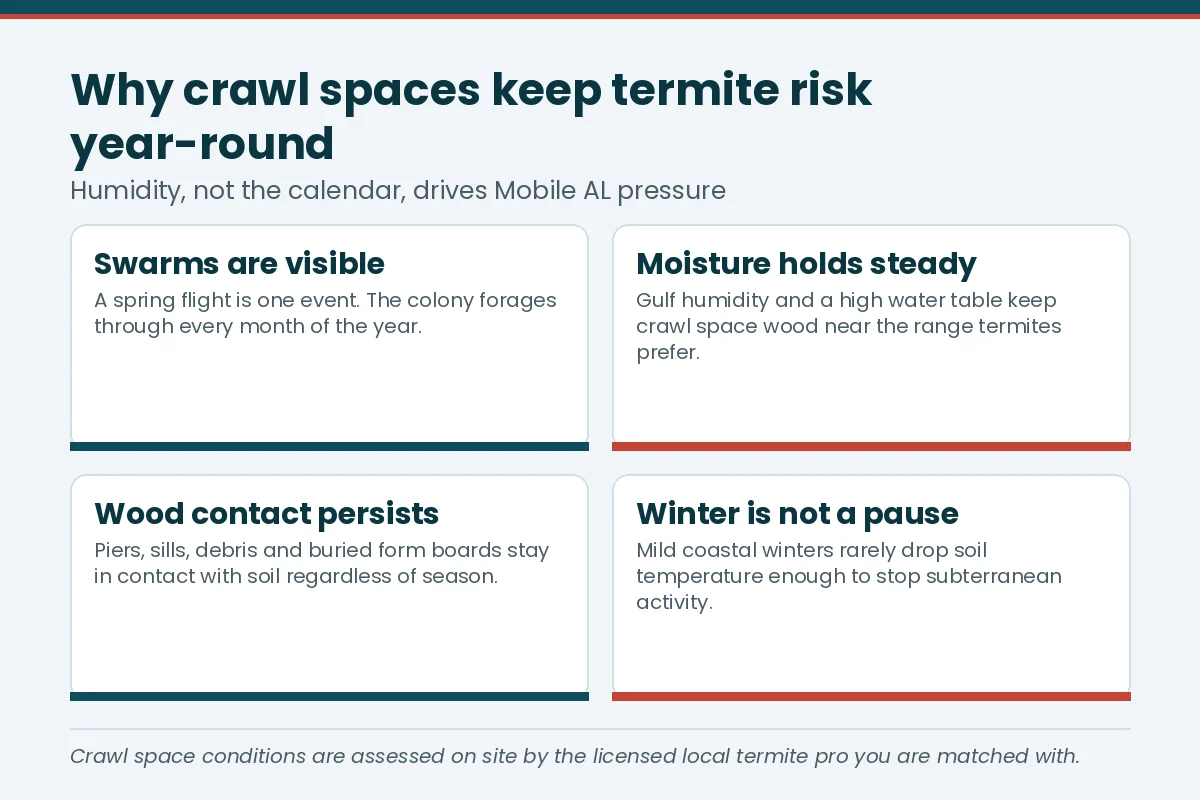
Swarms are the visible, dramatic part of the termite story, and they matter — but they’re a single event lasting minutes, once or twice a year. The colony feeding on your sill plate doesn’t pause between swarms. Understanding the conditions that keep it active year-round matters just as much as knowing when the winged reproductives take flight.
Why does Gulf Coast humidity change the math?
The National Weather Service consistently ranks the central Gulf Coast, including Mobile, among the most humid regions in the continental United States, with average relative humidity staying elevated across most months rather than dropping sharply in winter the way it does farther north. Subterranean termites need consistent moisture to survive outside the soil, and Formosan termites — the more aggressive species established in Mobile County since the 1960s — build aerial “carton nests” that hold their own moisture reserve, letting colonies persist in wall cavities and attics without needing constant ground contact. In a climate this humid, neither species gets a real winter dormancy the way populations do in drier, colder parts of the country.
Why Mobile’s older housing stock is especially exposed
Midtown Mobile, Old Dauphin Way, Spring Hill, and many of the city’s older neighborhoods have a high concentration of pier-and-beam and raised wood-frame construction with open or semi-open crawl spaces underneath — a very different exposure profile than the slab-on-grade construction common in newer subdivisions. Crawl spaces put wood framing, sill plates, and floor joists close to bare or lightly covered soil, often just inches away, with limited airflow to dry out humidity that collects underneath the house after rain. That combination — wood, soil proximity, and trapped moisture — is close to the textbook definition of a conducive condition for subterranean termite entry.
Conducive conditions to check around your house
- Wood-to-soil contact. Deck posts, stair stringers, or siding that touches soil or mulch directly, skipping the treated-wood or masonry barrier that’s supposed to separate structural wood from the ground.
- Poor crawl space drainage. Standing water or chronically damp soil under the house after normal rainfall, rather than water draining away within a day or two.
- Gutters discharging at the foundation. Downspouts that dump directly against the crawl space wall instead of routing water several feet away concentrate exactly the moisture termites need.
- Firewood or lumber stacked against the house. Even off the ground, wood piled against exterior walls creates a bridge over any soil-applied termiticide barrier.
- Storm debris and stumps left in the yard. Post-hurricane cleanup that leaves root balls, downed limbs, or storm debris in contact with the ground near the foundation gives a colony an easy stepping stone toward the house — see our hurricane pest prep guide for what to clear first.
- Cardboard, paper, or scrap wood left inside the crawl space. Builders’ debris left behind after a renovation is cellulose termites can feed on immediately, with no soil tube required if humidity is already high enough.
Subterranean vs. Formosan: two different entry strategies
Native eastern subterranean termites generally need soil contact to survive, which is why mud tubes on a foundation wall are the classic warning sign. Formosan termites are less constrained — their aerial carton nests can sustain a colony in an above-ground wall cavity or attic space as long as a moisture source keeps that nest damp, which is exactly what a leaking gutter, AC condensate line, or roof flashing failure can provide. That difference is a big part of why a WDO inspection focused only on visible ground-level mud tubes can miss an active Formosan infestation higher in the structure. For a deeper look at each species, see the Formosan termite reference and the termite control overview.
What this means for inspection timing
Because Mobile’s humidity keeps colonies active year-round, an annual WDO inspection shouldn’t be treated as a spring-only task tied to swarm season. A licensed WDC-certified operator inspecting in late fall or winter — before the spring eastern subterranean swarm and well after hurricane season debris has had time to settle — can catch conducive conditions and early activity before the next swarm cycle even starts. See WDO inspection / termite letter for what that inspection actually covers, and the complete termite treatment guide for how treatment differs between soil-based and structural approaches.
Frequently asked questions
If I don’t see a swarm, does that mean I don’t have termites?
No. Swarms are brief and easy to miss, and a colony can feed on a structure for years without ever producing a swarm you happen to see. Conducive conditions and physical evidence like mud tubes or damaged wood are more reliable year-round indicators than waiting for a swarm.
Does a crawl space automatically mean higher termite risk than a slab home?
Not automatically, but it does put structural wood closer to soil and trapped moisture in a way slab construction generally avoids. A well-maintained crawl space with a proper vapor barrier and good drainage substantially reduces that exposure.
Can I fix conducive conditions myself?
Many of them, yes — regrading a downspout, pulling mulch back from siding, and clearing wood-to-soil contact are homeowner-level tasks. They reduce risk but don’t treat an existing colony; that requires a licensed operator.
Get a crawl space and conducive-conditions check
One call reaches a licensed, local exterminator who covers your address — and a real person answers, 24/7.
One call reaches a licensed, local exterminator who covers your address — and a real person answers, 24/7.
Mobile Alabama Exterminators is a free referral service connecting Mobile and Baldwin County residents with structural pest control operators licensed by the Alabama Department of Agriculture and Industries (ADAI). This site does not perform pest control services and does not hold an ADAI license. Calls are routed to ADAI-licensed third-party operators.