
Restaurant pest control in Mobile — protect the kitchen, the score, and the name on the door.
A roach on the dish line during Friday service is a different kind of emergency than one in a house. This free 24/7 dispatch line connects Mobile and Baldwin County food-service operators with an independent, ADAI-licensed commercial pest operator — someone who works kitchens, keeps service logs, and can talk to your inspector’s checklist. They inspect, they quote, they treat. You decide. Availability, including after-hours windows, varies by operator schedule.
📞 Tap to call (888) 295-0220
Free to check, free match — the operator gives the quote. Availability varies by schedule.
Check your business ZIP first
Enter your restaurant’s Mobile or Baldwin County ZIP to confirm coverage and get matched with a dispatcher.
Free to use · No obligation to hire anyone
24/7 dispatch line — operator availability varies
Free call — the operator gives the quote
Mobile & Baldwin County coverage
Why Mobile kitchens fight a different fight
Commercial kitchens concentrate everything a German cockroach needs into a few hundred square feet: heat, moisture, food film, and a thousand dark seams to live in. Add Mobile’s climate — sixty-five inches of rain and a humidity blanket that never really lifts — and food-service pest pressure here runs harder than almost anywhere else these operators work.
The specific choke points come up on call after call:
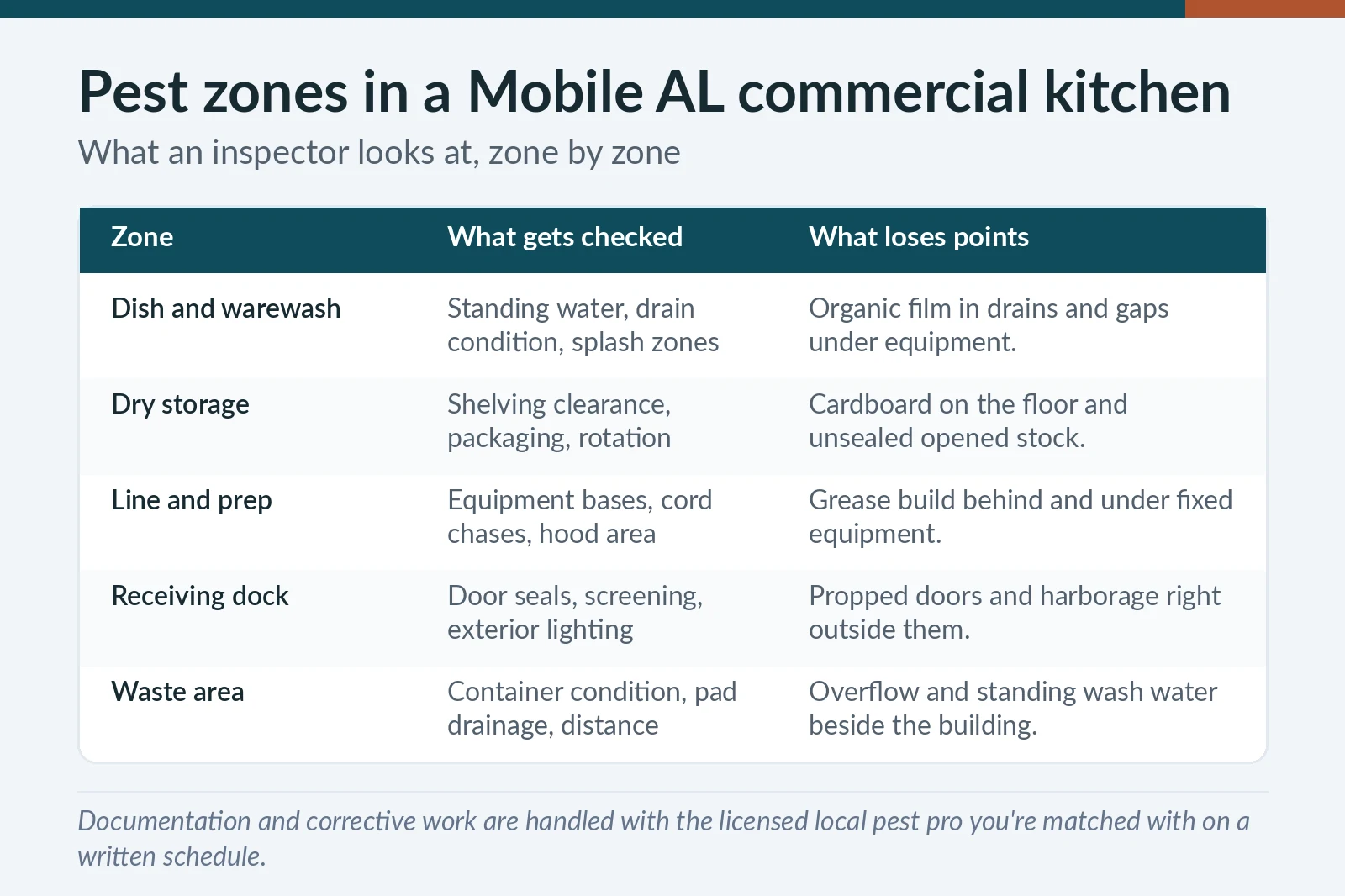
- The dish line. Warm, wet, and never fully dry, the gap behind the dish machine is prime German roach harborage. Same for the seams under stainless prep tables and the motor housings on coolers — warm equipment runs 24 hours, and the roaches know it.
- Floor drains. Organic film in drains feeds roaches, and drain lines connect spaces — which is how a problem next door becomes your problem in an old downtown block where buildings share walls and plumbing runs.
- Delivery cardboard. Corrugated boxes are the classic German roach transit system — egg cases ride the corrugation channels straight from a supplier’s warehouse into your dry storage. Kitchens that break down boxes at the receiving door and never store product in supplier cardboard cut their introductions dramatically.
- The dumpster corral and the receiving door. Rodents in commercial districts work the route between the dumpster and the back door every night. A receiving door with a worn sweep, or a corral pad with gaps and standing grease, is a standing invitation — especially in fall when nights cool and rats look for warm buildings.
- Storage rooms. Quiet, humid dry-storage and paper-goods rooms in older buildings also carry silverfish pressure — a minor player next to roaches and rodents, but one that shows up on inspection reports all the same.
Location shapes the problem too. Dauphin Street and the downtown entertainment district run on century-old buildings with shared walls, shared basements, and shared pest populations — coordination and monitoring matter as much as treatment. The seafood houses out the causeway sit over water with heavy rodent pressure and salt-air door hardware that never quite seals. West Mobile’s newer pads fight the delivery-cardboard cycle more than the building itself. An operator who works food service in this county has seen your exact floor plan before.
Saw activity during service? When you call, say what, where, and when — “German roaches behind the dish machine, worse at close” or “droppings on the receiving dock each morning.” Specifics route you to an operator with commercial kitchen experience, and they arrive with the right program in mind, not a guess.
How does the dispatch line work?
Total transparency: we answer phones and match. Licensed operators do the work.
You reach out, we listen
Requests come in any hour — managers submit at close, owners submit at dawn. Give us the ZIP, the concept, and what you’re seeing. About a minute, free, no obligation.
We match you locally
Mobile Alabama Exterminators is a dispatch and referral service, not a pest control company. Your call routes to an independent operator licensed by the Alabama Department of Agriculture & Industries who handles commercial food-service accounts in your part of the county.
The operator takes over
The licensed operator inspects the kitchen, proposes a program, and gives you their own quote — including what service windows their schedule allows. Hiring them is your call, and you can verify their ADAI license first at (334) 240-7240 in Montgomery.
Health inspections, scores, and the paper trail
The part of restaurant pest control that lives in a binder, not a sprayer.
Every food-service establishment in the county answers to the Mobile County Health Department, and inspection scores here are public — diners can and do look them up. Evidence of roaches or rodents is exactly the kind of finding that pulls a score down and puts a kitchen on the re-inspection treadmill. That’s not fear-mongering; it’s the ordinary math of running food service in a warm, wet port city. The kitchens that stay clean on paper are the ones that treat pest control as a documented program, not an emergency purchase.
A commercial program worth paying for leaves a paper trail. When the operator proposes one, look for:
- Service logs kept on site — dated entries for every visit, what was found, what was applied, and where. When an inspector asks, the binder answers.
- A monitoring map — numbered glue-board and bait-station locations on a floor plan, so trends show up as data (“station 7 by the dish line keeps catching”) instead of anecdotes.
- Findings and recommendations in writing — the torn door sweep, the wet cardboard in dry storage, the drain that needs the kitchen crew’s attention. Sanitation and exclusion notes are half the value of a good operator.
- Materials suited to food-handling areas — the operator selects and applies products consistent with their license and label requirements around food surfaces; that’s their professional lane, and a good one explains their choices plainly.
On timing: most Mobile kitchens want treatment after close or before prep, and many commercial operators build their routes around exactly that. Ask what service windows the operator can offer — after-hours scheduling is common in this market but always depends on the individual operator’s route and staffing, and is never guaranteed. Lock the expectation into the service agreement rather than assuming it.
The Mobile restaurant pest calendar
How the food-service pest year runs on the central Gulf Coast.
| Season | What Mobile & Baldwin County kitchens deal with |
|---|---|
| Feb–Apr | Mardi Gras through spring: delivery volume and crowd volume spike together downtown. More cardboard, more door-propping, more introductions — tighten receiving discipline when business is loudest. |
| May–Aug | Peak humidity. Outdoor smokybrown and American roaches push into kitchens on top of any indoor German roach activity; patio service adds ant pressure at thresholds. Drains and dish lines need their strictest routine. |
| Sep–Nov | Nights cool and rodents move — dumpster corrals, receiving doors, and cellar spaces in old downtown blocks see the traffic. The window for door sweeps, sealing, and exterior stations is before Thanksgiving, not after the first droppings. |
| Dec–Jan | Holiday volume, then the January lull — the trade’s classic window for deep cleaning, equipment pull-outs, and a full program review with the operator before the year cranks up again. |
Five questions to ask the operator before signing a program
Commercial agreements reward the owners who interview first.
- “What service windows can you actually offer?” If you need after-close service, say so up front and get the window written into the agreement. After-hours routes are common in Mobile food service, but they depend on the operator’s staffing and schedule — availability is theirs to promise, not ours.
- “What documentation do you leave on site?” Service logs, a monitoring map, and written findings should be standard on a food-service account. If the answer is a monthly invoice and nothing else, keep interviewing.
- “How will you handle the dish line and the drains?” Listen for specifics: crack-and-crevice work behind equipment, gel bait placement out of food zones, drain treatment, and monitoring. “We’ll spray the baseboards monthly” is a residential answer to a commercial problem.
- “What do you need from my crew?” Good commercial operators assign homework — cardboard breakdown at receiving, dry mopping at close, clearing the floor-wall seam. A pro who asks nothing of the kitchen is planning to fail politely.
- “What’s your ADAI license number?” Every legitimate Alabama operator carries one, and the Alabama Department of Agriculture & Industries’ Pesticide Management Section in Montgomery — (334) 240-7240 — can confirm it before you sign anything.
Restaurant pest control in Mobile — what do homeowners ask?
Why are German cockroaches such a problem in commercial kitchens?
Because a kitchen is their ideal habitat: constant warmth from equipment, moisture from the dish line and drains, food residue in seams, and nightly deliveries of cardboard that can carry egg cases in from elsewhere. They breed fast enough that a small introduction becomes an established population in weeks, which is why commercial kitchens run standing programs with monitoring instead of one-off treatments.
Will a pest problem affect my health inspection?
It can. The Mobile County Health Department inspects food-service establishments and publishes scores, and evidence of roach or rodent activity is the kind of violation that lowers a score and can trigger follow-up. A documented pest program — service logs, monitoring maps, written findings — both reduces the risk and shows the inspector the kitchen is managing it seriously.
Can the operator service my kitchen after hours?
Many commercial operators in the Mobile market build routes around after-close and pre-prep windows — it’s a normal request. But scheduling belongs to the individual operator and depends on their routes and staffing; after-hours availability varies and is not guaranteed. Raise it on the first call and get the agreed window in writing in the service agreement.
What paperwork should a commercial pest program include?
At minimum: dated service logs kept on site for every visit, a monitoring map showing numbered station locations, and written findings with sanitation and exclusion recommendations. That binder is what stands between you and an inspector’s open question — and it’s how you evaluate whether the program is actually working over time.
Are you a pest control company?
No — Mobile Alabama Exterminators is a free dispatch and referral service. We connect Mobile and Baldwin County restaurants and homeowners with independent, ADAI-licensed pest operators who perform every inspection and treatment themselves. We never do the work, and we encourage you to verify any operator’s license with ADAI before hiring.
Do you cover restaurants outside downtown Mobile?
One call reaches a licensed, local exterminator who covers your address — and a real person answers, 24/7.
Your kitchen has enough fires. This one has a number.
, free to get matched, no obligation to hire. The licensed operator inspects and gives the quote.
Prefer to send details first? Use the contact form →