Termite treatment in Trussville, AL — one call to a licensed operator.
From the 1930s New-Deal cottages of the Cahaba Project to the fastest-growing new-construction subdivisions in the metro, our 24/7 dispatch line matches Trussville homeowners who suspect termites with an independent, ADAI-licensed exterminator who already works this end of Jefferson County. You call, we match, the licensed operator inspects, identifies the species, and quotes the fix.
One call, and you’re matched
Tell the dispatcher what you’re seeing — mud tubes climbing a heart-pine sill under a Cahaba Project cottage, wings on a windowsill after a warm spring rain, a wooded new-build lot near the Cahaba headwaters — and get matched with a licensed operator who works your part of Trussville.
☎ Call (888) 295-0220 (888) 295-0220 — answered 24/7Free call · No obligation to hire anyone · The licensed local exterminator you’re matched with inspects and sets the price
Mobile Alabama Exterminators is a free 24/7 dispatch and referral line. Call (888) 295-0220, describe what you’re seeing — mud tubes, wings, damaged wood — and we match you with an independent exterminator licensed by the Alabama Department of Agriculture & Industries who covers your Trussville address. The licensed operator, not us, inspects, identifies the species, and sets the price for treatment.
Why does Trussville’s mix of 1930s cottages and new subdivisions create two different termite problems?
Trussville sits at the headwaters of the Cahaba River, and that fact shapes termite risk here more than most homeowners realize. The eastern subterranean termite is the only species active this far inland and this far north — Formosan termites are a coastal Mobile and Baldwin County problem and have not established in Jefferson County, so an aggressive-looking swarm in Trussville should prompt a species check, not a coastal-style emergency response. What eastern subterranean colonies lack in scale compared to their Formosan cousins, they make up for by working steadily through a housing stock that spans nearly a century.
The Cahaba Project, built by the federal Resettlement Administration in the 1930s as one of the New Deal’s planned communities, still anchors Trussville’s older core with small frame cottages set on pier foundations, many with original heart-pine sills and open or lightly enclosed crawlspaces. Heart pine is naturally resinous and more termite-resistant than modern framing lumber, but nearly a century of settled soil, foundation plantings and pier-level moisture around these cottages gives colonies ample opportunity regardless, and any treatment applied decades ago has long since lost its effectiveness.
Move outward from that historic core and Trussville tells a very different story: it has been one of the metro’s fastest-growing cities for two decades, and most of that growth is concrete slab construction on wooded lots pushed out toward the Cahaba headwaters and its tributary creeks. Slab construction hides termite entry at expansion joints, plumbing penetrations and the seam where brick veneer meets the foundation, and a builder’s original pretreatment is only rated to stay fully effective for roughly five to ten years — which means subdivisions built in the early-to-mid 2010s are now past that window without most owners realizing it.
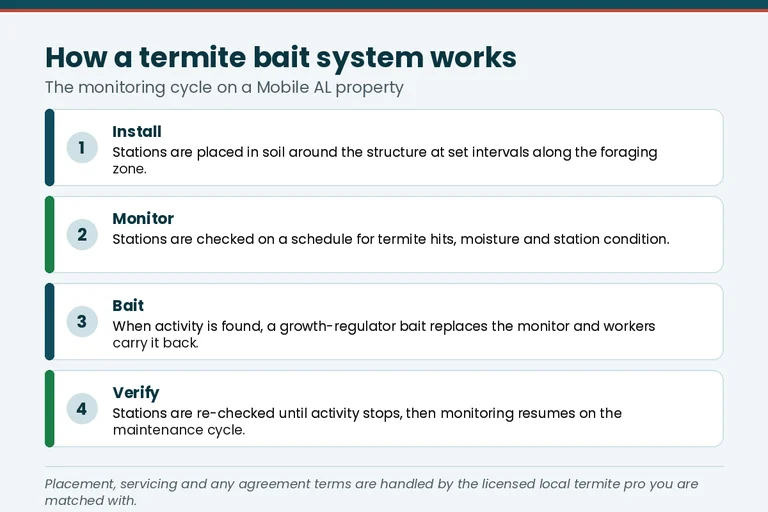
The wooded, heavily treed lots common to Trussville’s newer subdivisions add a wrinkle that flatter, more open metro suburbs don’t share: mature trees close to the foundation keep soil shaded and damp longer after rain, and root systems can create underground pathways that make a single continuous liquid barrier harder to guarantee. That combination is why in-ground bait stations, checked on a schedule rather than relying on one trenched barrier, are frequently the better fit for wooded new-construction lots here.
Swarm season runs mid-March through May, tied to the first warm rain after a cold snap, same as the rest of north-central Alabama. A cluster of shed, translucent wings on a Cahaba Project cottage windowsill or a newer subdivision’s patio door in that window is usually the first sign homeowners notice — and because it takes a mature colony years to reach swarming size, it typically means the colony has been established for some time already.
Foundation age and type together decide the protocol. Liquid soil treatment suits the open, accessible perimeter of a Cahaba Project pier cottage; bait stations often fit the wooded new-construction slabs better given root interference and canopy shade. Either way, ask whether an inspection walked the full crawlspace or attic access on an older cottage, since heart-pine framing can mask early damage that a purely visual exterior check would miss.
- Cahaba Project cottages: 1930s pier construction, heart-pine sills, decades past any original treatment
- 2000s-2010s slab subdivisions: builder pretreatments aging out of their effective window
- Wooded, headwaters-adjacent new construction: root interference favors bait over trenching
A near-century of housing stock spread across pier cottages and wooded new-build slabs makes Trussville a market where the right protocol depends heavily on which decade the house was built. An operator who works this part of Jefferson County every week reads that difference before recommending anything.
Seeing wings or mud tubes in Trussville? Tell the dispatcher whether you’re in a Cahaba Project cottage or a newer wooded subdivision — foundation type and lot age both change which operator and protocol fit.
☎ Call (888) 295-0220Free call · 24/7 · No obligation to hire — the licensed operator you’re matched with gives the quote
How does the termite dispatch line work in Trussville?
Total transparency: we answer phones and match. Licensed operators do the work.
You call, we listen
Tap the number, day or night, and tell the dispatcher what you’re seeing in Trussville — it takes about a minute, costs nothing, and you’re not committing to anything.
We match you locally
Mobile Alabama Exterminators is a dispatch and referral service, not a pest control company. We route your call to an independent operator licensed by the Alabama Department of Agriculture & Industries who covers Trussville and the surrounding Jefferson County area.
The operator takes over
The licensed operator inspects your property, walks you through what they found, and gives you their own quote. Hiring them is entirely your decision — and you can verify their ADAI license first through the Pesticide Management Section in Montgomery at (334) 240-7240.
What else can you call the Trussville line about?
The dispatch line routes five core problem types across Trussville. Each links to a deeper guide on this site.
Pest control in Trussville →
The parent hub for every pest problem across the city, from the Cahaba Project to the newest subdivisions.
Rodent control in Trussville →
Field-to-subdivision displacement and canopy roof rats in the same growth corridors.
Termite treatment in Birmingham →
How the same eastern subterranean risk plays out across Jefferson County’s core city.
Termite control →
The full statewide termite guide — species, protocols, and what a licensed inspection covers.
Termite swarming season →
When and why Alabama termites swarm, and how to tell a termite swarmer from a flying ant.
When is termite pressure worst in Trussville?
Foundation age and lot canopy set the risk; the calendar sets the timing.
| Season | What shows up in Trussville homes |
|---|---|
| Mar-May | Swarm season — winged termites and shed wings turn up on Cahaba Project windowsills and newer subdivision patio doors after the first warm rain following a cold snap. |
| Jun-Aug | Colonies feed hardest through the humid summer; shaded, tree-covered new-construction lots near the Cahaba headwaters stay damp longest. |
| Sep-Nov | Activity slows above ground but continues below it, especially where mature tree canopy keeps soil moisture higher than open lots nearby. |
| Dec-Feb | Colonies retreat deeper into warmer soil; a heated crawlspace under an older Cahaba Project cottage can still show occasional winter activity. |
Not sure if it’s active? Tell the dispatcher roughly how old the house is — a builder pretreatment’s effective window matters when the operator plans the visit.
☎ Call (888) 295-0220Free call · 24/7 · No obligation to hire — the licensed operator you’re matched with gives the quote
What should you ask the operator about a Trussville house?
Asking these on the first visit gets you a better outcome — and a fairer quote.
- “Is this eastern subterranean, or could it be something else?” Formosan termites are a coastal Mobile and Baldwin County problem, not a Trussville one. A licensed operator should identify the species from the wings or workers found, not assume.
- “What’s your ADAI license number?” Every legitimate Alabama operator carries one, and the Pesticide Management Section in Montgomery can confirm it. A pro expects the question and answers without hesitation.
- “Does my lot call for liquid trenching or bait stations?” Wooded new-construction lots near the Cahaba headwaters often favor bait over trenching because of root interference. Ask the operator to explain the reasoning for your specific lot.
- “Is this a retreat bond or a repair bond?” A retreat bond covers the operator coming back and re-treating; a repair bond also covers damage discovered later. Ask which one applies and how the annual reinspection is scheduled.
- “Did you inspect the crawlspace or attic on an older cottage, not just the exterior?” Heart-pine framing in a Cahaba Project cottage can mask early damage that a purely visual exterior walk-around would miss.
None of these questions slow down an operator who already works both the Cahaba Project cottages and Trussville’s newest subdivisions every week — the answers tell you who you’re dealing with before any work starts.
Termite treatment in Trussville — what do homeowners ask?
Are you a pest control company in Trussville?
No — Mobile Alabama Exterminators is a free dispatch and referral service. We connect Trussville homeowners with independent, ADAI-licensed pest control operators who perform the termite inspection and treatment. We never do the work ourselves, and we encourage you to verify any operator’s license before hiring.
How much does termite treatment cost in Trussville?
The price is set by the independent operator after they have inspected and identified the extent of the problem — it depends on the foundation type, protocol and structure size. The call and the match are free; ask the operator what drives their quote.
Are Cahaba Project cottages more at risk than newer Trussville subdivisions?
They carry different risk, not necessarily more. A 1930s pier cottage with heart-pine sills has had nearly a century of exposure, while a 2010s slab subdivision may be past a builder pretreatment’s effective window without anyone realizing it. Both warrant an inspection.
Why do wooded lots near the Cahaba headwaters need bait stations instead of a liquid barrier?
Tree roots close to the foundation can interfere with a continuous trenched liquid treatment, and shaded soil stays damp longer. In-ground bait systems, monitored on a schedule, often fit these lots better than a single perimeter barrier.
Why do I see wings on my windowsill every spring?
Mid-March through May, mature colonies send out winged swarmers after the first warm rain following a cold snap. A pile of shed, translucent wings on a windowsill is usually evidence of an established colony, not a new one.
Can I get someone after hours in Trussville?
The dispatch line answers 24/7. Appointment timing is set by the independent operator and depends on their schedule and your location — availability varies by operator and time of day. The operator confirms timing with you directly.
Ready when you are — day or night.
, free to get matched, no obligation to hire. The independent ADAI-licensed operator who covers your Trussville address inspects and gives the quote.
☎ Call (888) 295-0220(888) 295-0220 — free call, 24/7. The licensed operator inspects and gives the quote.