Termite treatment in Huntsville, AL — one call to a licensed operator.
From the antebellum sills of Twickenham to the bluff lots below Monte Sano, our 24/7 dispatch line matches Huntsville homeowners with an independent, ADAI-licensed exterminator who already works this limestone valley every week. You call, we match, the licensed operator inspects the crawlspace and quotes the job.
One call, and you’re matched
Tell the dispatcher what you’re seeing — mud tubes on a foundation wall, a spring windowsill full of shed wings, blistered baseboard paint in a Hampton Cove split-level — and get matched with a licensed operator who covers Huntsville.
☎ Call (888) 295-0220 (888) 295-0220 — answered 24/7Free call · No obligation to hire anyone · The licensed local exterminator you’re matched with inspects and sets the price
Mobile Alabama Exterminators is a free 24/7 dispatch and referral line, not a termite company. Call (888) 295-0220, describe what you’re seeing in Huntsville, from a Twickenham sill to a Hampton Cove slab, and we match you with an independent, ADAI-licensed operator who covers your street. The licensed operator inspects, identifies the species, and sets the price; calling costs nothing and creates no obligation to hire.
Why does Huntsville’s limestone geology change how termite treatment works?
Huntsville sits in a limestone karst valley cut into the southern end of the Cumberland Plateau, and that geology is the starting point for any serious termite conversation here. Shallow bedrock runs close to the surface on the ridgelines above town, springs surface downtown at Big Spring Park, and small cave systems honeycomb the slopes of Monte Sano and the bluffs above Blossomwood. None of that changes the species: like the rest of north Alabama, Huntsville deals with the eastern subterranean termite, not the more aggressive Formosan species that works the coastal counties around Mobile and Baldwin. What the karst does change is how an operator gets a treatment barrier into the ground.
Real winters are the second variable that sets Huntsville apart from the Gulf Coast. Hard freezes are routine from December into February, soil temperatures drop enough to slow termite activity for months, and the alates that would swarm across a longer window on the coast instead cluster into a tighter run here, typically April into May, right after the ground warms and a spring rain softens the soil. A shed-wing pile on a windowsill in that window is one of the more reliable termite signals a Huntsville homeowner will see all year, and it’s worth photographing before cleaning it up.
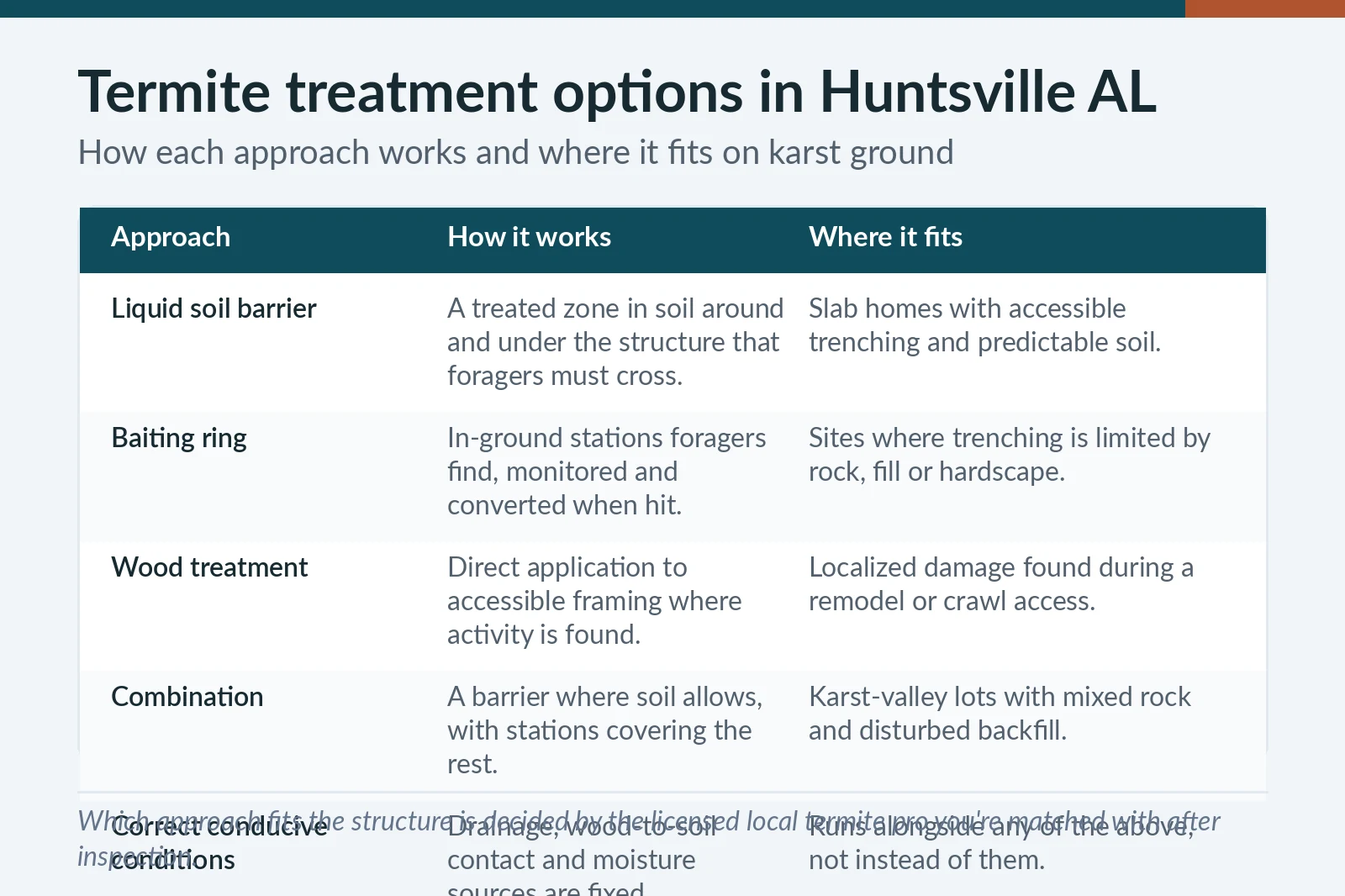
The bedrock itself is a practical problem for the classic termite treatment method. Full-perimeter trenching and rodding, digging a continuous trench around the foundation and rodding termiticide into the soil every several inches, assumes diggable soil the whole way around the house. On bluff and mountain lots toward Monte Sano and the ridgeline streets in Blossomwood, shallow limestone can sit inches under the topsoil and stop a trench cold. That’s one reason in-ground bait systems, relying on stations sunk at intervals around the yard rather than a continuous barrier, are often the more practical fit on karst terrain.
Karst also means water moves underground in unpredictable ways. Springs and small seeps feed into low spots across the valley floor, and in the older neighborhoods built before modern grading standards, that hidden moisture keeps crawlspaces damper than the rainfall totals alone would suggest, exactly the condition eastern subterranean termites look for when they’re foraging away from the soil line.
Huntsville’s 1990s and 2000s growth put thousands of houses into the subdivisions of southeast Huntsville and the Hampton Cove golf community off Highway 431, and nearly all of them left the builder with a one-time soil termiticide application rather than an ongoing bait program. Those chemical barriers don’t last forever, and a house built in 1998 is now carrying pretreatment protection that is two full decades past its likely working life. If nobody has renewed coverage since closing, that’s worth mentioning to the dispatcher.
Twickenham and Old Town carry a different risk profile entirely. Antebellum and 19th-century houses in one of Alabama’s largest concentrations of pre-Civil War architecture were framed with hand-hewn timber and set on stone pier or masonry foundations long before pressure-treated lumber or termiticide barriers existed, and many still have original sills somewhere in the structure. An inspection in this part of town is as much a structural read as a pest one.
Huntsville’s tech and defense-driven building boom, the mid-rise towers going up downtown and through MidCity along Research Park Boulevard, is almost entirely slab-on-grade construction. Termite access on a slab is different work: an operator drills through the slab at intervals along the perimeter and interior expansion joints and rods termiticide underneath, instead of trenching an open foundation. It’s a fair question to ask any operator quoting a new-construction slab.
Seeing shed wings or mud tubes right now? Tell the dispatcher exactly where — foundation wall, crawlspace pier, slab expansion joint — and whether it’s a Twickenham antebellum sill or a Hampton Cove slab. That detail gets you matched with the right operator faster.
☎ Call (888) 295-0220Free call · 24/7 · No obligation to hire — the licensed operator you’re matched with gives the quote
How does the termite dispatch line work in Huntsville?
Total transparency: we answer phones and match. Licensed operators do the work.
You call, we listen
Tap the number, day or night, and tell the dispatcher what you’re seeing in Huntsville — it takes about a minute, costs nothing, and you’re not committing to anything.
We match you locally
Mobile Alabama Exterminators is a dispatch and referral service, not a pest control company. We route your call to an independent operator licensed by the Alabama Department of Agriculture & Industries who covers Huntsville and the surrounding Madison County area.
The operator takes over
The licensed operator inspects your property, walks you through what they found, and gives you their own quote. Hiring them is entirely your decision — and you can verify their ADAI license first through the Pesticide Management Section in Montgomery at (334) 240-7240.
What else can you call the Huntsville line about?
The dispatch line routes five core problem types across Huntsville and Madison County. Each links to a deeper guide on this site.
Pest Control Huntsville, AL →
The main Huntsville hub for every pest category the dispatch line covers, from Redstone-area apartments to Hampton Cove houses.
Termite control guide →
A deeper look at eastern subterranean termite biology and treatment methods that applies statewide, including Huntsville’s karst terrain.
Bed bug treatment →
Travel and PCS-driven bed bug exposure around Redstone Arsenal and Huntsville’s new apartment towers.
Mosquito control →
Aldridge Creek and Indian Creek drainage keep mosquito pressure up in flood-prone SE Huntsville yards through the summer.
Bait vs. liquid barrier →
A closer comparison of in-ground bait systems and liquid soil barriers, useful background before a karst-terrain inspection.
When is termite pressure worst in Huntsville?
Huntsville’s termite calendar runs on a real winter, which compresses swarm season into a tighter window than the Gulf Coast sees.
| Season | What shows up in Huntsville homes |
|---|---|
| Mar-May | Swarm season — winged termites and shed wings appear on windowsills and foundation walls from Twickenham to Hampton Cove as the ground warms and spring rain hits. |
| Jun-Aug | Peak foraging season — mud tubes show up on crawlspace piers and slab edges across the older SE Huntsville subdivisions as termites push toward warm, moist wood. |
| Sep-Nov | Activity slows as soil temperatures drop, but foraging continues in insulated crawlspaces and heated structures on Monte Sano’s lower slopes. |
| Dec-Feb | Termites retreat below the frost line; this is inspection and pretreatment-renewal season for builder-treated 1990s and 2000s houses whose coverage has lapsed. |
Know your house’s decade and foundation type? A 1998 Hampton Cove slab and a 19th-century Twickenham pier foundation need different treatment approaches. Tell the dispatcher which one you have.
☎ Call (888) 295-0220Free call · 24/7 · No obligation to hire — the licensed operator you’re matched with gives the quote
What should you ask the operator you’re matched with?
Asking these on the first visit gets you a better outcome — and a fairer quote.
- “Is this eastern subterranean termite activity or something else?” Huntsville only has one termite species to worry about, but carpenter ants and old water stains get mistaken for termite damage. A licensed operator identifies the species from mud tubes, frass, or wings before recommending anything.
- “Can a full trench-and-rod barrier reach my whole foundation?” Shallow limestone on bluff and ridgeline lots can stop a trench partway around the house. Ask whether an in-ground bait system is the more practical fit for your lot before committing to one method.
- “What’s your ADAI license number?” Every legitimate Alabama operator carries one, and the Pesticide Management Section in Montgomery can confirm it. A professional expects the question and answers without hesitation.
- “Is my old builder pretreatment still active?” Soil termiticide applied when a house was built has a working life measured in years, not decades. Ask what the original treatment was, roughly when it was applied, and what renewal or monitoring options exist now.
- “Will this be a slab-drill job or a crawlspace job?” Downtown and MidCity’s newer builds sit on slabs; older Huntsville neighborhoods mostly have crawlspaces or pier foundations. Confirm which applies to your house before scheduling.
None of these questions slow a good operator down. On karst terrain with a genuine mix of housing stock, from antebellum sills to slab high-rises, an experienced Huntsville operator answers all five without blinking.
Termite treatment in Huntsville — what do homeowners ask?
Are you a pest control company in Huntsville?
No, Mobile Alabama Exterminators is a free dispatch and referral service. We connect Huntsville homeowners and businesses with independent, ADAI-licensed pest control operators who perform the inspections and treatments. We never do the work ourselves, and we encourage you to verify any operator’s license before hiring.
How much does termite treatment cost in Huntsville?
The price is set by the independent operator after they’ve inspected the property and identified the extent of activity. It depends on the foundation type, the lot’s terrain, and the treatment method. The call and the match are free.
Why does my foundation type matter for treatment method?
Huntsville’s karst bedrock can be too shallow for a full trench-and-rod barrier on some bluff and mountain lots, while slab-on-grade builds downtown need drilling instead. Ask the operator which method fits your specific foundation before work starts.
How long does termite treatment take on a Hampton Cove or SE Huntsville house?
Timing depends on the foundation’s perimeter, the terrain, and whether it’s a soil barrier or a bait-station installation. The operator gives a realistic timeline after inspecting; ask about access points and whether landscaping will need to be moved.
Are historic Twickenham and Old Town houses treated differently?
Often, yes. Antebellum and 19th-century framing on stone pier foundations calls for a more careful structural read than a modern slab, since original sills and hand-hewn timbers may already carry old damage. Ask the operator to walk you through what they find before any treatment begins.
Can I get someone after hours in Huntsville?
The dispatch line answers 24/7. Appointment timing is set by the independent operator and depends on their schedule and your location. The operator confirms timing with you directly.
Ready when you are — day or night.
, free to get matched, no obligation to hire. The independent ADAI-licensed operator who covers your Huntsville neighborhood inspects the foundation and gives the quote.
☎ Call (888) 295-0220(888) 295-0220 — free call, 24/7. The licensed operator inspects and gives the quote.