Mosquito control in Auburn, AL — one call to a licensed operator.
Town Creek and Parkerson Mill Creek cut straight through campus and the neighborhoods around it, and the Chewacla watershed they feed keeps Auburn wetter, longer, than most people expect from a college town. Our 24/7 dispatch line matches Auburn homeowners and landlords with an independent, ADAI-licensed operator who treats yards from the streets around S. College and W. Magnolia to the new subdivisions on the east side.
One call, and you’re matched
Tell the dispatcher where the pressure is worst — a creek-adjacent yard near campus, a student rental with standing water in the side yard, or a retention pond in a new east-Auburn subdivision — and get matched with a licensed operator who covers your part of Auburn.
☎ Call (888) 295-0220 (888) 295-0220 — answered 24/7Free call · No obligation to hire anyone · The licensed local exterminator you’re matched with inspects and sets the price
Mobile Alabama Exterminators is a free 24/7 dispatch and referral line. Call (888) 295-0220, describe where mosquitoes are worst on your Auburn property, and we match you with an independent operator licensed by the Alabama Department of Agriculture & Industries who covers your address. The licensed operator, not us, inspects the yard, identifies the breeding sources, and sets the price for a treatment plan.
Why does a college town built around two creeks fight mosquitoes differently than a typical Alabama suburb?
Auburn is built around water in a way that is easy to miss from campus itself. Town Creek runs along the edge of the university and through several of the neighborhoods just south and west of it, and Parkerson Mill Creek does the same on the other side of town, and both feed into the larger Chewacla watershed that drains this part of Lee County. Creeks like these do not stand still, but the low, shaded floodplain ground alongside them does — backwater pools, ditch connections and slow side-channels that hold water for days after a hard rain and give mosquitoes exactly the still water they need.
The neighborhoods around S. College Street and W. Magnolia Avenue sit close to that creek corridor and carry a second, very different mosquito driver: dense student-rental housing. A lot of these yards are rented and re-rented year after year, and the biggest single turnover event in Auburn’s calendar — the wave of August lease flips as one group of students moves out and another moves in — routinely leaves yards neglected for days or weeks at the worst possible time of year. A forgotten kiddie pool, a stack of tires, an unused grill cover pooling water, or a gutter nobody has cleaned all summer are common finds in these turnover windows, and each one is a ready-made breeding container sitting a short flight from the next house over.
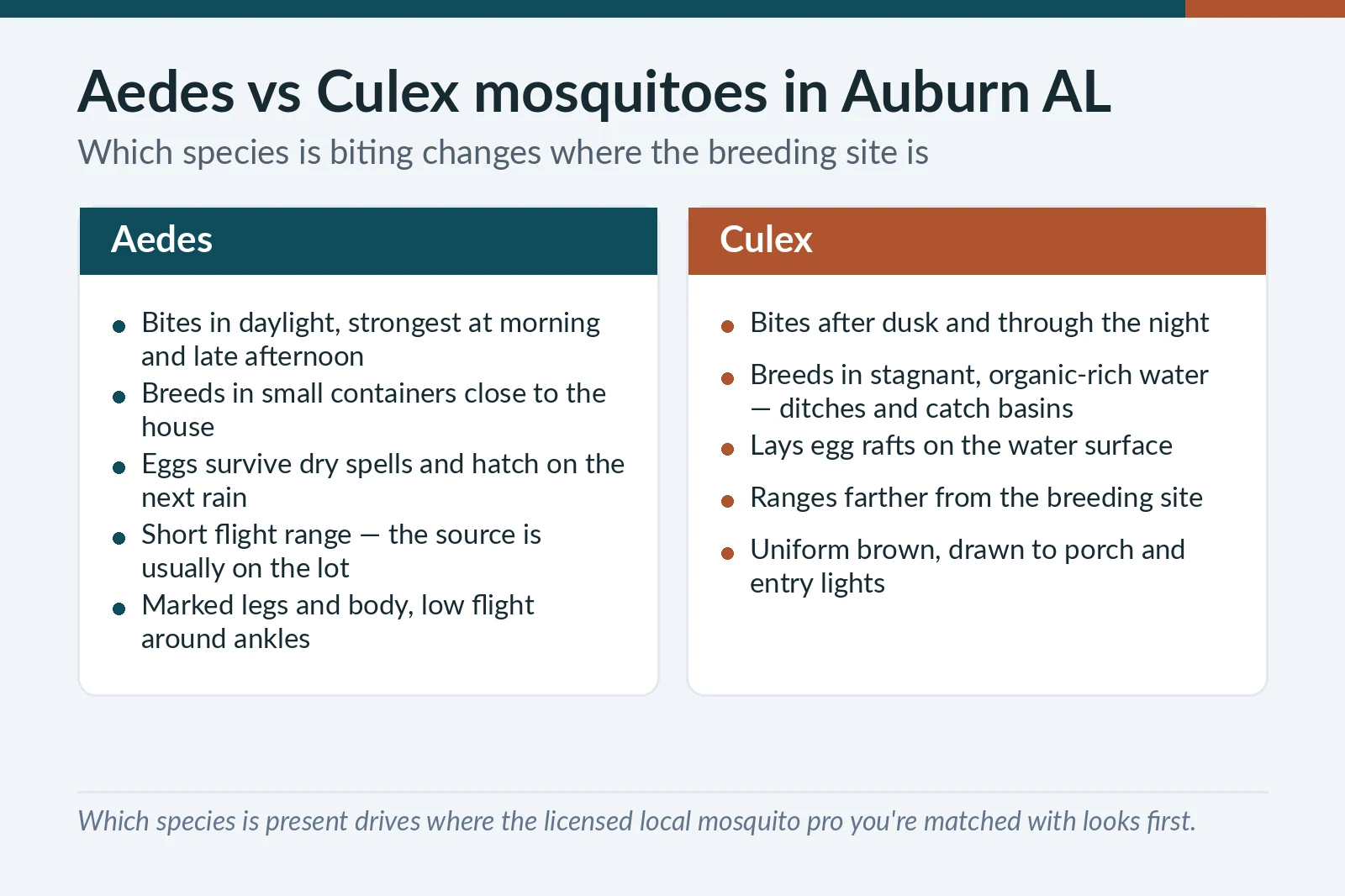
Auburn’s football calendar adds a driver that most Alabama cities its size do not have to plan around. September and October tailgate season fills yards, courtyards and rental-house porches with people sitting outside in the evening for hours at a time — exactly the hours when Culex mosquitoes, the species most associated with West Nile virus risk, are most active. A yard that looked fine in July can turn into a real nuisance, and a real exposure risk, on a game-day evening in October if the breeding sources near it were never addressed.
East Auburn’s newer subdivisions face a different, more modern source: engineered stormwater retention ponds built into the neighborhood design itself. These ponds are supposed to hold and slowly release runoff, and most of the time they do exactly that — but a pond that is not maintained on a regular cycle, or one with a shallow, vegetated edge, can produce mosquitoes in numbers that a nearby yard treatment alone cannot fully offset, because the source is a shared neighborhood feature rather than anything on one homeowner’s lot.
The honest scope for a homeowner near any of these sources — creek floodplain, student-rental yard, or subdivision pond — is that a licensed operator’s barrier treatment controls what is happening on the treated property. It does not stop mosquitoes flying in from a neighbor’s neglected yard, a shared retention pond, or the creek corridor itself, which is why a container audit on your own property matters as much as the treatment does.
Because adults keep arriving from those outside sources, most licensed operators in Auburn recommend a repeat barrier application on a roughly 21-to-30-day cycle through the warm months rather than a single visit, timed to still be working through the September and October tailgate evenings when people are outside the most.
Fighting mosquitoes in an Auburn yard right now? Tell the dispatcher whether you’re near Town Creek or Parkerson Mill Creek, in a student rental, or backing onto a subdivision pond — that detail helps match you with the right operator.
☎ Call (888) 295-0220Free call · 24/7 · No obligation to hire — the licensed operator you’re matched with gives the quote
How does the mosquito dispatch line work in Auburn?
Total transparency: we answer phones and match. Licensed operators do the work.
You call, we listen
Tap the number, day or night, and tell the dispatcher what you’re seeing in Auburn — it takes about a minute, costs nothing, and you’re not committing to anything.
We match you locally
Mobile Alabama Exterminators is a dispatch and referral service, not a pest control company. We route your call to an independent operator licensed by the Alabama Department of Agriculture & Industries who covers Auburn and the surrounding Lee County area.
The operator takes over
The licensed operator inspects your property, walks you through what they found, and gives you their own quote. Hiring them is entirely your decision — and you can verify their ADAI license first through the Pesticide Management Section in Montgomery at (334) 240-7240.
What else can you call the Auburn line about?
The dispatch line routes five core problem types across Auburn. Each links to a deeper guide on this site.
Pest control in Auburn →
The parent hub for every pest problem across the city, from the creek corridors near campus to the newer subdivisions on the east side.
Mosquito control →
The full statewide mosquito guide — species, season length, and what a yard treatment can and cannot reach.
Bed bug treatment →
Student-rental turnover and off-campus housing as a bed bug vector.
Ant control →
Fire ant and Argentine ant pressure across Auburn’s lawns and older housing stock.
Termite treatment →
Eastern subterranean termite pressure in Auburn’s campus-adjacent rental blocks and new-build subdivisions.
When is mosquito pressure worst in Auburn?
Creek floodplains, student turnover and game-day evenings all stack into the same stretch of the calendar.
| Season | What shows up in Auburn homes |
|---|---|
| Apr-May | Early-season breeding picks up along Town Creek and Parkerson Mill Creek floodplain edges as spring rain keeps low ground wet. |
| Jun-Aug | Peak breeding season; the August lease-flip window leaves student-rental yards around S. College and W. Magnolia neglected right when container breeding is at its highest. |
| Sep-Oct | Game-day tailgate evenings overlap directly with peak Culex activity, the mosquito most associated with West Nile virus risk in Alabama. |
| Nov | Activity tapers with cooler nights, though east-Auburn subdivision ponds can stay active later than creek-corridor yards. |
Getting ready for game day? Tell the dispatcher your address and when you need it done by — tailgate evenings are exactly when Culex activity peaks.
☎ Call (888) 295-0220Free call · 24/7 · No obligation to hire — the licensed operator you’re matched with gives the quote
What should you ask the operator about your yard?
Asking these on the first visit gets you a better outcome — and a fairer quote.
- “What are you finding as the main breeding source on my property?” A creek-adjacent low spot, a neglected rental-yard container, and a subdivision pond each call for a different mix of source reduction and barrier spray. Ask the operator to point out what they actually found.
- “How often will the barrier treatment need to repeat?” Most Auburn yards need a repeat application roughly every 21 to 30 days through the season, timed to still be working during September and October tailgate evenings. Ask what cadence fits your property.
- “What’s your ADAI license number?” Every legitimate Alabama operator carries one, and the Pesticide Management Section in Montgomery can confirm it. A pro expects the question and answers without hesitation.
- “Can you actually control mosquitoes from the creek or the subdivision pond?” A yard treatment reaches the treated property, not a creek corridor or a shared retention pond. Ask the operator to be honest about what a barrier spray realistically covers.
- “I’m a landlord with a student rental — what should I check between tenants?” August lease-flip turnover is one of the most common times a yard gets neglected long enough to start breeding mosquitoes. Ask the operator for a move-out-to-move-in checklist for the property.
None of these questions slow down an operator who actually works Auburn’s creek corridors and rental turnover every week — the answers tell you who you’re dealing with before any work starts.
Mosquito control in Auburn — what do homeowners and landlords ask?
Are you a pest control company in Auburn?
No — Mobile Alabama Exterminators is a free dispatch and referral service. We connect Auburn homeowners and landlords with independent, ADAI-licensed operators who perform mosquito inspection and yard treatment. We never do the work ourselves, and we encourage you to verify any operator’s license before hiring.
How much does mosquito control cost in Auburn?
The price is set by the independent operator after they’ve inspected the property and identified the breeding sources — it depends on lot size, standing-water sources and how often the treatment repeats. The call and the match are free; ask the operator what drives their quote.
Why does my rental yard keep breeding mosquitoes every August?
The lease-flip turnover that empties and refills student rentals around campus every August often leaves yards unattended for days or weeks, long enough for forgotten containers to start breeding. A licensed operator can build a treatment schedule around that turnover window.
Will treatment help before a home football weekend?
A barrier treatment timed a few days ahead of a tailgate weekend can knock down adult activity for that stretch, though results depend on nearby breeding sources like a creek or a pond. Ask the operator about timing a visit around your game-day schedule.
My yard backs onto a subdivision retention pond — can that be fixed?
A yard treatment covers your property, not the shared pond itself, so a pond-edge house should expect some ongoing pressure even after a good treatment. Ask the operator what realistic reduction looks like for a property in that situation.
Which parts of Auburn does the line cover?
The line routes across the city — the campus-adjacent creek corridors, student-rental neighborhoods near S. College and W. Magnolia, the newer subdivisions on the east side — plus the rest of Lee County. Call and the dispatcher confirms coverage for your address.
Ready when you are — day or night.
, free to get matched, no obligation to hire. The independent ADAI-licensed operator who covers your Auburn address inspects your yard and gives the quote.
☎ Call (888) 295-0220(888) 295-0220 — free call, 24/7. The licensed operator inspects and gives the quote.