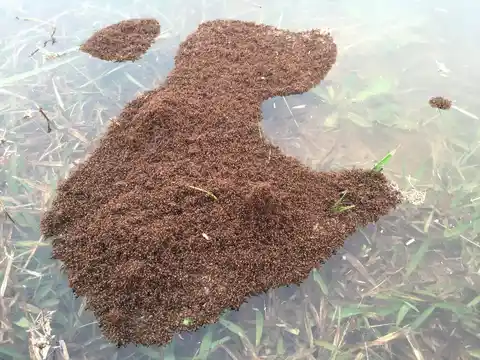
Quick answer: When floodwater rises, fire ants in Mobile, AL link their bodies together into a living raft that floats on the surface, keeping the colony – including the queen – alive until the water recedes. Rafts often wash up in a new spot and can re-colonize a yard within hours of touching dry ground. Knowing what a raft looks like and where it tends to land helps you avoid a nasty surprise during storm cleanup.
Dealing with a pest problem right now?
📞 Call now — get matched with a licensed local exterminator: (888) 295-0220When you call, stay on the line for a few seconds while we match you with the licensed local exterminator for your area. Have your address and a quick description of the problem ready.
Licensed local pros · Fast response, subject to availability · No obligation
How do fire ants survive flooding by forming rafts?
Fire ants (Solenopsis invicta, and the related black imported fire ant S. richteri found in parts of the Gulf South) are strong swimmers as individuals, but a whole colony can’t outswim a flash flood. Instead, when water starts filling the nest, the workers pour out and grab onto each other’s legs and mandibles, locking themselves into a flat, waterproof mat. The queen and brood get pulled into the center, above the waterline, while the outer layer of ants takes on the job of staying buoyant. According to the University of Florida’s IFAS entomology department, this raft behavior lets a colony survive floating on open water for days if it has to, and the ants use trapped air pockets between their bodies to keep the whole structure from sinking (UF IFAS Featured Creatures, red imported fire ant).
It’s a genuinely strange thing to see – a dense, dark mat of ants a foot or more across, sitting flat on standing water and drifting with the current. Homeowners sometimes mistake a raft for a floating mass of debris or mulch until it moves. The moment the raft touches something solid – a fence post, a tree trunk, the edge of a porch – the ants scramble off almost instantly and start digging in.
Why does Mobile’s storm season create ideal raft conditions?
Mobile and Baldwin County sit in one of the most flood-prone corners of the Gulf Coast, and the timing lines up almost exactly with fire ant colony activity. The Atlantic hurricane season runs June through November, but the sharpest spike in named storms and heavy rain events falls in the mid-August through October window, according to NOAA’s National Hurricane Center climatology data (NOAA NHC, Atlantic hurricane season climatology). That’s the same stretch when fire ant colonies in south Alabama are at or near their largest population of the year, since spring and summer growth has had months to build up the mound.
That overlap matters locally in a way that generic pest content usually skips: a heavy summer storm here isn’t just dumping rain on a smaller, quieter colony the way it might up north – it’s flooding out mounds that have had an entire growing season to expand. More ants in the raft means a faster, more aggressive re-colonization once the water goes down.
Standing water doesn’t have to come from a named storm, either. A hard afternoon thunderstorm that stalls over low-lying parts of Mobile, or a ditch and culvert system that backs up during a heavy rain event, can produce the same raft response in a yard that never saw hurricane-level wind.
What happens when a fire ant raft reaches your yard?
Once a raft makes landfall, the ants don’t wait around. They typically begin excavating a new mound within a few hours, often close to whatever solid structure the raft first contacted – which can mean a raft that drifts against a foundation, deck post, or low retaining wall ends up starting a colony much closer to the house than the original mound ever was. This is part of why post-storm fire ant activity in Mobile yards often shows up in places that never had a mound before the flood.
There’s also a practical safety issue during cleanup: floating rafts and the disturbed, muddy ground around a fresh landing site are easy to step into without noticing, especially when a yard is covered in standing water or debris. Fire ants that have just re-formed a mound after a raft landing tend to be defensive, since the colony is rebuilding and vulnerable. Anyone doing storm cleanup in Mobile – clearing branches, checking a fence line, walking through a low spot that’s still wet – should watch for that telltale dark mat on the water’s surface or a freshly disturbed patch of loose soil once things dry out.
Rafts don’t always land back in their original yard, either. Floodwater carries them wherever the current goes, which means a raft that started three properties away can just as easily wash up in a yard that’s never had a fire ant problem before. That’s one reason a yard with no history of mounds can suddenly have an active colony within days of a flood event.
How can you check your yard safely after a flood?
Give standing water a wide berth until it’s mostly drained, and look for the mat-like raft shape rather than assuming any floating debris is harmless. Once the ground has dried out enough to walk, scan low spots, the base of trees, and areas near the foundation for the loose, sandy-textured mounds that show up as colonies re-establish. Because a landed raft can turn into an active mound within a day, it’s worth checking a yard again a few days after visible floodwater is gone, not just immediately after the storm.
If you find fresh mounds in unfamiliar spots after a storm, that’s a sign a raft found your yard – not necessarily that your own colony survived in place. Getting a professional look at the extent of new activity is the fastest way to know whether it’s a single new mound or a broader re-colonization across the property. Our fire ant control page for Mobile, AL covers what that inspection and treatment process typically looks like. For pest pressure that goes beyond fire ants after a storm, our Mobile, AL pest control overview covers the broader post-storm picture.
FAQ
How long can a fire ant raft survive on water?
Colonies have been documented surviving afloat for several days when necessary, using trapped air between linked workers to stay buoyant until they reach something solid to climb onto.
Are fire ants more aggressive right after a flood?
A colony that just re-established after a raft landing is often defensive because it’s rebuilding and the queen and brood are still vulnerable, so it’s worth giving fresh mounds extra space during cleanup.
Can a fire ant raft start a new mound somewhere I’ve never had ants before?
Yes. Floodwater currents carry rafts wherever they flow, so a raft that started in a neighboring yard or a nearby ditch can land and colonize a property with no prior fire ant history.
Does a fire ant raft mean my whole yard is infested?
Not necessarily – a single raft landing usually starts as one new mound, but multiple rafts from a large flood event can mean several new colonies establishing across a property at once, which is worth having checked.
If storm cleanup has turned up fresh mounds or you spotted a raft drifting through your yard, it’s worth having a licensed local operator take a look before the colony fully re-establishes. Get matched with a licensed Mobile, AL exterminator for fire ant control.