Gulf Coast Pest Pressure Report
A sourced data study comparing termite and pest pressure across the five-state Gulf Coast — Texas, Louisiana, Mississippi, Alabama and the Florida Panhandle — built from NOAA/NWS climate and humidity records, USDA Forest Service Formosan termite distribution data, and county/parish-level surveillance from the Alabama Cooperative Extension System (ACES), Mississippi State University Extension, LSU AgCenter, and UF/IFAS. Every figure below is drawn from a public source and linked at the point of use so it can be independently checked. No figure on this page is estimated or invented.
Dealing with a pest problem right now?
📞 Call now — get matched with a licensed local exterminator: (888) 295-0220When you call, stay on the line for a few seconds while we match you with the licensed local exterminator for your area. Have your address and a quick description of the problem ready.
Licensed local pros · Fast response, subject to availability · No obligation
How Much Rain Does the Gulf Coast Actually Get?
Termite colonies need sustained soil moisture as much as they need warmth, and the Gulf Coast supplies both in abundance. NOAA’s 1991–2020 U.S. Climate Normals show a consistent band of high rainfall running the length of the coast, from the Florida Panhandle through Texas — though the total drops off noticeably the further west a city sits.
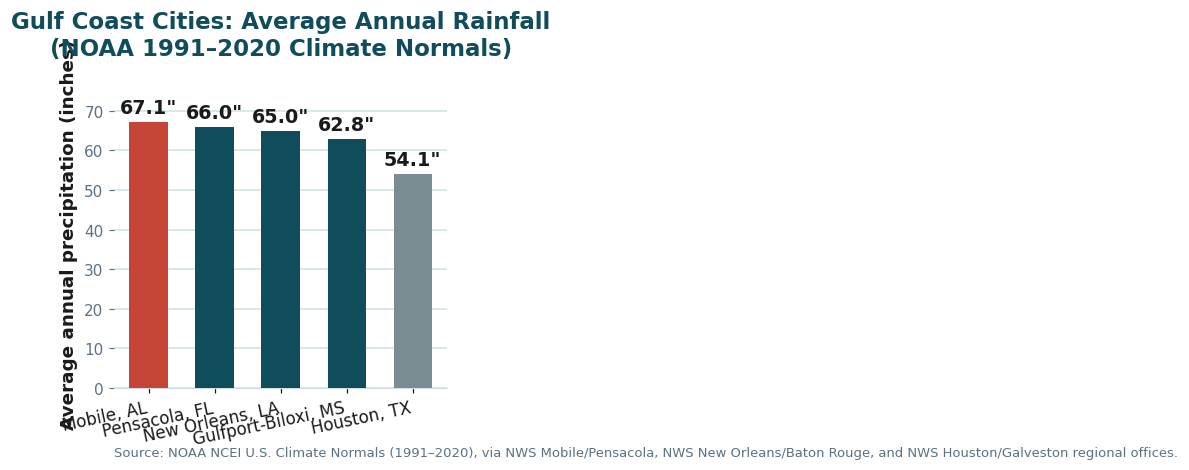
Mobile, AL averages 67.1 inches of rain a year — more than any other major Gulf Coast metro compared here, and among the highest totals of any city in the continental U.S. Rainfall drops by roughly 13 inches moving west from Mobile to Houston.
Source: NOAA NCEI U.S. Climate Normals (1991–2020), via NWS Mobile/Pensacola, NWS New Orleans/Baton Rouge, and NWS Houston/Galveston Weather Forecast Offices.
Why Is the Formosan Termite Called the Gulf Coast’s Worst Pest Problem?
The Formosan subterranean termite is an invasive species first documented in the continental U.S. in the 1950s at Gulf Coast port cities, and it has been expanding its range ever since. USDA Forest Service distribution records now place it in at least 11 states — Alabama, California, Florida, Georgia, Hawaii, Louisiana, Mississippi, North Carolina, South Carolina, Tennessee and Texas — plus Puerto Rico. Its Gulf Coast concentration is a direct function of climate: colony activity and above-ground nesting require average winter temperatures above roughly 50°F, a threshold Mobile clears with its 51°F January average.
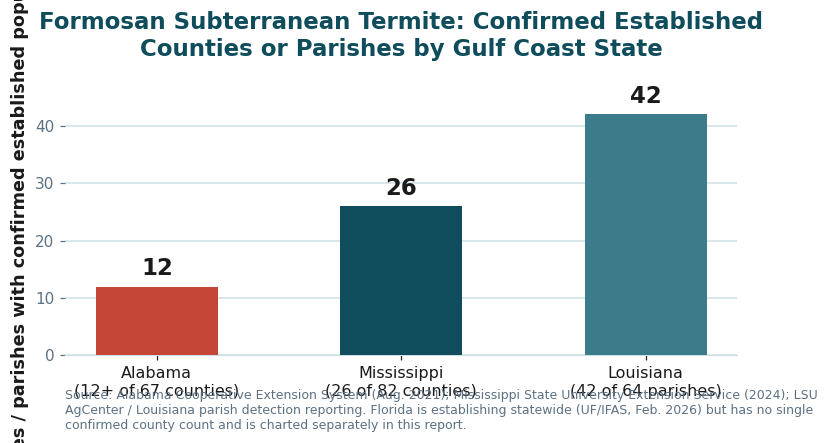
Louisiana carries the widest confirmed footprint of the three states with a published county/parish count — Formosan termites are established in roughly two out of every three Louisiana parishes. Florida is not shown here because no single statewide county count has been published; UF/IFAS’s February 2026 research instead describes Formosan termites as established in most of Florida’s large urban centers, with a full-state footprint projected by 2050.
Source: Alabama Cooperative Extension System (Aug. 2021); Mississippi State University Extension Service, “Formosan termite swarms threaten large part of state” (2024); LSU AgCenter Formosan termite program reporting.
Which Gulf Coast City Has It Worst?
By most measures, that’s New Orleans. LSU AgCenter researchers describe the French Quarter as carrying the worst Formosan subterranean termite infestation of any city in the continental United States — a problem serious enough that the U.S. Department of Agriculture launched Operation Full Stop, an area-wide Formosan termite management program, in the French Quarter in 2001. LSU AgCenter’s own area-wide management research has since shown that coordinated, neighborhood-scale treatment can measurably reduce Formosan termite numbers — a rare case of a Gulf Coast city fighting an invasive termite population at municipal scale rather than lot by lot.
| Gulf Coast city / area | Formosan termite status | Source |
|---|---|---|
| New Orleans, LA (French Quarter) | Documented as the worst Formosan infestation of any city in the continental U.S.; subject of a dedicated federal area-wide management program since 2001. | LSU AgCenter |
| Mobile & Baldwin County, AL | Named by ACES as the two Alabama counties with the heaviest confirmed Formosan activity statewide. | Alabama Cooperative Extension System |
| South Mississippi coast | Established in parts of 26 south and central Mississippi counties; swarms in the millions from late April into June. | Mississippi State University Extension |
| Florida Panhandle | Documented local swarm activity tracked by UF/IFAS’s Okaloosa County Extension office since at least 2016; part of Florida’s broader, still-expanding Formosan range. | UF/IFAS Okaloosa County Extension |
When Do Termites Actually Swarm Across the Gulf Coast?
Because the Gulf Coast spans four states’ worth of extension and agricultural research programs, no single swarm calendar has previously stitched their local swarm-timing data together into one regional picture. Overlaying ACES, Mississippi State Extension, LSU AgCenter and UF/IFAS reporting shows a rolling window that opens in the Florida Panhandle in spring and stays active into midsummer across the coast.
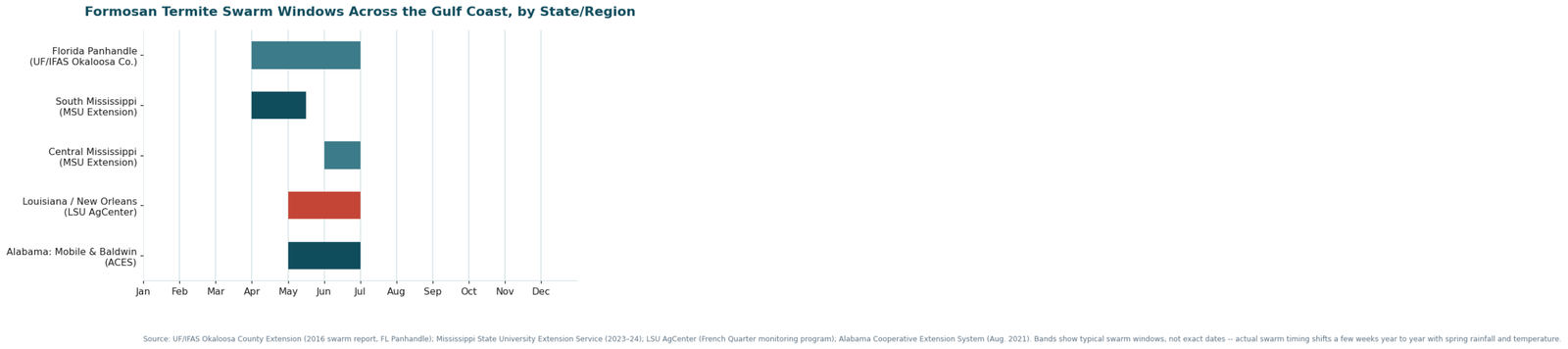
South Mississippi’s swarm window typically opens first, clustering around Mother’s Day in mid-May, while the same state’s central counties don’t see swarms until June — illustrating how much swarm timing can vary within a single state, let alone across four of them. Formosan termites swarm at dusk and are drawn to light, unlike native Eastern subterranean termites, which swarm by day.
Source: UF/IFAS Okaloosa County Extension (2016 swarm report); Mississippi State University Extension Service (2023–24 newsletters); LSU AgCenter French Quarter monitoring program; Alabama Cooperative Extension System (Aug. 2021). Bands show typical windows, not exact dates — actual swarm timing shifts with spring rainfall and temperature.
The Numbers at a Glance
What Does This Mean If You Live on the Gulf Coast?
Homeowner takeaway: if you’re in Mobile or Baldwin County, AL, south Mississippi, greater New Orleans, or the Florida Panhandle, extension researchers in your state already classify Formosan termites as established locally — not a rare or emerging risk. Swarmers at dusk in late spring, especially near outdoor lighting, are worth describing accurately (time of day, month, any mud tubes) to whichever licensed operator inspects your home, since Formosan colonies are documented as more aggressive and harder to control than native subterranean termites.
Frequently Asked Questions
Is the Formosan termite really worse than other termite species on the Gulf Coast?
Yes, by scale and difficulty of control. It’s widely described by extension entomologists as the most destructive termite species established in the United States, and unlike native Eastern subterranean termites, a single Formosan colony can contain millions of individuals foraging over a much wider area.
Which Gulf Coast city has the worst Formosan termite problem?
LSU AgCenter researchers describe New Orleans, specifically the French Quarter, as carrying the worst Formosan subterranean termite infestation of any city in the continental United States — serious enough that the USDA ran a dedicated area-wide management program there starting in 2001.
Does Alabama really have less Formosan termite pressure than Louisiana or Mississippi?
By confirmed county count, yes — Alabama’s 12+ of 67 counties is a smaller share than Mississippi’s 26 of 82 or Louisiana’s 42 of 64. That doesn’t mean lighter pressure where it is established: ACES data shows Mobile and Baldwin counties carry the heaviest confirmed Formosan activity in the state.
Why does rainfall matter for termite pressure?
Subterranean termites, including the Formosan species, need consistent soil moisture to build the mud tubes they use to travel between the soil and a structure’s wood. Mobile’s 67.1 inches of average annual rainfall, the highest among the Gulf cities compared here per NOAA climate normals, keeps soil conditions favorable for colony activity across more of the year.
When should I expect to see termite swarmers on the Gulf Coast?
It varies by state and even by region within a state. South Mississippi’s swarm window typically opens in late April, often close to Mother’s Day, while central Mississippi doesn’t see swarms until June. Alabama’s Mobile and Baldwin counties and the Louisiana/New Orleans area generally see Formosan swarms from May into June.
Is Florida part of this Formosan termite pattern?
Yes, though Florida doesn’t have a single published statewide county count the way Alabama, Mississippi and Louisiana do. UF/IFAS research from February 2026 describes Formosan termites as already established in most of Florida’s large urban centers, with researchers projecting a full-state footprint by 2050.
Seeing swarmers, mud tubes, or fresh damage around your Gulf Coast home?Call the dispatch line and get matched with an independent, licensed local operator. Free to use — the operator inspects and quotes.Cite This Report / Embed Kit
Free to cite, quote, or embed with attribution and a link back to this page — built for reporters, bloggers, and extension/resource pages who want a sourced Gulf Coast pest-pressure reference.
Methodology & Sources
How this report was built: every figure above was pulled directly from a named public source — NOAA’s National Centers for Environmental Information, the USDA Forest Service, the Alabama Cooperative Extension System, Mississippi State University Extension, LSU AgCenter, UF/IFAS, and the 2021 International Residential Code — and is linked at the point of use plus in the list below so it can be independently verified. Where a comparable figure could not be confirmed for all five states (for example, a single statewide Formosan county count for Florida or Texas), it was left out or explicitly noted as unavailable rather than estimated. This report contains no invented statistics, no dollar figures, and no price estimates of any kind.
- NOAA NCEI – U.S. Climate Normals (1991–2020)
- NWS Mobile/Pensacola – Temperature and Precipitation Data for Pensacola
- NWS New Orleans/Baton Rouge – New 30-Year Climate Normals (1991–2020)
- NWS Houston/Galveston – Houston Climate Normals Summary
- Alabama Cooperative Extension System – Termite Territory Is Expanding in Alabama (Aug. 2021)
- Mississippi State University Extension – Formosan Termite Swarms Threaten Large Part of State (2024)
- LSU AgCenter – Formosan Subterranean Termites
- LSU AgCenter – Management of the Invasive Formosan Subterranean Termite in the New Orleans French Quarter
- UF/IFAS News – New Study Shows Invasive Termites Spreading Farther Than Predicted (Feb. 2026)
- UF/IFAS Okaloosa County Extension – Formosan Termite Swarm Reports
- National Invasive Species Information Center – Formosan Subterranean Termite
- Building America Solution Center (U.S. DOE / PNNL) – Termite Infestation Probability Map, 2021 IRC Figure R301.2(7)
Related Gulf Coast & Regional Resources
About this report
This report compiles publicly available data from NOAA, the USDA Forest Service, the Alabama Cooperative Extension System, Mississippi State University Extension, LSU AgCenter, UF/IFAS, and the International Residential Code. It is a regional data reference, not a pest inspection or diagnosis for any specific property. Compiled August 2026; source pages are linked directly above so figures can be independently verified.
Disclosure: Mobile Alabama Exterminators (mobilealabamaexterminators.com) is a free referral and dispatch service for residential homeowners in Mobile and Baldwin County, Alabama. We are not a licensed pest control company and do not directly provide pest control services. All inspections and treatment are performed by independent third-party pest control operators in your area, who set their own schedule and terms; verify any operator’s ADAI license and insurance before work begins. Same-day, emergency, and 24/7 availability are not guaranteed and depend on provider schedules, location, and demand. Service availability, pricing, licensing, and final response times are determined solely by the providers. Data for Louisiana, Mississippi, Texas, and Florida in this report is provided for general regional context only; Mobile Alabama Exterminators dispatches exclusively within Mobile and Baldwin County, Alabama.