
Holes in the wool sweater? In Mobile’s humidity, clothes moths never take a season off.
One call reaches a licensed, local exterminator who covers your address — and a real person answers, 24/7.
Free to check coverage — the operator gives the quote after inspecting.
Check your ZIP first
One call reaches a licensed, local exterminator who covers your address — and a real person answers, 24/7.
Free to use · No obligation to hire anyone
24/7 dispatch — operator scheduling varies
Free to check coverage — the operator gives the quote
Fabric-safe treatment guidance, not blanket sprays
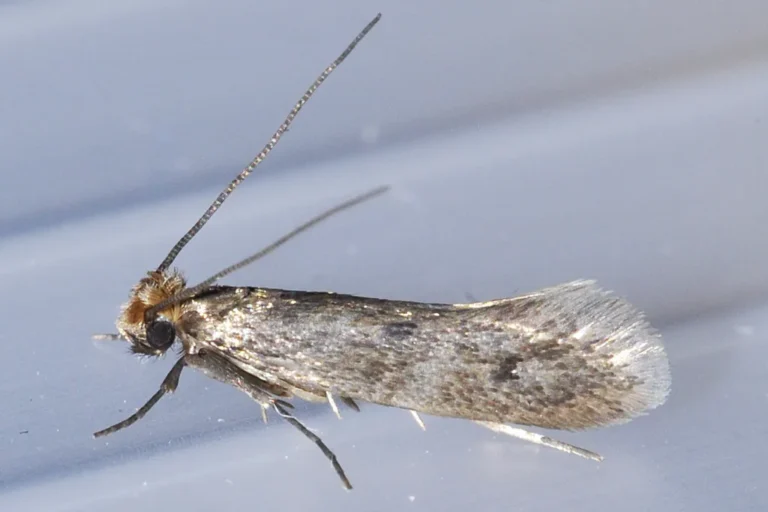
What’s actually eating the closet
Two species, one appetite — and it’s the larvae, not the moths, doing the damage.
Webbing clothes moth
The Gulf Coast’s most common fabric pest. Larvae spin silky webbing tubes across wool, cashmere, silk, and feathers while they feed. The adult is small, golden-buff, and avoids light — if a moth flutters TOWARD your lamp, it’s probably a pantry moth instead.
Casemaking clothes moth
Slightly darker, and its larva drags a portable case built from the fibers it’s eating — rice-grain-sized tubes that match your sweater’s color. Cases on shelves and along baseboards are the diagnostic sign, and they’re common in Mobile’s humid closets.
What they eat — and skip
Keratin: wool, cashmere, silk, fur, feathers, felt — plus blends, and anything soiled with sweat or food. Clean pure cotton and synthetics are largely safe, which is why damage clusters in the “nice” end of the closet.
Why Mobile closets are a clothes moth paradise
Clothes moths thrive in warmth, humidity, and darkness — and a Gulf Coast closet supplies all three most of the year. Mobile’s ambient humidity keeps fabric moisture content high enough for larvae to develop quickly, the mild winters never interrupt the breeding cycle, and the same undisturbed storage that protects a recluse spider protects a moth population: cedar chests opened twice a year, attic boxes of heirloom quilts, the winter-coat closet nobody touches from March to November.
The undisturbed part matters more than most homeowners expect. Clothes moths hate disturbance — light, movement, vacuuming, laundering. An infestation almost always maps to the closet, chest, or box that’s been sitting quietly the longest. That’s why the fix is procedural before it’s chemical.
- Check first: seldom-worn wool and silk, under collars and cuffs, the folds of stored blankets, the carpet edge under furniture (wool rugs are a favorite), and felt piano hammers if you have one.
- Look for: irregular holes, silky webbing, sand-grain droppings colored like the fabric, and shed larval cases.
- Confirm with traps: pheromone traps catch adult males and tell you whether the population is active — they’re monitors, not cures.
Free to check coverage. ADAI-licensed operators serving Mobile & Baldwin County, AL.
What actually stops an infestation
The honest sequence, in order of impact:
- Heat or cold every infested item. Dry cleaning kills all stages; so does a hot dryer cycle for items that tolerate it, or a week in a chest freezer in sealed bags for items that don’t. This — not spray — is what clears the clothes themselves.
- Vacuum like you mean it. Closet floors, baseboards, carpet edges, under furniture, shelf corners — eggs and larvae go out with the bag. Empty the vacuum outside.
- Store clean, store sealed. Moths target soiled fabric first. Launder or clean before storage, then use sealed totes or garment bags. Cedar smells nice but is not a reliable kill — treat it as a supplement, never the plan.
- Fix the humidity. A closet dehumidifier or better HVAC circulation makes the microclimate hostile — in Mobile this is the difference between a one-time cleanup and an annual tradition.
- Professional treatment for the structure. When larvae are in carpet edges, wall voids, or an attic’s insulation and stored goods, a licensed operator’s targeted treatment reaches what laundering can’t — with fabric-safe products applied where larvae actually live.
When is it time to call? If damage shows up in more than one room, if you’re finding larvae or cases after two cleanup rounds, or if the source traces to an attic or wall void you can’t treat yourself — that’s structural, and it’s licensed-operator work. Mention what you’ve found when you get connected; it shapes the inspection.
Clothes moths in Mobile — what do homeowners ask?
Are you a pest control company?
No. Mobile Alabama Exterminators is a free dispatch and referral service. We connect you with independent, ADAI-licensed pest control operators in Mobile and Baldwin County who perform every inspection and treatment. We encourage verifying any operator’s license with the Alabama Department of Agriculture & Industries Pesticide Management Section at (334) 240-7240 before hiring.
How do I know it’s clothes moths and not pantry moths?
Location and behavior. Clothes moths stay near fabric, avoid light, and flutter weakly in dark closets. Pantry (Indian meal) moths fly toward kitchen lights and trace back to dry goods. Wrong ID means the wrong pheromone trap and a wasted month — check where they’re living before buying anything.
Do mothballs work?
They can kill in truly airtight containers, but in a normal closet the vapor never reaches lethal concentration — you get the smell without the control, plus a chemical odor in fabrics you then wear. Sealed storage of clean garments beats mothballs in every practical way.
Does cedar actually repel clothes moths?
Fresh cedar oil has mild repellent effect on young larvae, but it fades within a year or two and never kills an established population. Treat cedar chests as nice-smelling storage — the protection comes from cleaning items first and sealing them.
Why do I keep getting them back every year?
Recurring infestations usually mean a reservoir was missed — a wool rug edge under furniture, an attic box, felt or feather items in storage, sometimes an old bird nest in a soffit feeding the population. Finding the reservoir is exactly what a professional inspection is for.
How much does clothes moth treatment cost in Mobile?
Each independent operator prices after inspecting — scope ranges from a single closet treatment to attic and whole-structure work, and that spread is why quotes come after the look. The coverage check and match are free, and comparing quotes is reasonable.
Save the wardrobe, not the moths.
Free to check coverage, free to get matched, no obligation. The licensed operator inspects and gives the quote.
Free to check coverage. ADAI-licensed operators serving Mobile & Baldwin County, AL.
Prefer to send details first? Use the contact form →